


Most ABM programs produce activity instead of pipeline where accounts get targeted, sequences go out, and reports show opens and clicks but still qualified meetings stay flat.
The issue is lack of clear sequence, signal layer, and feedback loop connecting targeting to revenue outcomes.
AI agents in ABM change this by running the full motion autonomously from identifying the right accounts to triggering outreach at the right moment to handing sales a warm, context-rich opportunity. This guide walks through each stage: defining target accounts, enriching with GenAI-driven intelligence, setting signal triggers, orchestrating multi-channel outreach, and measuring pipeline impact.
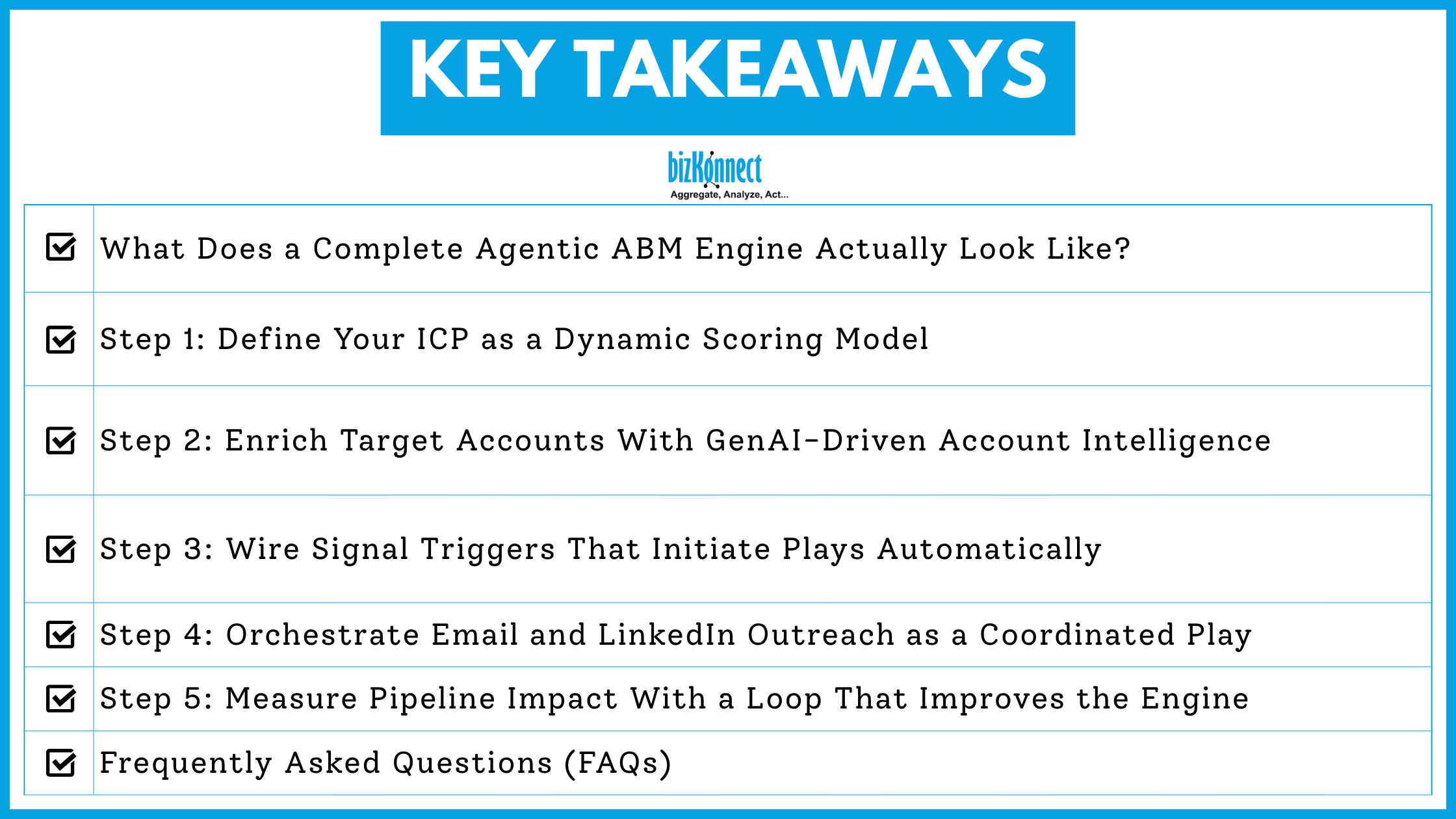
What Does a Complete Agentic ABM Engine Actually Look Like?
An agentic ABM engine has five interconnected layers, each feeding the next with measurement at the end looping back into stage one:
- ICP definition and dynamic account selection
- Account enrichment via GenAI-driven org charts and intelligence
- Signal triggers that initiate plays automatically
- Orchestrated email and LinkedIn outreach
- Pipeline measurement with a feedback loop
Most teams have pieces of this but the real gap is the connective tissue: agents that pass information between stages, act on signals without human queuing, and improve the model based on what's working.
Let’s understand each step in detail:
Step 1: Define Your ICP as a Dynamic Scoring Model
The first failure point in ABM is treating ICP definition as a one-time exercise. A list gets built, approved, and handed off. Six months later, it's stale but still running.
Agentic ABM starts with a living ICP model. Define scoring criteria that agents apply continuously to rank and re-tier accounts as new data comes in. Start with your closed-won data: map patterns across firmographics (size, industry, geography), technographics (tools in use, recent adoptions), and behavioral signals. Layer in negative signals too. Accounts that are churned or never converted are as instructive as your best customers.
Define three tiers:
- Tier 1: High ICP fit with active buying signals.
- Tier 2: Strong fit, lower signal intensity.
- Tier 3: Fit confirmed, no active signals yet.
A Tier 3 account today becomes Tier 1 the moment it starts researching your category.
Step 2: Enrich Target Accounts With GenAI-Driven Account Intelligence
While firmographic data tells you whose account is this, enrichment tells you how to engage them. Most teams stop at the first. GenAI-driven intelligence builds decision-ready context: who the real buyers are, what they care about, what's likely happening internally.
At the account level, enrich for:
- Org chart mapping: Dynamic buying committee maps covering economic buyers, evaluators, champions, and blockers updated when roles shift or new hires signal an active initiative.
- Initiative signals: Job postings in a function your product serves are a reliable indicator of active investment and agents monitor this continuously.
- Competitive context and trigger events: Contract renewal windows, funding announcements, M&A activity, and executive changes all create entry points worth tracking.
But, there is a critical distinction:
GenAI-generated enrichment needs a human-verification layer, especially in enterprise accounts where titles are misleading and decision authority isn't obvious. Dynamic data plus verified contacts is what makes outreach feel informed rather than automated.
Step 3: Wire Signal Triggers That Initiate Plays Automatically
This is where most ABM programs lose momentum because signals exist but they sit in a dashboard until someone manually queues a follow-up. By then, the window had closed. So, the signals worth wiring in are:
- Intent platform surges on your core category
- First-party behavioral patterns (repeat visits to pricing or case study pages)
- CRM velocity signals (deals stalling, champions going dark)
- VP-level hiring in a relevant function
Set these signal thresholds by tier. When an account crosses its threshold, agents don't just flag it, they initiate the play: updating the tier, selecting the sequence, personalizing the opening message, and notifying the rep with context.
Step 4: Orchestrate Email and LinkedIn Outreach as a Coordinated Play
Multi-channel means sending outreach across channels and orchestrated means every channel runs off the same account signal and same buying stage, sequenced to reinforce each other.
When an account enters a high-intent tier, the agent assembles the full play:
- Email sequence: Variants matched to account industry, inferred buying stage, and the specific trigger signal for relevant personalization.
- LinkedIn outreach: A connection request or InMail to the primary contact, followed by a content engagement action to establish presence before the direct ask.
- SDR context brief: The rep receives who the account is, what signal triggered the play, what's already been sent, and what to say on the first call.
- Ad retargeting layer: Account-matched LinkedIn ads reinforce the message in the email and SDR are carried in parallel.
Teams using agentic orchestration commonly report meeting rates up 15–25% and 20–40% SQO lift in top-scored deciles within 60–90 days, because agents execute the moment intent is highest rather than waiting in a human queue.
Step 5: Measure Pipeline Impact With a Loop That Improves the Engine
Most ABM measurement stops at activity metrics: emails sent, meetings booked, influenced pipeline. These matter, but they don't tell you whether the engine is getting smarter over time.
So, track at the account level with the metrics that reflect real pipeline health:
- Engaged account rate: What percentage of Tier 1 accounts showed meaningful response within the play window?
- Signal-to-meeting conversion: How often does a triggered play result in a qualified meeting within 30 days?
- SQO contribution by tier: What share of pipeline came from accounts the agent scored and targeted?
- Cycle time delta: Are deals sourced through agentic plays closing faster than baseline?
Measurement must close the loop back into the engine.
Underperforming plays adjust signal thresholds in Step 3.
Low engagement updates message variants in Step 4.
Accounts lost at proposal refine ICP criteria in Step 1.
Each cycle makes the next play more precise.
Addressing Some Frequently Asked Questions (FAQs)
Q1. How is an agentic ABM engine different from standard marketing automation?
Automation executes fixed sequences on a schedule. Agentic ABM adapts continuously: re-tiering accounts, adjusting plays, and triggering outreach based on live signals rather than calendar timing.
Q2. How do you prevent agents from over-triggering on weak signals?
Build a tiered signal hierarchy. High-confidence plays require two or more signals converging on the same account. Single signals feed nurture sequences only. Over-triggering burns deliverability and saturates accounts before they are ready.
Q3. What data quality is required before deploying agents?
Clean CRM data and a validated ICP model are the minimum. Agents amplify what exists: poor data produces poor prioritization. Human-verified org chart enrichment significantly improves output quality, particularly in steps 2 and 4.
Ready to activate an agentic ABM engine built on verified account intelligence and coordinated outreach? CLICK HERE to see how BizKonnect powers the data and campaign layer that makes AI agents work in practice.
CLICK HERE to know more with BizKonnect.