


A VP of Sales at a mid-sized B2B technology firm had done everything right. Pipeline cleaned up, ICP (Ideal Customer Profile) tightened, and a round of data services to get account records in shape. The AI (Artificial Intelligence) agent was already delivering automated lead scoring surfacing the right accounts, smart account prioritization cutting through noise, and AI-recommended outreach sequences keeping the team focused. The investment was paying off.
But there was one thing quietly working against all of it.
The CRM data refresh that had run six months ago was already showing its age with changed roles, companies restructured, and firmographic fields quietly drifted. And unlike a sales rep who might sense something is off, an AI agent reads what is there and acts on it, without question.
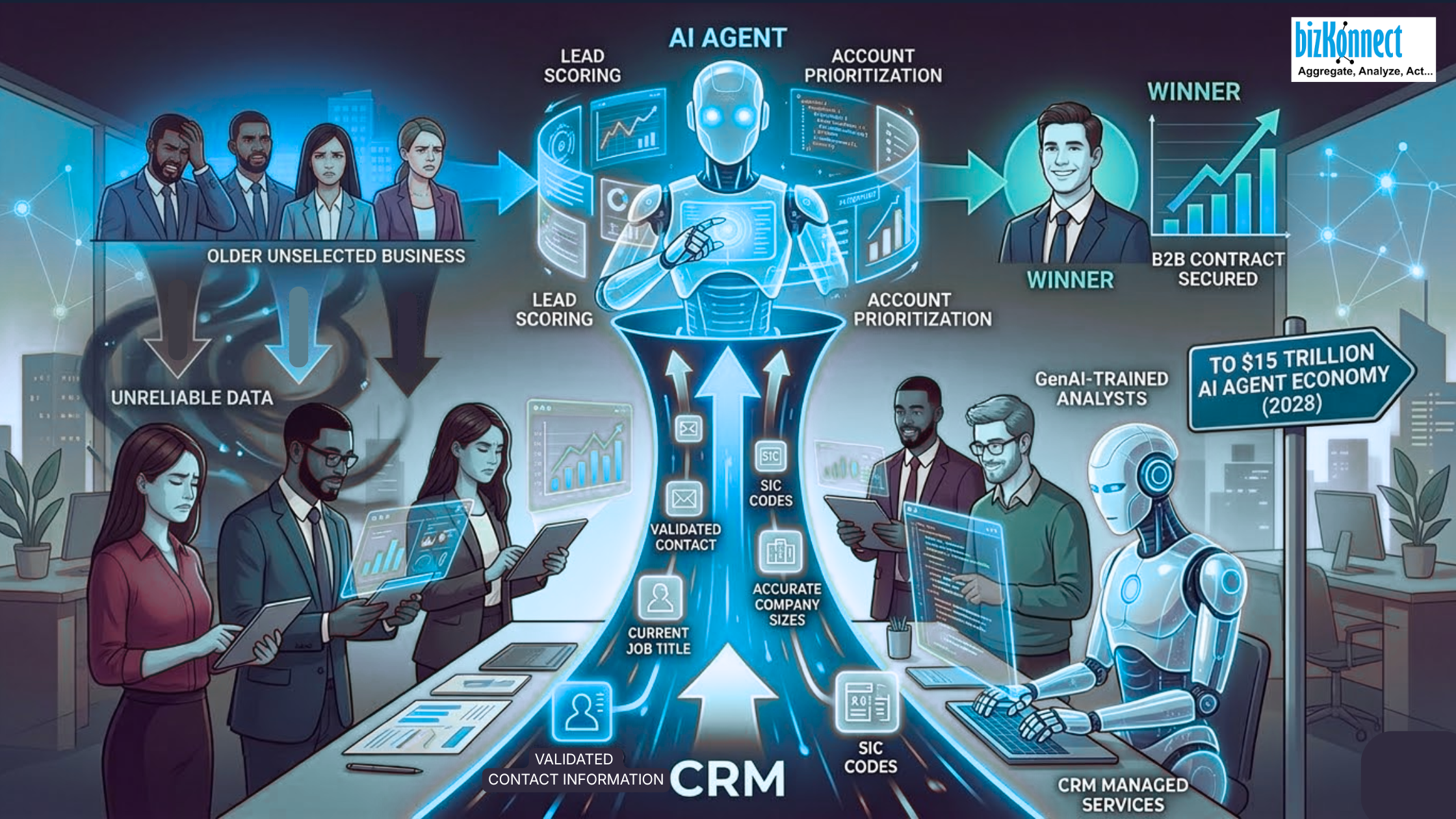
Recent industry research indicates that by 2028, 90% of B2B buying will be AI agent-intermediated, pushing over $15 trillion of spend through AI agent exchanges. That is a buying environment where the data your CRM holds will directly determine whether AI agents select you or skip you.
The VP was beginning to see exactly how this plays out and what CRM managed services backed by GenAI-trained analysts could do to stay ahead of it.
The tools were performing well. So what was quietly working against them?
The VP dug into the CRM records the agent had been querying. The technology was functioning correctly: lead scoring firing, account prioritization running, outreach sequences live. But the records being fed into all of it had drifted:
- Job titles no longer matched current roles.
- Company size and employee count fields were outdated.
- Duplicate entries had quietly crept back in.
- SIC (Standard Industrial Classification) codes and industry classifications had not been touched since the last import.
AI agents do not apply judgment to gaps. They evaluate what is present, score it, and act on it.
As per recent reports, B2B procurement is shifting toward autonomous machine-to-machine transactions where being found means being machine-readable and verifiable.
The problem was clear. But how do you fix data quality at scale without pulling the team off selling?
The VP needed an ongoing data operation, instead another one-time cleanup. She turned to CRM managed services backed by GenAI-trained analysts working as a virtual extended team.
Here is what that engagement covered:
- Data validation and de-duplication: scrubbing records, merging duplicates, standardizing formats for machine-readable consistency.
- Contact enrichment: appending missing fields like direct phone, email addresses, job titles, and company size that AI agents rely on for account scoring.
- Scheduled CRM data refresh cycles: importing updated records on a rolling basis so the agent was never working off a six-month-old snapshot.
- External data integration: connecting live data flows so account changes and contact updates fed into the CRM automatically.
The analysts also brought what no automation tool can replicate: Judgment.
Verifying whether a contact is still at a company, researching org hierarchies, and cross-referencing restructures. That combination of GenAI supporting and trained human oversight is what made the data services output something the AI agent could actually trust.
It was the same AI agent, same logic, so why were the results so different three months later?
Nothing about the technology had changed. The model was not retrained and the scoring logic was identical. What changed was the data underneath it.
- Lead scores reflected how accounts were actually behaving.
- Decision-makers in the CRM were the people currently holding the role.
- Campaigns ran on verified contact lists, and response rates climbed.
Research points to a trust-based economy taking shape around AI-intermediated buying, where verified, structured data becomes a direct competitive advantage. Companies with enriched, current CRM records will be the ones AI agents select.
Those with neglected databases will be passed over quietly, systematically, and without explanation.
Is this only a problem for companies in the middle of a CRM migration or a growth phase?
The organizations at highest risk right now are the ones in motion: scaling sales teams, merging CRM data after an acquisition, or migrating to a new platform. These are the moments data quality problems compound the fastest.
A new CRM system filled with old, unverified data is actually the same problem, just in a newer interface. The VP learned this the hard way and early enough to fix it before $15 trillion of B2B spend moves through AI agent exchanges where her data quality would have determined her visibility.
With these challenges and solutions in focus, a few specific questions tend to surface. Here are the most important ones addressed directly.
Frequently Asked Questions (FAQs)
Q1. How often does CRM data need to be refreshed for AI agents to work accurately?
At minimum, quarterly because contact roles, company structures, and firmographic details shift continuously. Annual cleanups leave AI agents working off outdated records for most of the year.
Q2. Which CRM data gaps hurt AI-driven lead scoring the most?
Missing or outdated job titles, company size, industry classification, and direct contact details are the most damaging. These are the fields AI agents weigh most heavily when evaluating account fit and routing decisions.
Q3. Can GenAI tools handle CRM enrichment without human analysts involved?
GenAI tools handle volume and speed well, but they cannot apply contextual judgment like verifying if a contact is still at a company, or interpreting a corporate restructure. Analysts trained in GenAI workflows are what keep enrichment accurate as well as fast.
Q3. Is CRM data readiness relevant only during large-scale migrations or platform changes?
No, data decay is continuous. Migrations amplify the risk, but even stable CRM environments accumulate drift over months. Ongoing managed services prevent the backlog from building in the first place.
The VP's story does not end with the AI agent working perfectly. It ends with her realizing the agent was never the variable, the data always was.
With $15 trillion of B2B spend moving through AI agent exchanges by 2028, clean, enriched, and continuously refreshed CRM data is the infrastructure that AI-intermediated buying runs on. So, build it before the shift is complete.
Ready to prepare your CRM for an AI-first buying world? CLICK HERE to see how BizKonnect can help.
CLICK HERE to know more with BizKonnect.