


A clear signal is emerging across the tech enterprise landscape as the final quarter of 2025 winds down: the era of surface-level digital transformation is over. We are moving from mere digital transactions to Intelligent, AI-driven, and ecosystem-powered commerce.
For B2B sellers targeting Google, this transition from 2025’s experimentation to 2026’s pragmatic deployment means the rules of engagement are changing dramatically. Your ability to win major contracts next year will not be based on your solution's features, but on your actionable intelligence within Google.
The core challenge remains the same: every deal has resistance. But the platforms to manage it have become exponentially more powerful. The dynamic, GenAI-driven organizational charts you use today will become even more crucial as Google demands faster proof, deeper personalization, and a relentless focus on demonstrable value.
So, what is the major shift Google's enterprise buyers will make as we move into 2026?
The biggest change in the new year will be a move from reactive buying (addressing an immediate pain) to proactive, AI-agent intermediated procurement. Tech buyers at Google are suffering from "CX fatigue" and rejecting fragmented experiences. Teams are already moving in this direction as they narrow the gap between internal mandates and external vendor engagement. They are not just looking for a vendor; they are looking for a strategic partner who can reduce their risk and simplify their complex internal landscape.
By 2026, enterprise tech buyers will prioritize:
- Trust and Compliance: With the rise of Agentic AI, concerns around data governance and ethical AI will be non-negotiable. Demonstrating responsible AI use such as GenAI Powered Actionable Org Chart of Google or the Account Map of Microsoft will be a key factor in purchasing decisions.
- Predictive Value: They won’t buy based on a generic future promise. They need predictive buying signals that show your solution will align with their specific, often mandated, internal Key Performance Indicators (KPIs) for the new fiscal year.
- Seamless Digital Engagement: With most of tech B2B buyer-supplier interactions expected to be digital-first, sales reps' roles will shift entirely towards high-value consultative selling. The simple, transactional sales steps will increasingly be handled by AI-powered digital self-service.
How Must Your Strategy Adapt to Neutralize Blockers at Google?
The velocity of organizational change at Google, driven by geopolitical forces and rapid AI adoption, means the IT company org chart is changing faster than ever. The blockers you identified in Q4 of 2025 might have a completely new mandate by Q1 of 2026.
That’s why you need GenAI-driven account mapof Google that delivers:
- Updated Mandate Tracking: A GenAI-powered Actionable Org Chart of Google tracks which business units are centralized or separated in response to changing regulations. This allows you to instantly identify blockers whose turf is currently being redefined and precisely target people in units whose budget/turf is threatened by a fresh mandate.
- Leveraging 'Agentic' Goals: As enterprises adopt Agentic AI, autonomous systems that plan and execute multistep workflows are emerging in operations and security. If a blocker's goal at Google is to reduce operational errors using Agentic AI, you must reframe your solution to enable that outcome. It will allow you to find common ground through shared, new-year objectives.
- Multi-Stakeholder Resonance: The number of stakeholders involved in a six-figure tech B2B deal is increasing. The GenAI-driven org chart of Google must enable a multi-threaded approach where your team engages the CIO on strategy, the CISO on compliance, and the VP of Operations on efficiency, all based on their uniquely mapped goals.
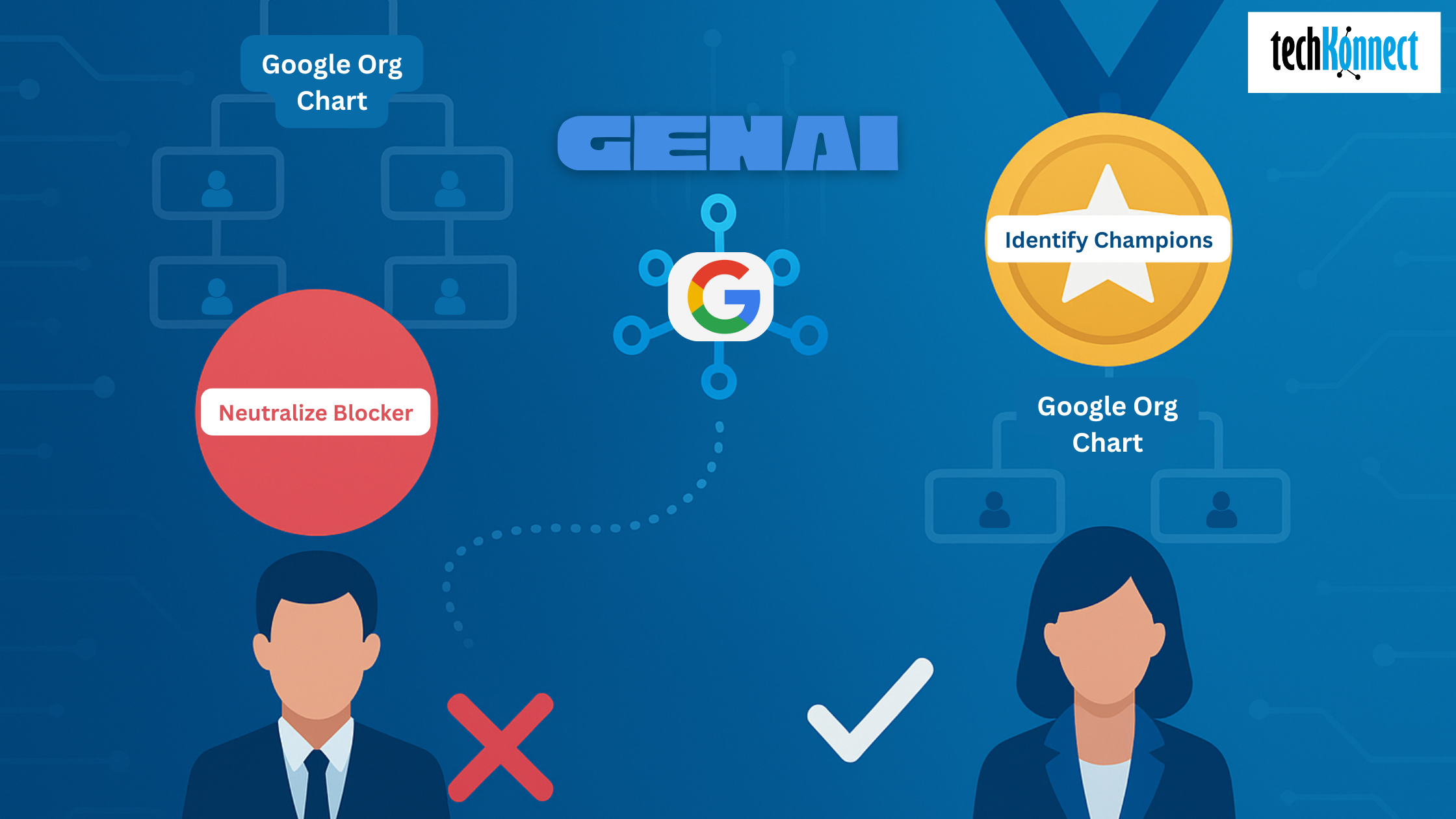
What is the New Imperative for Leveraging Champions Within Google?
In the increasingly complex environment of Google, having a single Champion is no longer enough. The 2026 imperative is on ecosystem sales and integrated revenue teams. For that:
- Map the Influence Ecosystem: A GenAI-powered Actionable Org Chart of Google must reveal how a champion’s influence stretches beyond a vertical line. You must locate their ties across revenue teams in Sales, Operations, and Architecture.
- Offer the Champion Agent-Ready Data: Champions need machine-readable metrics that internal procurement AI agents can validate. When selling into Google, you must equip the champion with verified data that neutralizes subjective resistance raised by blockers.
- The ABM Shift: Account-Based Marketing (ABM) must now target individuals based on their Q1 2026 accountability. GenAI intelligence allows outreach to speak directly to the person held responsible for procurement success at Google, rather than a generic role.
As 2025 closes and planning for 2026 begins, clarity is no longer optional. Since every deal encounters resistance, a GenAI-driven map built on IT company org charts shows where that resistance comes from and how influence flows across the structure. With this understanding, teams can align with Google's internal priorities, empower champions, and shape outreach that reflects the real world inside the enterprise.
However, as the year turns, teams often raise a few focused questions that tie the full view together. Here are some of them:
Q1. Do Google's internal structures change more often now? Yes. The velocity of change, driven by rapid AI adoption and shifting market priorities, means Google's organizational chart requires constant, real-time tracking.
Q2. Which positions remain central in Google's organizational structure? Program leaders, product owners, operations heads, architecture leaders, and financial partners who handle portfolio planning.
Q3. Can these charts support ongoing account management through the next year? Absolutely. They help track reorganizations, new reporting paths, and shifts in ownership that often occur at year-end within Google.
Q4. Do these views help both sales and marketing teams? Yes. Sales teams use them to chart decision paths. Marketing teams use them to tailor communication that fits real roles and priorities within the Google structure.
Stop guessing the org structure of Google. See how BizKonnect reveals decision chains using GenAI. FREE SAMPLE.
CLICK HERE to know more with BizKonnect.