


B2B marketing teams spent the last decade optimizing for human attention: the right headline, the right emotional pull, and the right cadence to keep a buyer moving through a funnel. The assumption underneath all of it was that a human was doing the evaluating and the shortlisting.
That assumption is now structurally wrong.
89% of B2B buyers now use generative AI as a primary source of self-guided research before they ever engage with a sales rep.
This is what the self-guided B2B buying journey looks like today, an AI-mediated one.
Buyers are entering the market with synthesized vendor summaries and messaging comparisons built not on what your team said, but on what the AI layer surfaced. B2B sales intelligence that doesn't account for this layer arrives too late to matter.
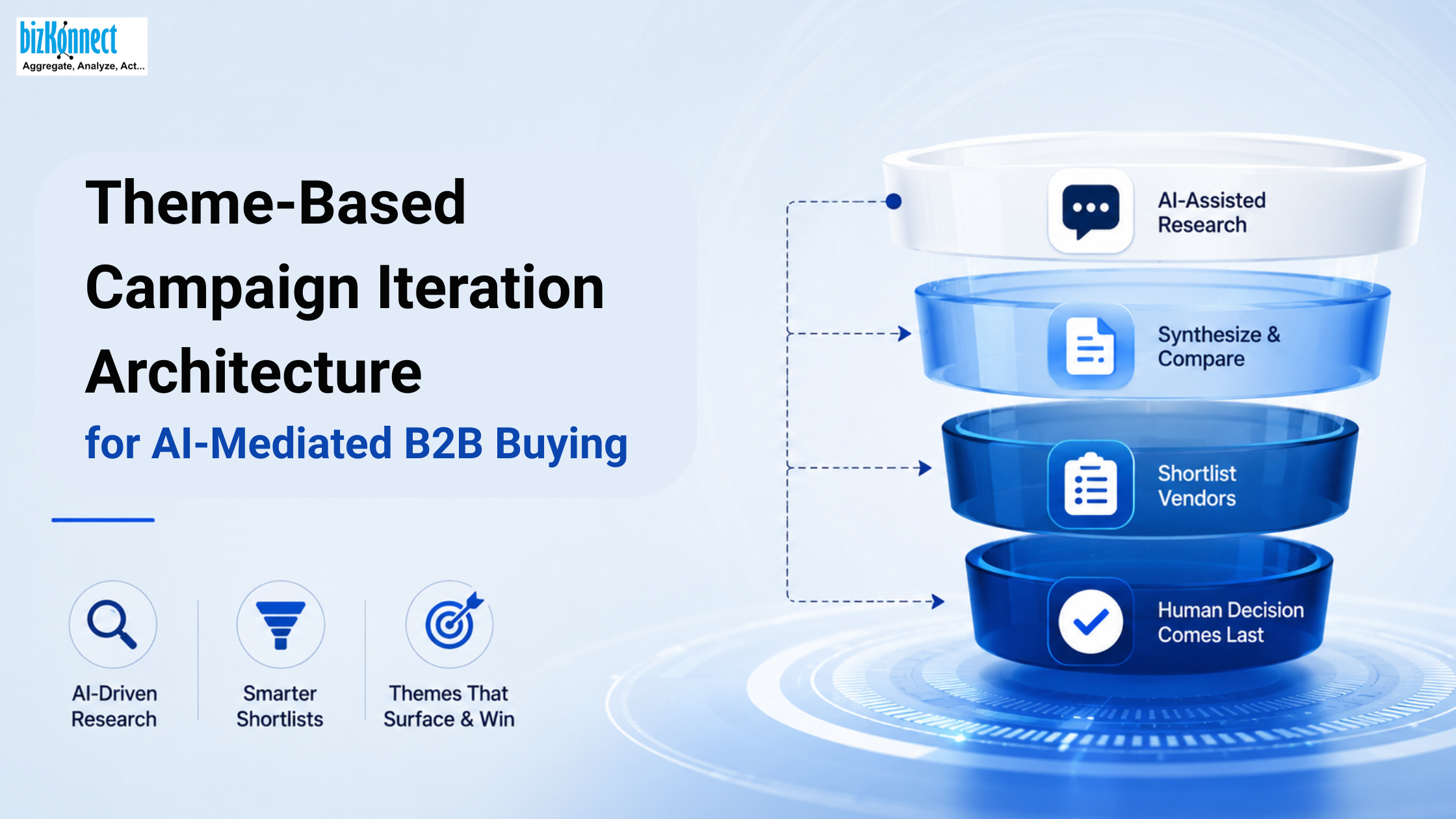
Which means a theme-based campaign strategy can no longer be built solely for human readers. It needs to be architecturally suited for AI-powered campaign optimization which is surfaceable, semantically distinct, and reinforced across content before any human reads a word.
Before diving into this, let’s understand:
What Is a Self-Guided B2B Buying Journey and Why Does It Break Outbound Logic?
The self-guided B2B buying journey is what happens when a buyer moves through research, category evaluation, and vendor shortlisting before any direct sales interaction. Historically, this existed but was bounded. The sales team could still intercept and redirect.
Generative AI changed the velocity and structure of that journey.
Buyers now enter AI-assisted research with a specific problem, receive a synthesized framing of the solution space, and emerge with a mental model of what good looks like, all before an SDR reaches out.
The consequence isn't just that outbound is harder to time. The campaign theme must now pass through an AI interpretation layer before it reaches a human decision-maker. That layer:
- Aggregates signals across your published content
- Synthesizes your category positioning
- Establishes whether your theme survives compression or collapses into something generic
Most enterprise marketing teams still build themes for the human reader at the end of the journey. That's where campaigns lose relevance before they're seen.
Why Generic Themes Don't Survive AI Compression?
AI systems don't amplify themes that sound important, they surface themes that are specific, semantically distinct, and corroborated across multiple content touchpoints.
A theme like "We help enterprise teams scale smarter" gets flattened the moment an AI layer categorizes it. It becomes indistinguishable from competitors using adjacent phrasing. The buyer's research summary never includes it, so the shortlist never forms.
What survives that layer:
- Themes with a specific, named tension the buyer is experiencing, not a generalized category benefit.
- Themes appearing consistently across multiple owned content formats, creating semantic reinforcement.
- Themes that map to the vocabulary buyers use when describing their problem to an AI assistant.
That last point is most counterintuitive.
Buyers describe operational problems and campaign copy describes solution outcomes. That gap is where well-resourced campaigns disappear from AI-driven discovery.
Why Theme-Based Campaign Iteration Architecture Matters Now?
Theme-based campaign strategy has historically been a creative discipline: find a narrative, pressure-test it, run it until the numbers dip, then refresh. That cycle worked when campaigns spoke directly to a human audience.
What's emerging in high-performing enterprise marketing functions is architecturally different.
Theme-based campaign iteration as a data-driven campaign ecosystem, where each theme is deployed, measured for AI surfaceability, and iterated before market saturation occurs.
This is what AI-powered campaign optimization means in practice. Where there is no AI generating content, but AI providing the feedback loop on whether a theme is picked up by the same systems buyers use to self-research.
The practical mechanics look like:
- Theme signal testing: Tracking whether AI-driven search tools surface your theme in relevant buyer queries.
- Semantic gap analysis: Comparing campaign vocabulary with buyer query language, then closing the distance.
- Shorter iteration cadence: Month-over-month theme cycles, not quarterly.
- Cross-channel reinforcement: Consistent language across thought leadership, product pages, and sales enablement so the AI layer finds corroboration.
It's a continuous calibration loop between what you publish and what AI systems surface.
How AI-Driven Account-Based Marketing Changes When the Account Is Already Informed?
The standard ABM model assumes outreach is the first meaningful contact a target account has with your positioning.
That assumption is eroding.
The target account may have already formed a vendor shortlist, built by their own AI layer, based on what your campaign theme communicated in the channels AI was reading.
B2B sales intelligence and AI-driven account-based marketing need to operate upstream at the content layer that informs the AI that informs the account. The organizations recognizing this, treat the AI research layer as a channel in its own right, where semantic footprint across owned and earned media determines what a self-guided buyer sees before any outreach begins.
Frequently Asked Questions (FAQs)
With these operational shifts in mind, several practical questions tend to surface during evaluation and execution. Let’s address a few of them:
Q. What makes a campaign theme "AI-surfaceable"?
Specificity, consistency, and vocabulary alignment. Themes naming a precise operational tension across multiple content formats survive AI compression. Broad benefit language gets compressed or dropped.
Q. How is theme-based campaign iteration different from standard campaign refresh?
Standard refresh is driven by creative fatigue. Theme-based campaign iteration is driven by semantic performance, whether the theme is being picked up by AI-assisted discovery tools and maintaining distinctiveness over time.
Q. What's the biggest execution gap in current campaign theme development?
A vocabulary mismatch between campaign assets and buyer queries. Campaign language is outcome-oriented; buyers query AI tools in problem-oriented terms. Closing that gap improves AI discoverability.
Q. Does ABM still work if the buyer has already completed AI-assisted research?
Yes, but the function shifts. ABM must reinforce a partially formed mental model, requiring operationally specific content and faster movement to consequence-level insight.
Campaign strategy in B2B is evolving in audience, not just execution. The path to the human decision-maker runs through an AI research layer most marketing teams aren't architecting for. Organizations that recognize this earliest will build themes that survive compression and reach buyers already aligned. The rest will optimize campaigns that are never seen.
CLICK HERE to see how BizKonnect helps enterprise marketing teams build campaign themes with the semantic precision and iteration speed AI-driven B2B buying now demands.
CLICK HERE to know more with BizKonnect.