


Sales teams in 2026 have access to more data than ever before, yet struggle to convert it into meaningful conversations. Your CRM holds thousands of contacts, your database subscriptions deliver extensive information, and still, your outreach lacks precision and personalization.
The challenge isn't the data itself, it's the absence of strategic context. Enter the ABM org chart powered by GenAI.
It is a strategic solution that transforms how B2B teams approach account-based marketing by layering actionable intelligence onto your existing contact data. Instead of just names and titles, you get a complete navigational system through complex enterprise structures that turns static lists into dynamic account maps.
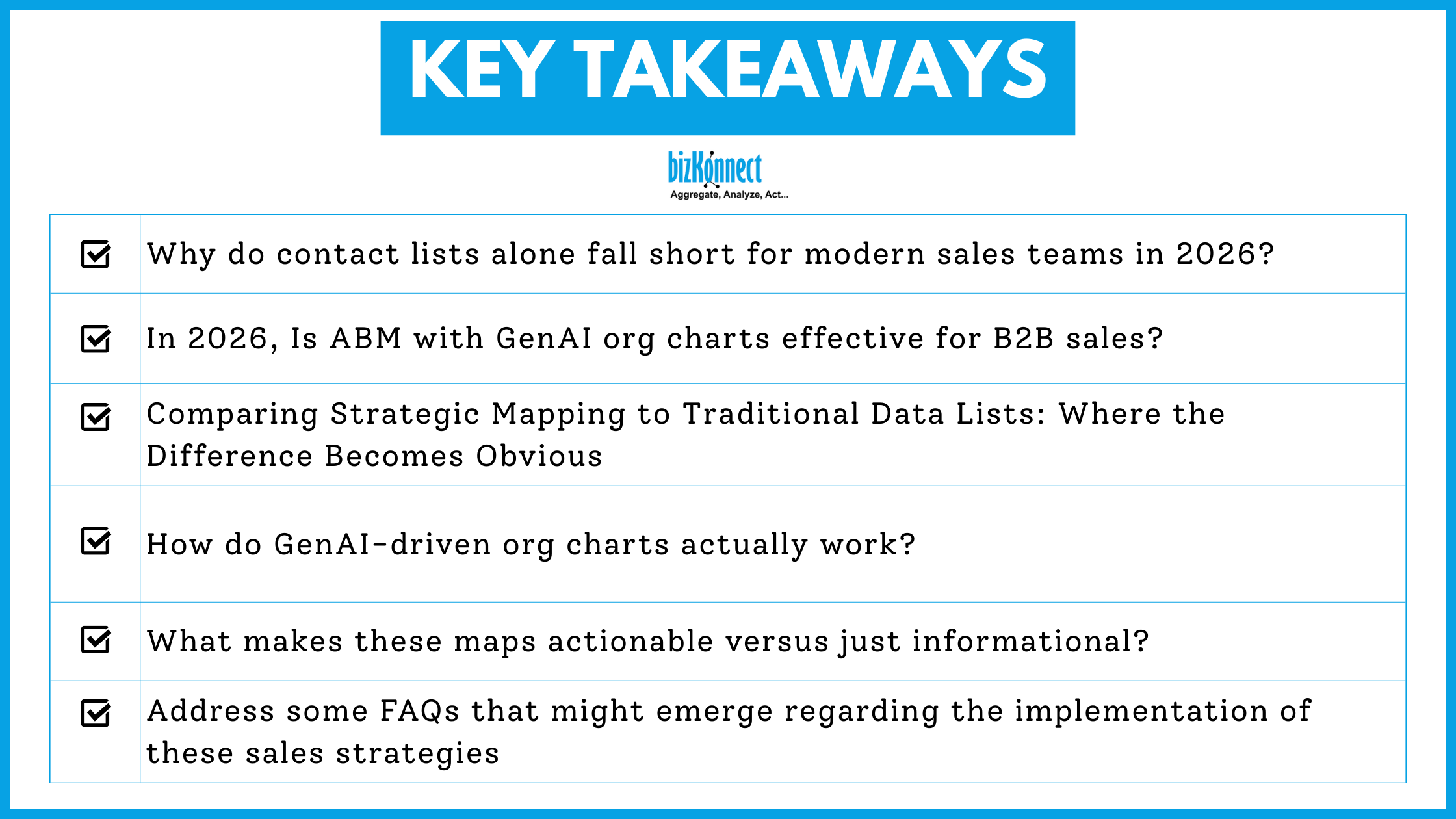
So, why do contact lists alone fall short for modern sales teams in 2026?
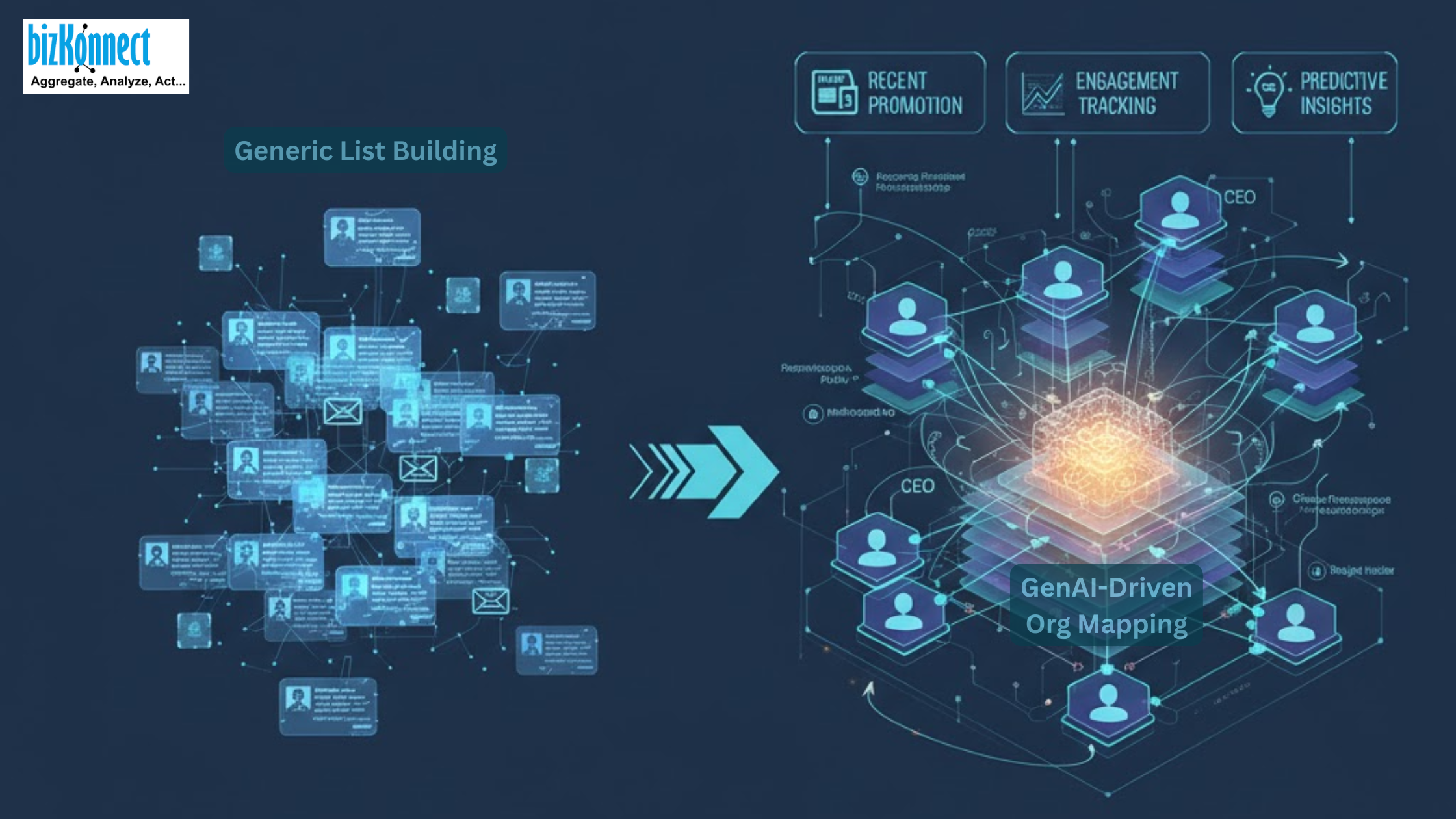
Generic list-building gives you essential data points like names, emails, and job titles which is the foundation for any outreach. But without organizational context, you're missing how decisions actually get made. You might reach a VP who seems perfect on paper, but you have no idea they report to a C-suite executive who holds budget authority, or that three other stakeholders need to approve before any deal moves forward.
Account-based marketing org charts enhance your contact lists by mapping the entire decision-making ecosystem. Instead of individual contacts in isolation, you see:
- Reporting hierarchies and who influences whom
- Budget holders versus technical evaluators
- Cross-functional relationships that impact buying decisions
- Multiple entry points when your primary contact goes cold
This is how B2B account targeting is done right in 2026. Treating enterprises as interconnected systems rather than collections of random people.
In 2026, Is ABM with GenAI org charts effective for B2B sales?
Companies using ABM account mapping in 2026 experience higher conversion rates because they're having the right conversations with the right people at the right time. When you understand organizational structure layered on top of your contact data, you stop wasting time on contacts who can't move deals forward.
Here's what changes when you leverage ABM with org charts for lead generation:
- Your sales intelligence becomes predictive rather than reactive
- You identify champions before you need them
- You map alternative pathways when doors close
- You understand political dynamics that kill deals before they start
Comparing Strategic Mapping to Traditional Data Lists: Where the Difference Becomes Obvious
To understand why 2026 demands a map-based approach, it's helpful to look at how these two strategies perform side-by-side:
| Feature | Generic List-Building | GenAI-Powered Org-Mapping |
|---|---|---|
| Data Type | Flat contact info | Contextual, hierarchical account structures |
| Relevance | Broad and generic | Tailored to your solution & priorities |
| Sales Speed | Reactive (manual navigation) | Predictive & guided (strategic navigation) |
| Risk Mitigation | Single point of failure | Multiple entry points/paths |
| Team Synergy | Individual use | Integrated view for all departments |
Your contact lists give you access to names and roles which is the starting point. Org-mapping adds the context, connections, and intelligence you need to turn those names into actionable conversations.
How do GenAI-driven org charts actually work?
Modern account-based marketing org charts leverage Natural Language Processing (NLP) and business knowledge graphs spanning millions of global companies. These are dynamic maps built from continuous data collection across news sources, company announcements, professional networks, and public records and then layered onto your existing contact repository.
The GenAI contextualizes this data for 2026's business priorities. When you're selling cybersecurity solutions, the system highlights executives discussing digital transformation, recent breaches at competitor companies, or regulatory compliance pressures. For marketing automation? It surfaces contacts talking about customer experience initiatives or attending relevant industry events.
This is ABM with org charts for sales intelligence at scale where technology does the heavy lifting of connecting dots that human researchers would need weeks to map.
What makes these maps actionable versus just informational?
Truly effective, actionable org charts in 2026 integrate three critical layers on top of your contact database:
- Connection Intelligence: See which colleagues already know your target accounts. Your colleague in marketing might have established relationships with the CFO you're trying to reach but you'd never know from a standard contact list.
- Insight Overlays:Recent promotions, speaking engagements, project announcements, and investment news are all mapped directly to decision-makers. So your outreach feels timely and relevant.
- Engagement Tracking: Monitor movement through your sales cycle like who's engaging, who's going cold, and where deals are stalling. These are all visualized against the organizational structure so you can adjust strategy with updates.
The maps become living documents that sales, marketing, and leadership use collaboratively.
Management sets strategic direction, marketing crafts targeted campaigns, inside sales generates qualified leads, and account executives navigate complex deal structures. It is an essential coordination for 2026's competitive environment.
Let’s address some FAQs that might emerge regarding the implementation of these sales strategies:
Q: How frequently are GenAI-powered org charts updated in 2026?
AI-driven systems update continuously as public information changes such as new hires, promotions & restructuring, keeping your account intelligence current unlike quarterly database refreshes.
Q: How do you ensure data privacy compliance with these detailed maps?
Reputable platforms source only publicly available information like company websites, press releases, and professional networks. They never violate GDPR or privacy regulations that continue evolving in 2026.
Q: How does this integrate with existing CRM systems?
Modern platforms integrate seamlessly with CRMs, syncing contact data, tracking engagement, and enriching records with contextual intelligence that sales teams need in 2026.
Q: Is the investment justified for companies with smaller deal sizes?
ROI depends on sales cycle complexity rather than deal size. If you're navigating multiple stakeholders, increasingly common in 2026, strategic mapping delivers faster cycles and higher win rates.
The shift from contact lists alone to strategically mapped org charts isn't just a tactical upgrade, it's a fundamental enhancement of how B2B sales operates in an increasingly complex buying environment. As buying committees expand and decision-making becomes more distributed in 2026, your strategy needs data with direction. Your contact repository provides the foundation and org-mapping builds the strategic framework that accelerates results.
Discover what data-driven ABM really looks like. CLICK HERE to leverage it with BizKonnect.