


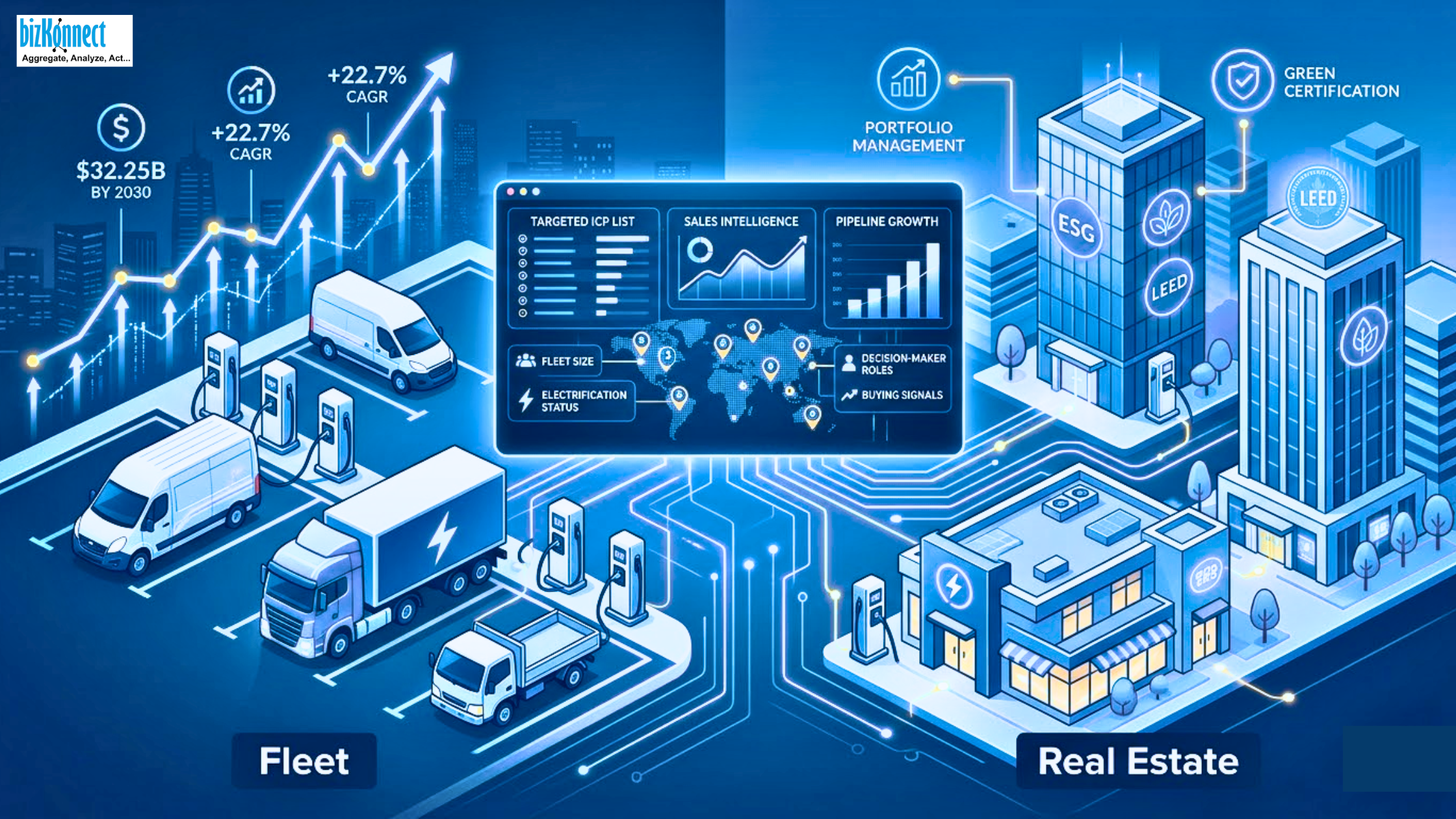
The EV charging software market is expanding fast. The global EV Fleet Management Market is projected to reach USD 32.25 billion by 2030, up from USD 9.10 billion in 2025, growing at a CAGR of 22.7%. On the real estate side, the private sector is increasingly being called upon to fill the gap in EV charging infrastructure investment as public funding alone falls short of the scale needed. The many governments are also shifting their automotive ecosystem focus to EV based vehicles which sees exponential growth in EV market valuation.
For EV charging SaaS companies, this creates a significant commercial opportunity. But the challenge is pipeline quality.
Most sales teams selling EV charging software for fleet management companies are working with incomplete, generic, or outdated prospect lists that don't reflect how buying decisions are actually made in these two verticals. Without verified, role-specific, and actionable sales intelligence-driven contact data from an EV Technology Companies Email List or a Fleet Business Professional Email List, even the best platform struggles to get traction.
This blog breaks down exactly why that targeting gap exists, what it costs, and how actionable sales intelligence fixes it.
What Is EV Charging SaaS Software and Why Do Fleet and Real Estate Buyers Care?
EV charging SaaS software refers to cloud-based platforms that manage the deployment, monitoring, billing, and optimization of EV charging infrastructure. For fleet operators, this means route-aware charging schedules, battery health monitoring, and energy cost management. For real estate operators, it means tenant billing, load balancing, and usage analytics across a property portfolio.
As organizations transition from conventional vehicles to electric fleets, they face new operational challenges. It includes battery management, driving range optimization, and efficient charging coordination, all of which EV fleet management solutions directly address.
On the property side, modern EV charging solutions include app-based monitoring, remote diagnostics, usage analytics, automated billing, and load balancing. These are the features that reduce operational complexity for property managers.
Both buyer segments have clear, functional reasons to adopt EV charging management software. The issue for SaaS sales teams is identifying who to call, when to call them, and what buying signal to reference in outreach.
Why Does Outbound Fail When Targeting Fleet Managers and Real Estate Decision-Makers?
Fleet and real estate buying decisions don't follow the same cycle as typical SaaS purchasing. A Fleet Manager evaluating EV charging software for fleet management companies is simultaneously accountable to a CFO tracking fuel savings, a Sustainability Director reporting on carbon targets, and an operations lead worried about uptime. A Real Estate Development Head, meanwhile, is weighing EV infrastructure as a tenant retention tool, a green certification lever, and a new revenue stream all at once.
The ICP Mismatch Problem
Most commercial outreach in this space targets too broadly. Reps pull generic logistics or property lists, reach mid-level contacts with no budget authority, and fail to address the specific trigger driving purchase intent. Common failures include:
- Contacting Facilities Managers without referencing their specific property portfolio or ESG compliance timeline
- Reaching Fleet Managers at companies still operating ICE vehicles with no near-term electrification mandate
- Using outdated job titles that no longer reflect restructured sustainability teams
Leading companies in the EV fleet management market, including Geotab, Samsara, ChargePoint, and Driivz, are focusing on strategic partnerships, technology innovations, and product launches to strengthen market presence. “These companies are winning deals through targeted, actionable sales intelligence-led prospecting”.
What a Clean Fleet Business Professional Email List Actually Contains?
A useful Fleet Business Professional Email List for EV charging SaaS outreach goes beyond a contact name and email. It should include:
- Fleet size and vehicle type (critical for determining charging load requirements)
- Decision-maker role and reporting structure
- Current fleet electrification status or mandate
- Location and regulatory environment (urban emission zones, sustainability deadlines)
- Technology stack signals (telematics vendors, existing charging hardware)
Without this context, personalization is impossible and conversion rates reflect that.
How Do EV Charging SaaS Companies Build a Real Estate ICP List That Converts?
The real estate vertical is structurally different from the fleet. Purchase decisions move through development heads, facilities managers, and sustainability directors, often in parallel, and the trigger events differ by property type.
Charging will no longer be a "nice-to-have" but a necessity to maintain the business, particularly as EV drivers prefer to charge where they can multitask such as having a meal, shopping, or accessing other services. This means commercial office parks, retail centers, and mixed-use developments are all active buyers but each requires a different value proposition and a different primary contact.
For SaaS sales teams building segment-specific ICP lists, here's how EV charging management software benefits map to buyer roles:
- Commercial Office Parks: Sustainability Directors are the entry point. EV infrastructure contributes to IGBC ratings, LEED certifications, and sustainable building benchmarks, attracting institutional investors and ESG-focused tenants.
- Retail and Hospitality Properties: Facilities Managers focus on operational uptime. Retailers benefit whether they charge fees for station use, act as owner-operators, or receive lease revenue from a third-party operator.
- Industrial and Logistics Real Estate: Real Estate Development Heads care about land use economics. As fleets present a strong recurring revenue profile, heavy EV charging is materializing into an investment-worthy asset class.
Each of these buyer archetypes requires a separate outreach sequence, separate messaging, and separate contact data sourced from a role-specific Electric Vehicle Manufacturers Email List or real estate decision-maker database.
What Signals Indicate a Target Account Is Ready to Buy EV Charging Software?
A company evaluating EV charging software six months before a fleet expansion mandate is a very different prospect than one that just signed a sustainability pledge. And, the same goes with the real estate industry. So, high-intent accounts typically show one or more of these signals:
Fleet-Side Buying Triggers
- Recent announcement of fleet electrification goals or EV procurement contracts
- Regulatory pressure from urban low-emission zones or government fleet mandates
- Active telematics or route optimization investment (indicates operational sophistication)
- Logistics sector growth such as logistics companies are increasingly deploying electric vans and trucks to comply with urban emission regulations while reducing fuel and maintenance costs
Real Estate-Side Buying Triggers
- New development projects or property portfolio expansion announcements
- Green building certification applications in progress
- Tenant mix changes toward ESG-conscious corporate tenants
- The coming wave of commercial EV fleets will create a race to develop properties into charging hubs for medium to heavy-duty electric trucks as demand grows more quickly on the vehicle side than real estate can supply
An EV Technology Companies Email List that incorporates these intent signals allows sales reps to prioritize outreach based on actual buying readiness along with company size and industry category.
How Does Sales Intelligence-Driven Prospecting Improve Conversion for EV Charging SaaS?
The conversion gap in EV charging SaaS sales is usually a data problem. Reps are spending cycles on accounts that aren't ready, contacting people without budget authority, and missing the window when intent is highest.
Actionable sales intelligence changes three things:
- Account prioritization: Reps focus on accounts showing active buying signals rather than working broad vertical lists.
- Contact accuracy: A Fleet Manager may influence the technology decision, but the CFO or Sustainability Director often holds budget authority. Verified, role-specific data maps this before the first call.
- Outreach relevance: Performance management solutions analyzing driving behavior, route conditions, and power usage are among the fastest-growing segments in fleet management. A rep who references this with a Fleet Manager demonstrates credibility immediately.
For SaaS teams targeting both fleet operators and real estate accounts simultaneously, a segmented EV charging station management contact strategy, built from verified ICP lists by role, vertical, and trigger, is the most direct path to pipeline acceleration.
Let’s Address Some Frequently Asked Questions (FAQs)
Q1. Does the email list include contacts for government or specialized fleets?
Yes, high-quality professional lists cover a wide range of specialized requirements, including Police Fleet Manager Email Lists and Fleet Management Association Mailing Lists. These sectors often have specific regulatory mandates to electrify, making them prime candidates for EV charging software.
Q2. Is it possible to filter the list by the size of the company or geographic location?
Filtering is one of the most important features of an intelligent list. You can segment data based on targeted industry, company size, demography, and specific business units to ensure your software solution matches the scale of the prospect's needs.
Q3. Are the lists updated to reflect current market changes?
To maintain a 100% quality guarantee, the data should be as recent as the date it is sent to you. This is achieved through continuous verification and data enrichment processes that normalize information and remove inaccuracies.
EV charging adoption is no longer limited to public infrastructure. Fleet operators and real estate developers are becoming central players in the transition to electric mobility. For EV charging Software as a Service providers, expansion into these markets depends on accuracy, timing, and access to the right decision makers. Accurate ICP lists backed by actionable sales intelligence provide the foundation that enables faster, more focused growth.
CLICK HERE to get access to a manually verified, sales intelligence-driven list from BizKonnect and start scaling your EV charging SaaS business with precision.
CLICK HERE to know more with BizKonnect.