


Enterprise retail no longer runs technology decisions through one office. A single omnichannel platform deal today touches e-commerce, store operations, supply chain, data, and finance, and each of those functions holds a piece of the budget and a veto over the outcome. For B2B sellers targeting retail accounts, that split authority is the single biggest reason deals stall. This guide breaks down who actually holds the budget for omnichannel technology in 2026, how many stakeholders sit in a modern retail buying committee, and how RetailKonnect's buying committee mapping turns that complexity into a workable go-to-market plan.
Who Makes E-Commerce Technology Decisions in Enterprise Retail?
E-commerce technology decisions rarely sit with one title anymore. The Chief Digital Officer (CDO) typically owns the platform roadmap and customer experience budget, but Chief Technology Officers, Chief AI Officers, and increasingly Chief Digital and Technology Officers share the mandate for data, personalization, and AI across channels. Recent retail moves illustrate this shift clearly: The Home Depot brought in a new EVP and chief technology officer in 2026 with a mandate spanning product, data, and AI across stores, e-commerce, and its professional contractor business, while Marks & Spencer named a new chief digital and technology officer to lead its next phase of digital transformation in the UK. Croma appointed a new Chief Digital Officer in 2026 to lead its Digital & Technology Office and elevate customer experience, and IKEA's Chief Digital Officer role continues to expand beyond customer-facing tools into wider business strategy.
The pattern across these appointments is consistent: e-commerce technology decisions increasingly sit inside a role that owns AI, data, and cross-channel operations together, not a narrow "digital" function reporting up through marketing. That consolidation matters for sellers because it changes who needs to be in the room for a technology pitch to move forward.
Retail Technology Decision Makers: The Three-Way Split
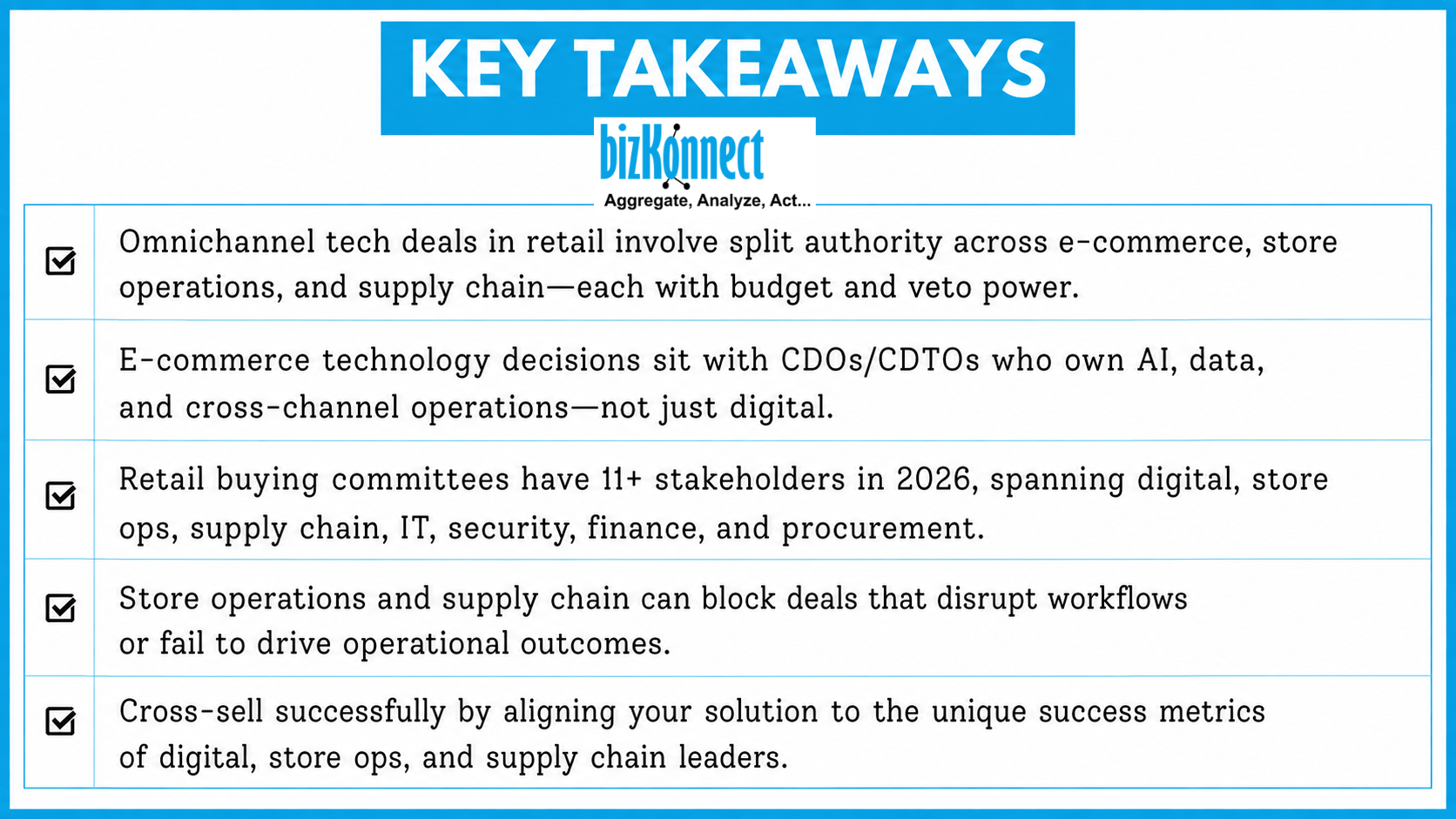
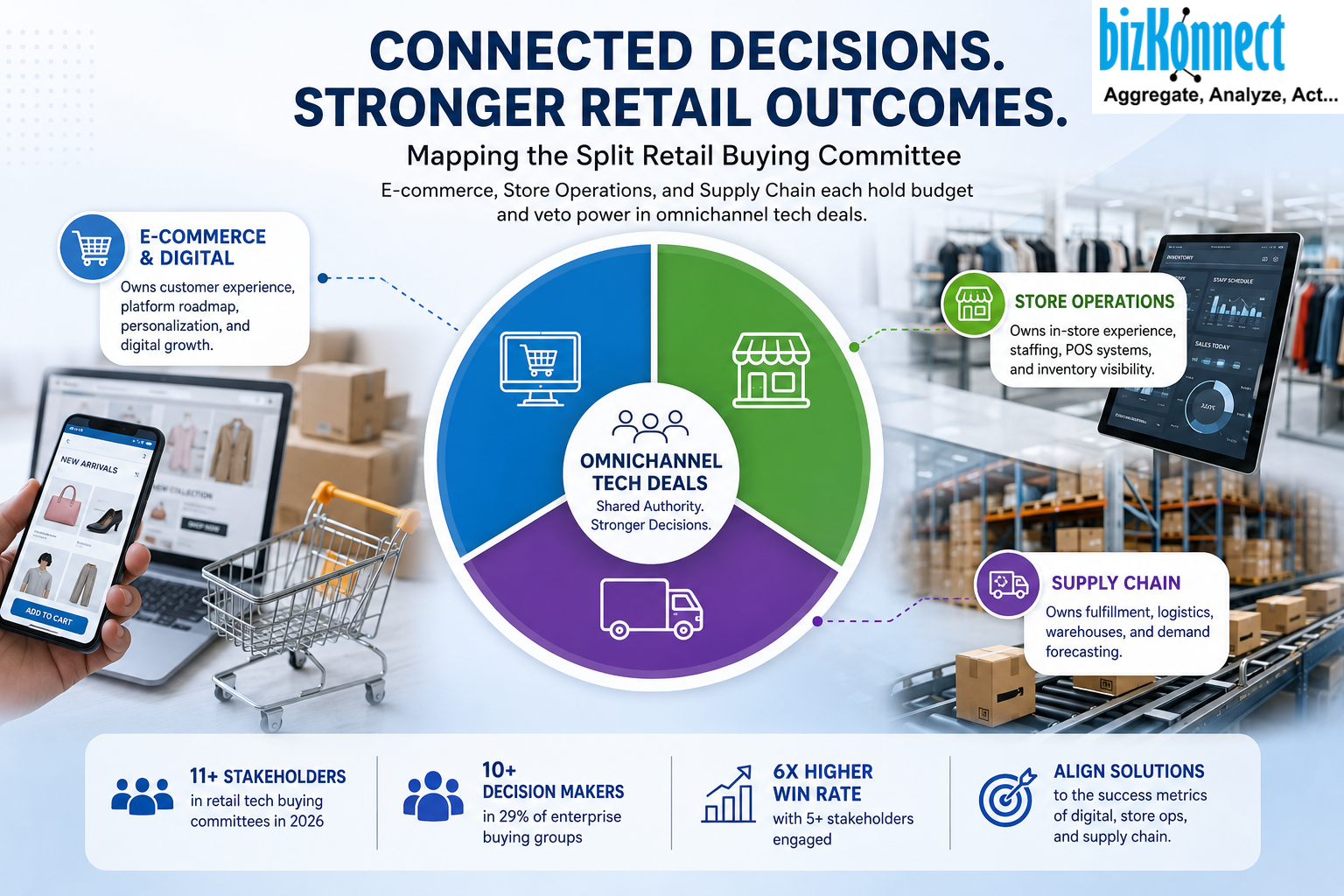
Retail company org charts built for omnichannel technology purchases generally split authority across three centers of power.
Chief Digital Officer (CDO) or Chief Digital and Technology Officer. Owns the customer-facing roadmap: e-commerce platforms, personalization, mobile, and increasingly AI-native operations layered on top of existing digital infrastructure. This function usually initiates the technology conversation and controls the largest discretionary budget line.
VP of Store Operations. Owns the in-store experience, staffing tools, point-of-sale systems, and inventory visibility at the shelf level. Store ops rarely initiate an enterprise software purchase, but it can block one. If a platform disrupts store workflows or adds friction for frontline staff, store operations leadership has enough influence to stall or kill the deal even after digital leadership has signed off.
Chief Supply Chain Officer (CSCO). Owns fulfillment, logistics, warehouse systems, and increasingly the demand forecasting layer that AI-native retail depends on. As omnichannel fulfillment blurs the line between online orders and in-store pickup, supply chain leadership has moved from a back-office function to a co-owner of the technology budget for anything touching inventory movement.
A deal that only engages the CDO's team is a single-threaded deal in a market where that no longer works.
How Many Decision-Makers Sit in a Retail Tech Buying Committee?
The scale of this split authority shows up clearly in 2026 buying committee data. Gartner's research shows the average B2B buying committee has grown from 5.4 stakeholders in 2014 to roughly 8.2 in 2024 and 11 or more in 2026, more than double in a decade. Enterprise-specific benchmarks put the typical group even higher: Gartner and Forrester both cite 11 to 20 stakeholders for larger enterprise purchases, and industry research from 2026 shows 29% of enterprise buying groups now include 10 or more stakeholders. For strategic deals above roughly $1 million in annual contract value, median stakeholder counts commonly reach 15 to 25 people.
For enterprise retail technology specifically, this translates into a committee that spans digital, store operations, supply chain, IT security, finance, and procurement, each represented by champions, influencers, and blockers with different priorities. Multi-threaded outreach that reaches five or more stakeholders closes at roughly six times the rate of single-threaded outreach that stops at one contact. In retail, where the three functional silos rarely share a reporting line, that multi-threading has to be deliberate rather than incidental.
How to Cross-Sell Software Between Retail IT and Store Operations
Cross-selling across these silos starts with recognizing that each function evaluates technology against a different success metric. Digital leadership measures conversion, engagement, and revenue per session. Store operations measure labor efficiency, shrink, and customer wait times. Supply chain measures fill rate, inventory turns, and forecast accuracy. A pitch built around only one of these metrics will resonate with one committee member and stall everywhere else.
The practical sequence that tends to work: open with the function that owns the budget for the category being sold, but build the business case around the metric each downstream function actually tracks. When a platform touches inventory visibility, involve the supply chain early rather than after a contract is drafted. When a platform changes frontline workflows, bring in store operations before the pilot phase, not after rollout begins. This is where a visual influence map becomes more than a nice-to-have. Sales and marketing teams selling into retail need a live picture of who reports to whom, which budget line a purchase draws from, and which function has informal veto power even without formal sign-off authority.
RetailKonnect: Purpose-Built Omnichannel Buying Committee Mapping
This is precisely the gap RetailKonnect, from BizKonnect's suite, is built to close. RetailKonnect visualizes the multi-departmental influence chain inside enterprise retail accounts, mapping the connections between the CDO's digital organization, the VP of Store Operations, and the Chief Supply Chain Officer, along with the analysts, directors, and procurement contacts who sit underneath each. Instead of guessing who else needs to be in the deal, sales and marketing teams get an org-chart-level view of the account before the first call, so outreach can be structured around the real decision path rather than the org chart on the company website.
For go-to-market teams selling omnichannel technology into enterprise retail, that visibility shortens the multi-threading process that now determines whether a deal closes at 18% or at 40%, and it replaces months of manual LinkedIn research with a structured, continuously updated map of the account's real buying committee.
Frequently Asked Questions
1. Who holds the budget for omnichannel technology in enterprise retail? Budget authority typically sits with the Chief Digital Officer or Chief Digital and Technology Officer, but store operations and supply chain leadership hold approval or veto power over purchases that touch their workflows, effectively co-owning the decision even without formal budget lines.
2. How many decision-makers are in a retail tech buying committee? Enterprise retail technology committees generally include 8 to 20 stakeholders depending on deal size, spanning digital, store operations, supply chain, IT security, finance, and procurement.
3. What is the difference between a CDO and a CSCO in retail technology decisions? The CDO generally owns customer-facing digital experience, e-commerce platforms, and increasingly AI strategy, while the CSCO owns fulfillment, logistics, and inventory systems. Both influence any purchase that spans online and in-store operations.
4. Why does store operations get involved in software purchases it doesn't fund? Store operations leadership can block or slow adoption of tools that disrupt frontline workflows, even when the budget and sign-off sit elsewhere, making early engagement essential for smooth rollout.
5. How has the retail buying committee changed in 2026 compared to a decade ago? Committee size has roughly doubled since 2014, driven by AI governance, cross-channel fulfillment, and data security requirements that pull in more functions than a traditional single-department purchase.
6. What is retail buying committee mapping? It is the process of visualizing the reporting lines, budget owners, influencers, and blockers inside a target retail account so sales and marketing teams can plan outreach around the real decision path rather than a public org chart.
7. How does RetailKonnect help with cross-selling between departments? RetailKonnect surfaces the connections between digital, store operations, and supply chain leadership within a single account view, helping teams sequence outreach and tailor messaging to each function's priorities before a deal stalls.
8. Why is multi-threading important in retail technology sales? Deals that engage multiple stakeholders across departments close at significantly higher rates than single-threaded deals, since retail purchases rarely move forward on one executive's approval alone.
9. What retail company org chart trends should sellers watch in 2026? Watch for the consolidation of digital, data, and AI mandates under a single executive, the rising influence of chief AI officer roles, and closer coordination between supply chain and digital leadership as fulfillment and e-commerce continue to converge.
Ready to see your target retail accounts mapped this way? Explore RetailKonnect's Omnichannel Buying Committee Mapping from BizKonnect.
CLICK HERE to know more with BizKonnect.