


Sales representatives rarely struggle from a lack of information. Modern sales stacks are overloaded with databases, intent feeds, and intelligence tools. Yet, according to industry benchmarks, the average account executive spends less than 35% of their working day actually selling. The remaining time is consumed by administrative overhead, manual data entry, and multi-tab research.
This friction represents an execution tax, a productivity drain caused by constant context switching across disconnected tools.
When a rep must open one platform to monitor intent signals, switch to a social network to map buying groups, navigate to a database to extract contact details, and then record the interaction inside a CRM, sales momentum stalls.
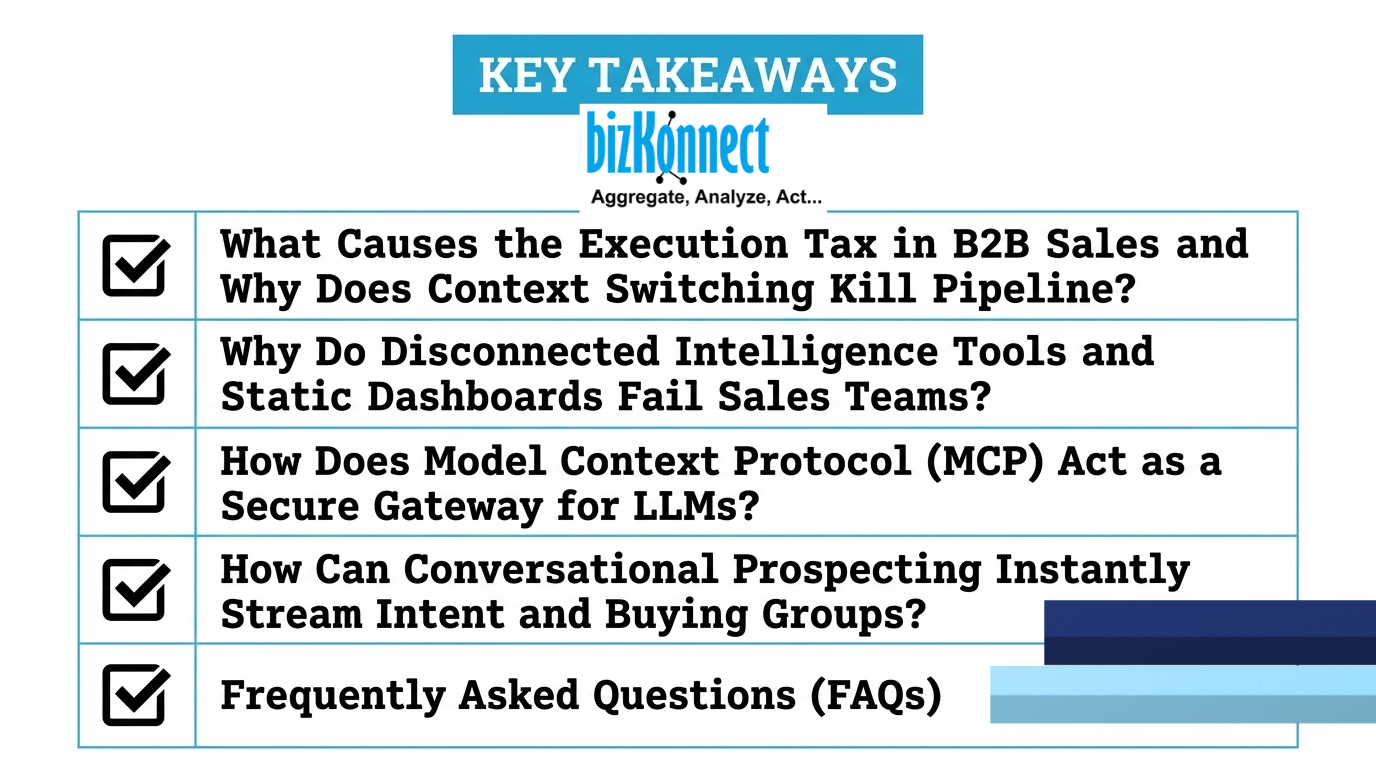
By unifying data streams through Model Context Protocol (MCP) and leveraging AI marketing automation for B2B, enterprise teams are closing this execution gap. Instead of navigating five different browser tabs, reps can stream intent data, organizational hierarchies, and account insights directly into a single conversational window.
1. The Reality of Friction: The Cost of Context Switching
Every time a sales professional switches tabs, their cognitive focus breaks. Context switching carries a measurable cost in operational velocity, deal velocity, and response quality.
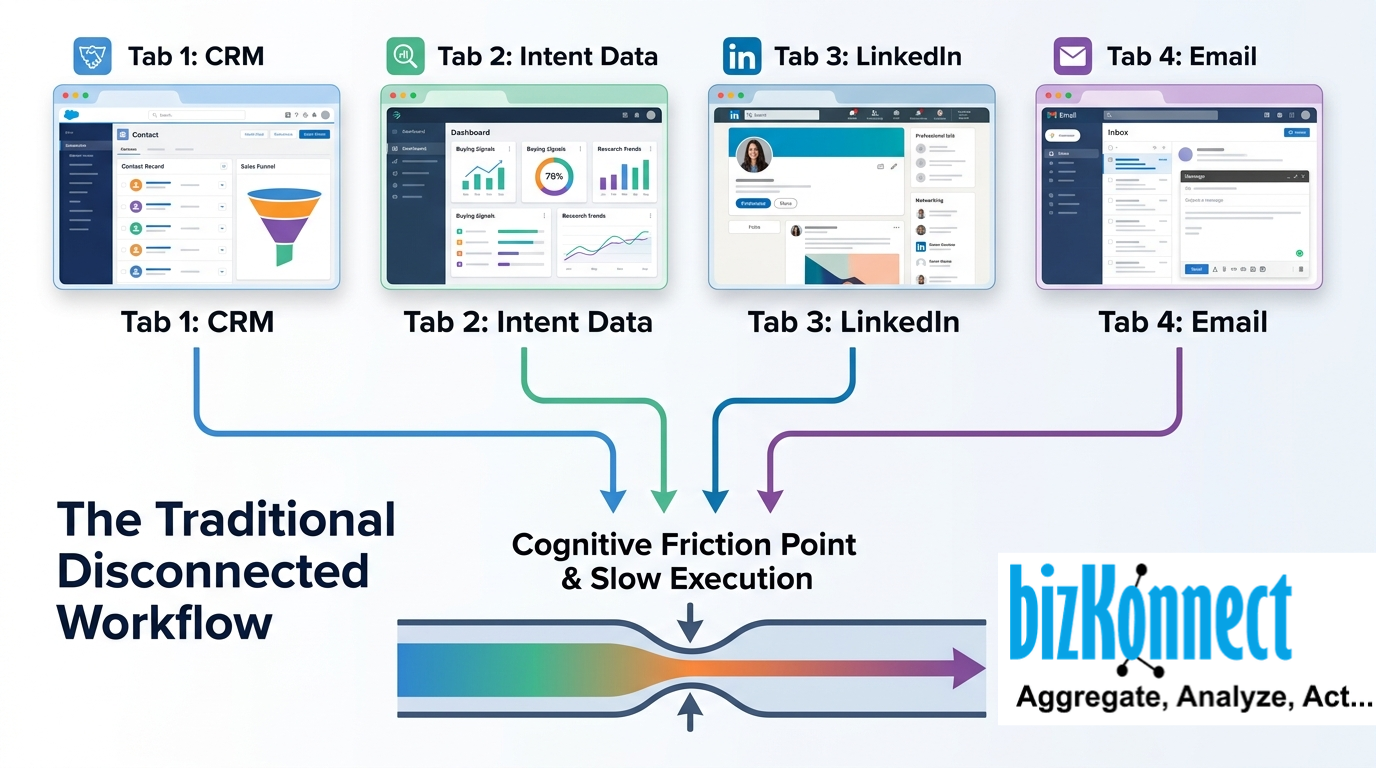
In a typical outbound or account-based motion, a rep executes a fragmented sequence:
- Intent Signal Discovery: Reviewing intent dashboards to identify accounts showing spike activity.
- Account Research: Searching corporate records to verify revenue tiers, tech stacks, and current initiatives.
- Buying Group Mapping: Finding current decision-makers across executive and operational levels.
- Data Verification: Confirming direct-dial phone numbers and verified email addresses.
- Personalized Messaging: Writing customized outreach based on disparate data points gathered across steps 1 through 4.
When these operations are performed across isolated tools, execution slows to a crawl. High-intent opportunities cool down before the first touchpoint is delivered. B2B marketing automation must address this human workflow friction rather than simply adding another analytical dashboard to the tech stack.
2. The Semantic Gateway: How Model Context Protocol (MCP) Works
To eliminate context switching, AI applications require a standardized mechanism to communicate securely with internal corporate databases, CRM platforms, and live market intelligence feeds.
Model Context Protocol (MCP) acts as an open, secure semantic gateway. It functions as a universal bridge, allowing standard Large Language Models (LLMs) such as Claude or ChatGPT to securely query internal databases and surface live context on demand without storing proprietary data within the core model.
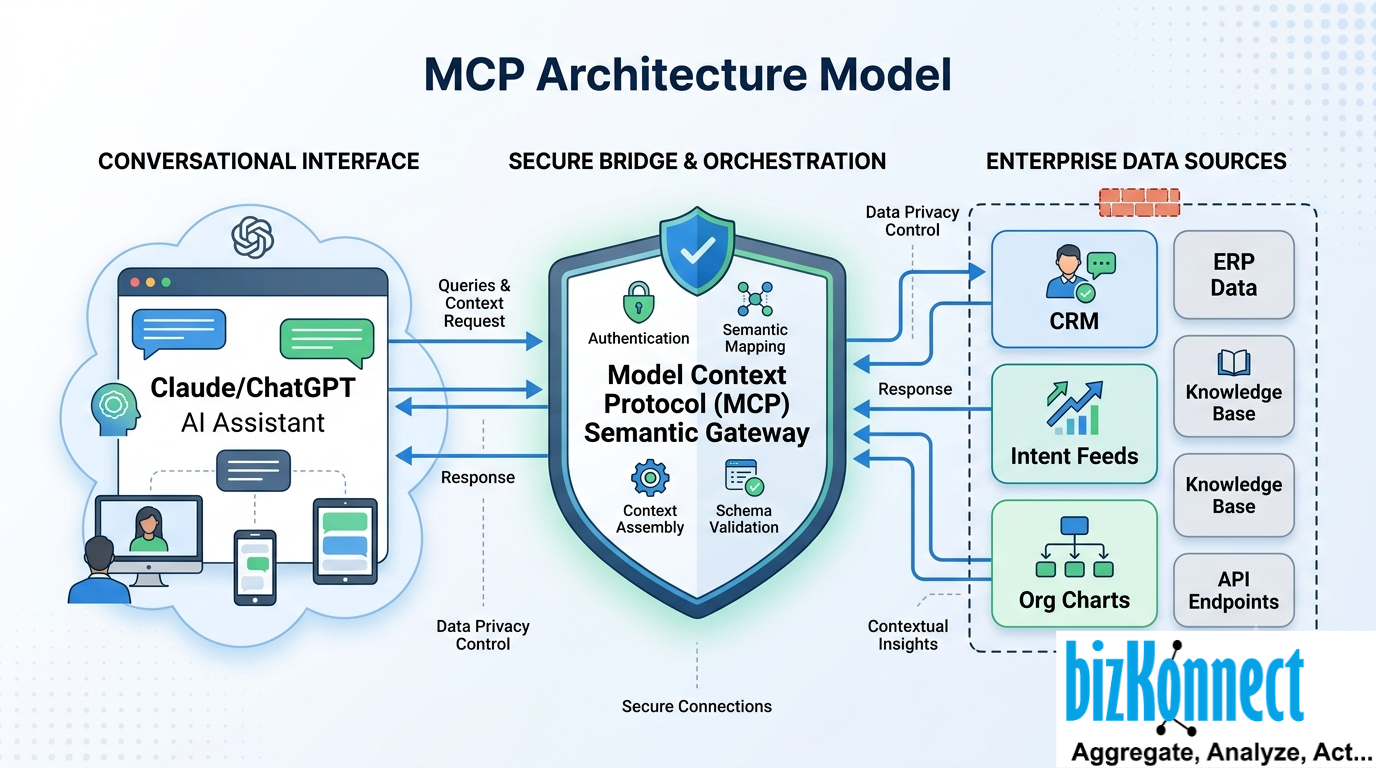
Key Technical Advantages of MCP Architecture:
- Zero ETL Overhead: Eliminates the need to build and maintain brittle custom API integrations between every tool in the revenue stack.
- Real-Time Data Streaming: Pulls live account activity, buying intent metrics, and organizational changes directly at the moment of query execution.
- Enterprise-Grade Security Control: Maintains role-based access controls (RBAC) and strict data boundary protections, ensuring sensitive CRM fields remain within enterprise governance.
By establishing an MCP connection, reps no longer need to learn complex database syntax or master multiple user interfaces. The LLM becomes a unified workspace capable of understanding plain-language requests and executing multi-step data retrieval in seconds.
3. Conversational Prospecting: Operationalizing Instant Intent Data
When AI-powered B2B marketing automation is connected via MCP, sales execution shifts from manual research to conversational interaction. Sales reps can perform complex research workflows entirely within a single interface.
Practical Conversational Query Workflows
Scenario A: Priority Account Prospecting
- Rep Query: "Summarize intent surges for Acme Corp over the last 14 days, identify the top 3 decision-makers in their GTM leadership team, and draft an introductory outreach framework referencing their cloud migration initiative."
- System Action: The MCP server queries internal intent dashboards, fetches verified buying group org charts, checks past CRM touchpoints, and streams a complete, ready-to-edit action plan into the chat window within seconds.
Scenario B: Buying Group Gap Identification
- Rep Query: "Which open deals in our Q3 pipeline over $100k are missing a CFO or Finance stakeholder in the contact log? Pull contact records for those missing roles."
- System Action: The LLM inspects active CRM deal stages, cross-references associated contact roles against target buyer personas, identifies missing decision-makers, and surfaces verified contact details immediately.
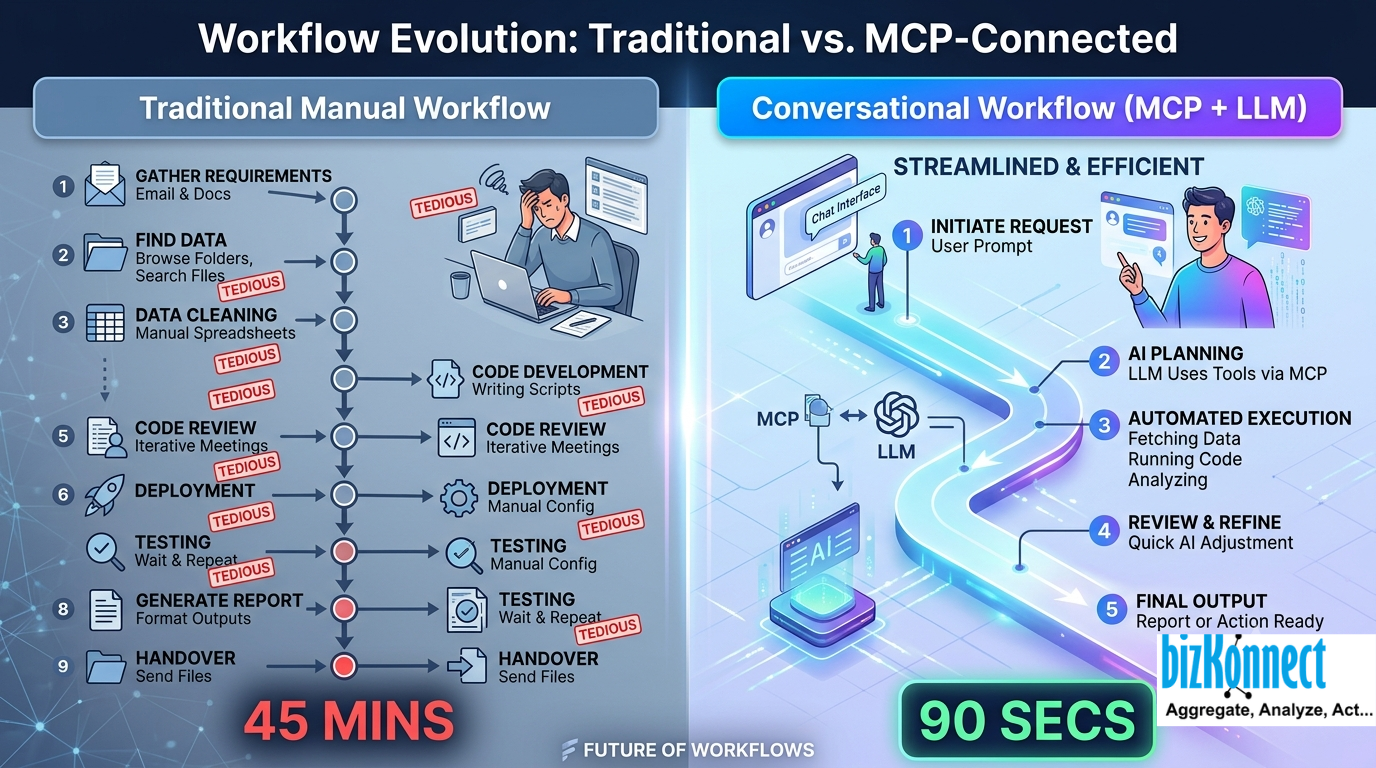
Data is only valuable if your team can access and operationalize it instantly. Removing software friction speeds up pipeline motion and gives reps more time for genuine buyer conversations.
4. Balancing AI Automation with Human Expertise
While AI campaign automation dramatically accelerates data discovery, technology alone cannot replace strategic human oversight. High-value B2B deals demand precise data accuracy, deep enterprise context, and refined domain positioning.
The most successful B2B automation frameworks leverage a hybrid model: combining high-speed AI connectivity with expert human validation.
By pairing high-performing MCP data pipelines with specialized human analysts, organizations ensure that account maps, direct-dial contacts, and buying signals maintain high precision. BizKonnect leverages advanced AI automation tools alongside expert GenAI analysts to deliver maximum operational performance ensuring sales teams receive verified contact structures and actionable intelligence without spending hours on research.
5. Frequently Asked Questions (FAQs)
What is B2B marketing automation?
B2B marketing automation refers to technology solutions designed to streamline, automate, and measure marketing tasks and workflows across complex, multi-touch business sales cycles. It encompasses lead management, account scoring, automated campaigns, and sales integration.
How does AI automate B2B marketing?
AI automates B2B marketing by analyzing large volumes of account data to identify purchase intent signals, dynamically segmenting target audiences, personalizing account messaging at scale, and orchestrating multi-channel engagement workflows without manual intervention.
What is Model Context Protocol (MCP) and how does it support sales intelligence?
Model Context Protocol (MCP) is an open standard that allows Large Language Models (LLMs) to securely connect directly to enterprise databases, CRMs, and external APIs. In sales intelligence, it enables reps to retrieve live intent data, org charts, and account histories using natural conversational prompts within a single chat window.
How does context switching impact B2B sales productivity?
Context switching forces sales reps to navigate between multiple application tabs to collect prospect data, update records, and craft messages. This fragmented workflow creates cognitive fatigue, increases administrative overhead, delays response times, and significantly reduces the time reps spend on active selling.
How does conversational prospecting differ from traditional research?
Traditional research requires manual platform searches, data extraction, and cross-referencing across separate software applications. Conversational prospecting enables reps to query integrated systems in plain language (e.g., via Claude or ChatGPT) to instantly receive actionable account insights, buyer group charts, and personalized outreach drafts.
Why are intent signals alone insufficient for closing the execution gap?
Intent signals indicate that an account is researching a topic, but they do not automatically provide verified buyer contacts, organizational structures, or contextual engagement history. Without connected execution tools, reps spend excessive time researching who to contact within an intent-surging account.
What role do actionable org charts play in AI-driven sales workflows?
Actionable org charts map the key decision-makers, influencers, and buying group hierarchies within a target company. When streamed directly into AI workflows, they allow reps to identify missing stakeholders, execute multi-threading strategies, and target the complete buying committee efficiently.
How do connected LLMs maintain data security when querying internal databases?
MCP-connected LLMs utilize secure API bridges and strict role-based access controls (RBAC). The LLM processes queries dynamically without ingesting, training on, or permanently storing proprietary enterprise database records outside the secure organizational boundary.
How does BizKonnect close the B2B sales execution gap?
BizKonnect combines intelligent B2B automation with expert human-in-the-loop validation, delivering verified actionable org charts, intent-driven prospect intelligence, and seamless GTM data integrations that allow sales teams to focus on revenue-generating activities.
Eliminate administrative friction and accelerate your team's sales momentum. Learn how BizKonnect connects AI intelligence with expert human validation to close your B2B execution gap today.
CLICK HERE to know more with BizKonnect.