


In February 2026, Saudi Aramco signed an MoU with Microsoft to co-develop industrial AI on Azure. A month earlier, ExxonMobil confirmed AI was central to its $15 billion cost-reduction programme. Around the same period, Shell dissolved its Projects & Technology directorate, folding its technical functions directly into business lines.
These are structural signals, i.e., visible changes in how energy companies organise authority, accountability, and budget around digital investment.
For any vendor, consultant, or solution provider targeting the energy sector, this matters enormously. The energy company org chart which is long a stable hierarchy of exploration, production, and operations, is being redrawn by artificial intelligence, grid modernisation, and surging data-centre demand. If your go-to-market strategy maps to titles and structures from three years ago, you are likely targeting people who no longer hold the budget.
This guide unpacks who now controls digital transformation spending inside major energy companies, what structural changes are driving that shift, and how GenAI-powered energy org charts help sales and marketing teams identify the right buyers before the competition does.
What Is Driving the Change in Energy Company Org Chart Structure?
Three forces are simultaneously reshaping the energy company hierarchy, and each one moves budget authority in a different direction.
- AI mandates are pushing budget into operations
When ExxonMobil sets a $15 billion cost-savings target driven by AI and process intelligence, that mandate lives in operations, instead of IT. TotalEnergies’ billion-dollar AI efficiency programme for 2026–2028 is similarly framed as an operational outcome. In both cases, COOs, EVPs of Operations, and Supply Chain leads now co-own or lead digital investment decisions that previously sat with the CIO.
- Restructuring is dissolving centralised tech authority
Shell’s elimination of its Projects and Technology directorate which is integrated into individual business lines in H1 2026 is the clearest example of a wider trend. Business unit presidents and commercial directors now hold procurement authority that previously required sign-off from a central technology function. There is no single CTO gate anymore, just multiple business-unit-level gates.
- New infrastructure demand is creating new titles
Chevron’s anticipated Final Investment Decision in H1 2026 on a 1 GW AI data-centre power foundry pulls CFOs, asset development VPs, and hybrid roles like Chief AI Officer into procurement conversations alongside. Virtual power plants, decentralised energy resources, and cloud-edge IoT deployments are generating VP-level roles across the sector that carry real budget authority but appear nowhere on a static oil and gas org chart.
How Do You Identify Who Actually Holds the Budget in a Reorganised Energy Company?
The energy company org chart you can see on a website, in an annual report, or scraped from LinkedIn is a lagging indicator. During active restructuring, public data typically runs 6–12 months behind operational reality. To find the real budget holder at a given account, follow three steps.
Step 1: Match the solution to the business outcome
AI and automation for cost reduction routes to Operations leadership. Grid modernisation and digital twin deployments route to Asset Management or Engineering. Cybersecurity, especially given EU regulatory pressure on grid interoperability and AI governance, routes to the CISO or VP of Risk. Data infrastructure routes to the CIO or Chief Digital Officer where that role still exists as a standalone function. Starting with the business outcome tells you which track of the energy company hierarchy to enter.
Step 2: Monitor structural trigger signals
New VP-level digital or AI hires, restructuring announcements, technology MoUs, and earnings call language shifting from “IT cost” to “AI-driven P&L impact” each signal a buying event and an authority shift. These triggers are more reliable than a published org chart of top energy companies because they reflect the org as it is changing.
Step 3: Map the full stakeholder constellation
A digital twin deployment at a major operator may require aligned sign-off from the VP of Asset Management, the CIO, the CISO, and the CFO. Knowing the primary budget holder is only the start. Map who influences, who approves, and who can stall. Then sequence outreach to build internal momentum rather than relying on a single contact to carry the deal.
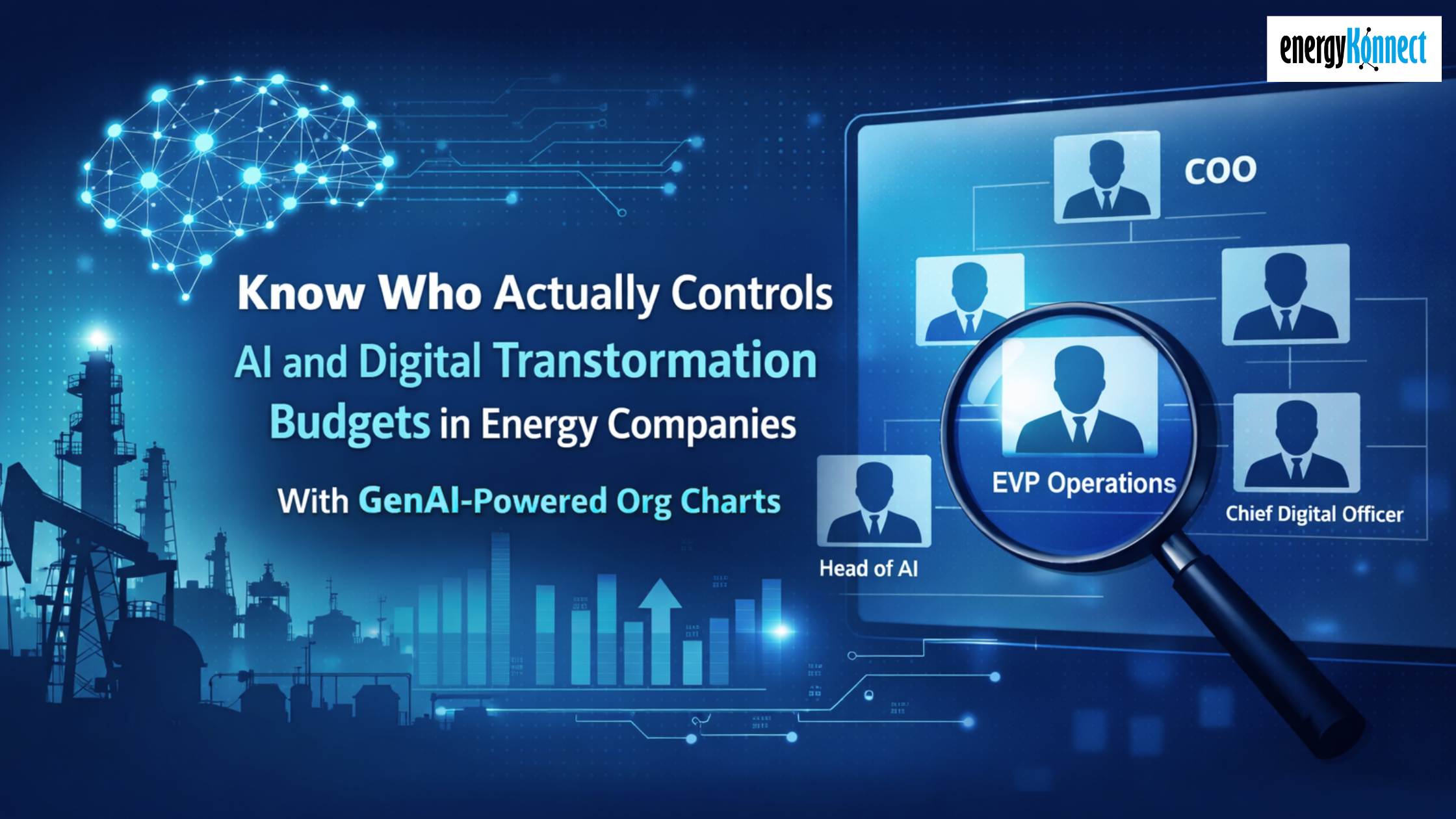
How Do GenAI-Powered Energy Org Charts Make This Actionable at Scale?
The three-step framework above works account by account. Scaling it across a territory of 50 or 500 energy accounts requires infrastructure. GenAI-powered energy org charts apply continuous signal monitoring such as hiring patterns, regulatory filings, and earnings calls to infer real-time authority structures. It shows the energy leadership structure as it is functioning rather than as it was announced. For go-to-market teams, that translates into four concrete capabilities:
- Continuous authority mapping: Identifies who currently holds the budget for a given initiative type at a specific account, even mid-restructuring.
- Trigger-based alerting: Flags the moment a company signals a buying event such as a new AI hire, a partnership MoU, or a grid investment announcement, so outreach lands before the RFP is written.
- Stakeholder relationship mapping: Surfaces reporting lines and cross-functional relationships, revealing the fastest path to consensus rather than just the energy company org chart roles and responsibilities on paper.
- Structural readiness scoring: Segments accounts by how far their reorganisation has progressed, distinguishing companies with clear procurement paths from those still in authority flux, so teams focus effort where pipeline velocity is achievable.
For vendors selling into a sector where $15 billion AI mandates and 1 GW infrastructure decisions are now standard deal triggers, closing the gap between published energy company insights and real decision-making authority is the baseline requirement for competitive go-to-market execution.
With these changes and the targeting framework in mind, a few important questions naturally arise for teams navigating similar challenges in the energy sector.
Frequently Asked Questions (FAQs)
Q1. How do you find energy company org charts that reflect current authority?
Use GenAI-powered platforms monitoring hiring patterns, earnings calls, and regulatory filings in real time. LinkedIn and annual reports lag organisational reality by 6–12 months during active restructuring which describes most major operators in 2025–2026.
Q2. Which roles in an oil and gas company org chart now control digital transformation budget?
It depends on the initiative: AI and automation routes to COOs and EVP Operations; power infrastructure to asset development VPs; cybersecurity to the CISO; data and cloud to the CIO or Chief Digital Officer. Matching solution to outcome tells you which track of the energy company hierarchy to enter.
Q3. What signals indicate that a new budget holder has emerged inside an energy company?
VP-level AI or digital executive hires, restructuring announcements, technology MoUs, and earnings call language shifting from IT cost to P&L impact are the most reliable indicators, each one narrows the authority map at a specific account.
Q4. How does EU regulation affect energy company org chart roles and responsibilities?
EU mandates on AI governance and grid interoperability have generated compliance-linked roles such as Head of AI Governance, and Chief Digital Regulation Officer, that sit close to budget and appear quickly. Operators like TotalEnergies and Shell are adding these titles faster than static databases capture them.
If your team is targeting energy companies and needs accurate, decision-ready contact data mapped to today’s reorganised org structures, the competitive advantage is in the intelligence layer. CLICK HERE to explore how BizKonnect can help you with accurate, decision-ready datasets.
CLICK HERE to know more with BizKonnect.