


Indian companies looking at Europe have long faced a familiar set of hurdles: high regulatory complexity, mobility restrictions for skilled staff, and the sheer cost of establishing a credible local presence. That’s changing fast with the India–European Union (EU) Free Trade Agreement and the ongoing push toward Social Security Agreements (SSA) with EU member states.
These are the moves reshaping the economics of the cross-border EU business expansion ecosystem.
Alongside these policy shifts, companies are also experimenting with leaner go-to-market models, including fractional sellers backed by Generative Artificial Intelligence (GenAI) insights, to test and scale European markets without committing to heavy upfront sales investments. However, at the core of this shift is not just tariff reduction, but more predictable access for services firms, clearer mobility paths for professionals, and frameworks that reduce financial friction. It also includes social security contributions for Indians operating across EU borders.
Now, it’s one thing to read policy announcements. It’s another to understand what this actually means for unit economics when selling into Europe, especially for Indian businesses expanding to Europe with lean budgets and high return expectations.
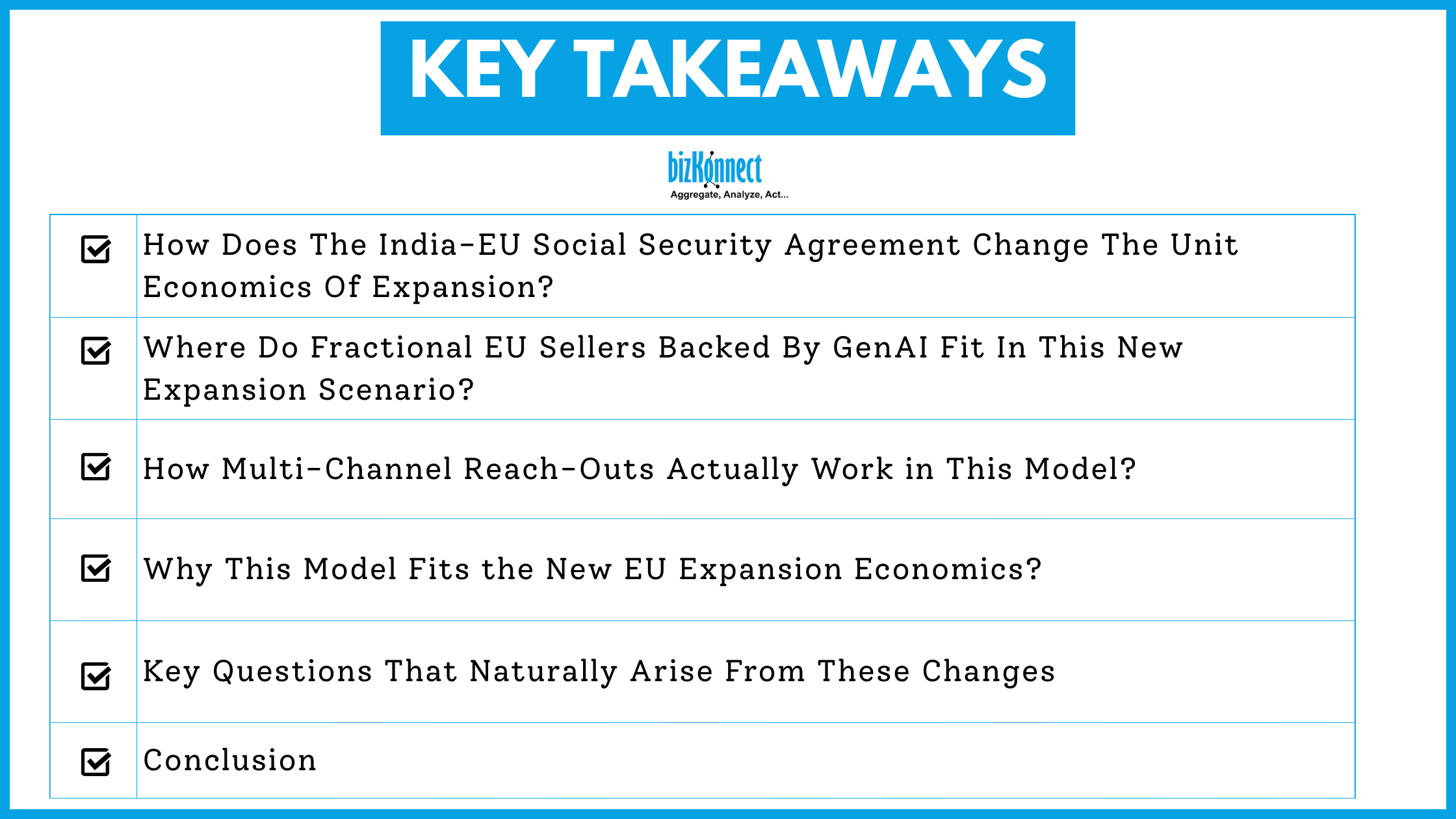
How Does The India-EU Social Security Agreement Change The Unit Economics Of Expansion?
Expanding into the EU has historically meant navigating a fragmented regulatory environment where "double social security" contributions acted as a hidden tax. Indian companies often had to pay into both the Indian provident fund and the local European social security systems for their deputed staff, adding premium to labor costs and complicating how Indian companies expand to Europe sustainably.
The India-EU FTA changes many of these calculations:
- Elimination of Double Contributions: The SSA allows Indian professionals to remain under their home country’s social security net while working in Europe. This instantly wipes out redundant costs and is one of the clearest benefits of India EU agreement for businesses.
- Competitive Pricing Power: By removing this "labor tax," Indian firms can bid for European projects with far more aggressive pricing, making their unit economics comparable to local European firms but with the scale of Indian operations.
- Improved Mobility: With standardized certificates of coverage, the administrative friction of moving high-skill talent across the 27-nation bloc is significantly reduced, ensuring that the right expert is on-site when a deal needs closing.
These changes in economics, more predictable cost structures and quicker monetization, make European expansion more attractive and less capital intensive for Indian companies.
Where Do Fractional EU Sellers Backed By GenAI Fit In This New Expansion Scenario?
Despite better deals and mobility frameworks, the real challenge for many Indian businesses expanding to Europe remains effective go-to-market execution with limited budgets and zero local network. This is where fractional sellers, senior European sales executives engaged on a flexible basis, become a game-changer, especially when combined with GenAI-powered insights from a modern sales intelligence platform.
Instead of hiring a full-time local team (which can be prohibitively expensive), companies now use experienced European sellers who:
- Understand target buyer profiles
- Have established domain networks
- Bring prospects, partners, and decision-makers to the table
And when this expertise is backed by GenAI intelligence, every outreach from email sequences to partner engagement becomes more accurate and effective.

How Multi-Channel Reach-Outs Actually Work in This Model?
Step 1: Decision-Maker and Partner Mapping
GenAI systems help answer a critical question: how to find decision-makers in Europe. They identify:
- Ideal customer profiles
- Buying committees within European organizations
- Channel partners and ecosystem players aligned to the solution
This avoids wasted outreach and focuses only on accounts with real buying intent inside the European EU business expansion ecosystem.
Step 2: Email-First, Insight-Driven Engagement
Instead of broad campaigns:
- Emails are sent to mapped decision-makers and partners, not lists
- Messaging reflects local context, regulatory realities, and business priorities
- Engagement signals such as opens, clicks, and replies are tracked
This creates an early intelligence layer before any meeting is scheduled.
Step 3: Intelligent Follow-Ups Across Channels
Based on response behavior:
- Personalized follow-ups are triggered
- LinkedIn and direct calling are layered only where interest is shown
- Partners are activated where co-selling improves credibility
Step 4: Fractional Sellers Execute Locally
The fractional seller:
- Conducts discovery calls and demos
- Meets prospects and partners in person
- Represents the company at events and meetings
- Feeds structured insights back to the India team
All activity is tracked, monitored, and optimized.
Why This Model Fits the New EU Expansion Economics?
The India-EU deal lowers structural barriers and fractional sellers backed by GenAI optimize execution. Together, they deliver:
- Lower customer acquisition cost
- Faster pipeline creation
- Reduced dependency on permanent hires
- Measurable return with defined deliverables
- Flexibility to scale up or exit without long-term risk
This alignment is what makes European expansion viable for mid-market and growth-stage Indian businesses expanding to Europe, not just large enterprises.
Key Questions That Naturally Arise From These Changes
Q1. Does the Social Security Agreement immediately reduce expansion costs?
It reduces long-term deployment costs and improves predictability, which directly impacts pricing and margin planning.
Q2. Can Indian firms rely on emails as a serious EU outreach channel?
Yes. When emails are decision-maker-mapped, personalized, and backed by local sellers, they become a high-signal channel.
Q3. Is a fractional seller effective without a full internal team?
Absolutely, when supported by GenAI insights, tracking, and clear objectives, effectiveness is measurable and scalable.
Q4. Does this model work beyond information technology services?
It applies to software, engineering services, sustainability solutions, and professional services where trust and local presence matter.
Conclusion
The India-EU trade and social security alignment marks a strategic inflection point for Indian companies looking to scale into Europe. By lowering barriers and improving predictability, it makes growth in the EU a far more economically rational decision.
Combine these structural improvements with modern sales execution models such as fractional sellers powered by GenAI insights and you get a high-velocity, low-risk expansion playbook. It significantly improves return on investment (ROI) in one of the world’s largest markets.
Break into the EU industry faster with BizKonnect’s Fractional Sales model. CLICK HERE to learn more.