


Selling rendering software or IP licenses to a legacy studio used to follow a predictable script.
- Vendors targeted the VP of Interactive.
- Pitched a standalone game budget.
- Moved to procurement.
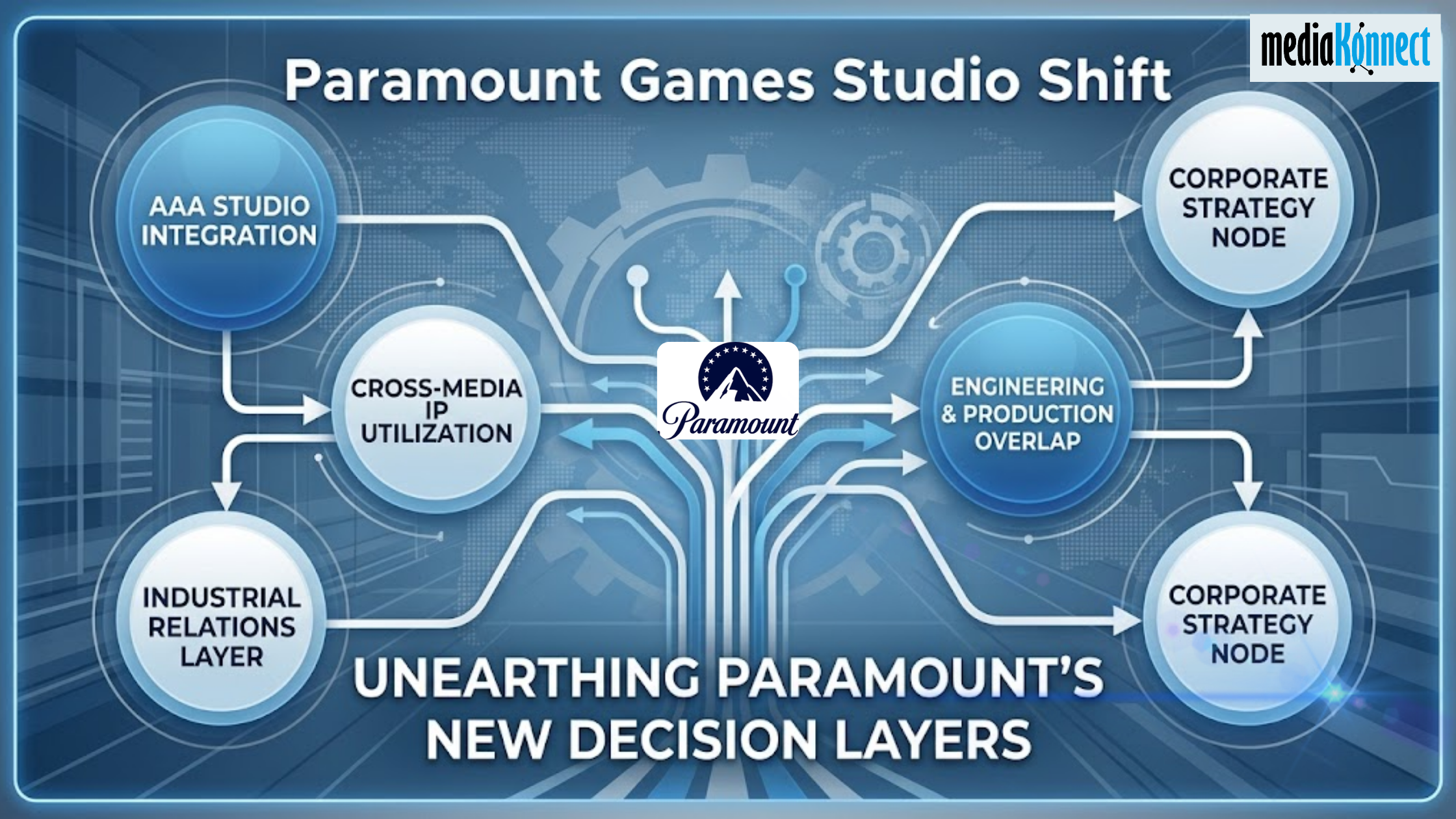
That playbook evaporated on June 4, 2026, when Paramount officially unified its AAA Skydance Games arm with its traditional IP portfolio to form the Paramount Games Studio, appointing Tony Driscoll as President. Combined with the June 22, 2026 formation of a new Industrial Relations Division under Nicole Lang and Sheldon Kasdan, vendor pipeline visibility has collapsed.
Standard B2B prospecting tools cannot decode these overlapping matrix structures. When legacy media groups fold interactive games directly into their main entertainment divisions, a new class of cross-media engineering and production buyers emerges.
To win these high-value accounts, technical vendors must re-evaluate how they analyze a digital media company org chart to unlock hidden decision-makers.
How the Paramount Games Studio Consolidation Changes Vendor Targeting?
The traditional media organizational chart separated film production from interactive gaming. This structural division allowed rendering, engine, and middleware vendors to sell distinct, siloed licenses to game studios without crossing paths with theatrical or streaming infrastructure buyers. The Paramount leadership change destroys this historical boundary. By bringing Skydance Interactive and Skydance New Media under a unified studio banner alongside traditional legacy properties, budgets and infrastructure requirements are pooling together.
For technology vendors, this consolidation introduces immediate operational tension. A rendering platform that previously required approval only from a game studio VP of Engineering must now pass technical and strategic evaluations governed by cross-media executives. Tony Driscoll concurrently serves as EVP and Head of Corporate Strategy and Development, meaning that purchasing decisions are tied directly to broader corporate integration initiatives rather than isolated project budgets. Vendors who rely on static, historical media company org charts are pitching the wrong operational layers, resulting in prolonged sales cycles and dead opportunities.
Navigating the New Paramount Leadership Structure in 4 Steps via GenAI Charts
Unlike static databases, generative AI charts dynamically parse unstructured regulatory filings, press announcements, and corporate registries to reconstruct a live media organizational chart. By processing the structural shifts at Paramount, GenAI mapping reveals the exact operational friction points where sales pitches fail or succeed. Vendors can execute this automated alignment through four systematic steps:
- Step 1: Isolate the Cross-Media Production Layer. Commercial teams must look past traditional gaming titles. Use GenAI to identify engineering executives who sit at the intersection of real-time rendering and virtual film production, as these layers now share core pipeline tools under the new studio.
- Step 2: Map the Industrial Relations Overlap. The creation of the Industrial Relations Division under Nicole Lang and Sheldon Kasdan indicates that union compliance, talent licensing, and proprietary asset usage are tightly integrated. GenAI charts trace the invisible reporting lines showing which technical agreements must pass this layer before contract signing.
- Step 3: Track Dual-Role Executive Influence. Because key decision-makers hold responsibilities across both interactive media and corporate integration planning, GenAI helps software platforms identify cross-functional nodes. This allows sales teams to position their value propositions around enterprise scalability rather than single-game performance.
- Step 4: Align Licensing Workflows with Unified IP Controls. Vendors selling asset management or digital licensing systems must locate the specific intersection where legacy film IP is cleared for interactive AAA game engines. GenAI isolates these active gatekeepers by tracking historical asset movement across the media company organizational structure.
Why Traditional Tracking Breaks in the Modern Media Leadership Structure?
When searching for the answer to what is a media company org chart, enterprise sellers often mistake a static hierarchy for an operational map. In a rapidly evolving enterprise, a standard directory fails to capture the second-order consequences of consolidation. The real friction for software vendors does not lie in discovering names or emails. The friction lies in tracking how changing corporate mandates alter the functional authority of individuals within that structure.
The addition of the Industrial Relations Division introduces an entirely new approval layer for engineering vendors. A rendering engine or AI production tool cannot merely satisfy the technical benchmarks of a game producer. It must now align with complex labor, talent, and compliance frameworks governed by the newly created division. When these operational divisions interact, decision-making velocity drops unless vendors can map the exact reporting lines between the gaming engineering teams and the industrial relations compliance layer.
Practical Alignment for Software, Rendering, and Licensing Vendors
To survive this category evolution, business development teams must shift from volume-based outbound prospecting to precise, structural targeting. This requires real-time intelligence that updates as fast as corporate re-engineering occurs. The modern enterprise purchase is never a single-stakeholder decision. It requires balancing the technical needs of engineering with the corporate alignment metrics of executive leadership.
For instance, rendering and engine software vendors can no longer focus solely on the Studio Lead Programmer; they must target the Cross-Media Technical Director to pitch pipeline interoperability between film asset pools and game engines. Similarly, IP and asset licensing platforms must bypass traditional line producers and head directly toward the Industrial Relations and Intellectual Property lawyers to address compliance verification and automated talent royalty tracking. Finally, production middleware vendors must pivot their attention toward Corporate Integration and Strategy Infrastructure teams, tailoring their messaging around scalability across multiple concurrent AAA and casual game properties rather than isolated projects.
By monitoring the shifting nodes of the media leadership structure, technical vendors can predict where budget friction will occur before sending a proposal. Targeting a single layer without validating its cross-functional dependencies leads to stalled deals. Success requires parsing the exact organizational design to match the enterprise reality of 2026.
With these operational shifts in mind, several practical questions tend to surface during evaluation and execution.
Frequently Asked Questions (FAQs) For Enterprise Decision-Makers
Q1. How does the merger of Skydance Games and Paramount IP change software procurement?
Procurement shifts from independent, project-based studio budgets to centralized enterprise agreements. Software vendors must prove their platforms can scale across both traditional entertainment assets and interactive AAA gaming environments simultaneously.
Q2. Who holds the ultimate budget authority for cross-media tools at Paramount?
Budget authority is shared between the technical leadership of Paramount Games Studio and corporate strategy layers. Because Tony Driscoll manages both game studio operations and corporate development, purchases must align with broad corporate efficiency goals.
Q3. Why must rendering vendors coordinate with the new Industrial Relations Division?
The Industrial Relations Division manages compliance and talent frameworks. Any rendering or production tool that impacts creative workflows, automated generation, or proprietary asset deployment must clear this compliance layer to ensure it meets labor guidelines.
Q4. Where do licensing vendors find the entry point for traditional IP utilization in games?
The entry point resides at the intersection of business development, licensing, and the creative production teams. Vendors must track the specific operational executives responsible for translating legacy film and television portfolios into interactive game-ready assets.
Q5. How frequently should a digital media company org chart be audited for active sales cycles?
Audits should occur continuously or upon any major corporate announcement. In a matrixed environment undergoing large-scale integration, reporting lines, compliance layers, and budget thresholds can shift within weeks of a structural announcement.
To navigate complex corporate structures, untangle executive layers, and accelerate enterprise sales cycles, CLICK HERE to discover how BizKonnect transforms data into actionable sales intelligence.
CLICK HERE to know more with BizKonnect.