


AI Search Optimization 2026 is no longer a future-facing concept, it is the operating reality for every brand that depends on search visibility to drive traffic, leads, and revenue.
For years, SEO (Search Engine Optimization) meant ranking on a list. A user typed a query, Google returned ten blue links, and your job was to be among them. Today, that list is being replaced by a single, synthesized answer generated by an AI (Artificial Intelligence) model that has already decided which sources to trust, which content to cite, and which brands deserve to exist in its response. If you are not inside that answer, you are invisible and in 2026, invisible means losing ground to competitors who understood this shift earlier.
If you think that this is a thought experiment, it’s certainly not. This actuallyis happening right now and the brands scaling their digital presence need a fundamentally different approach.
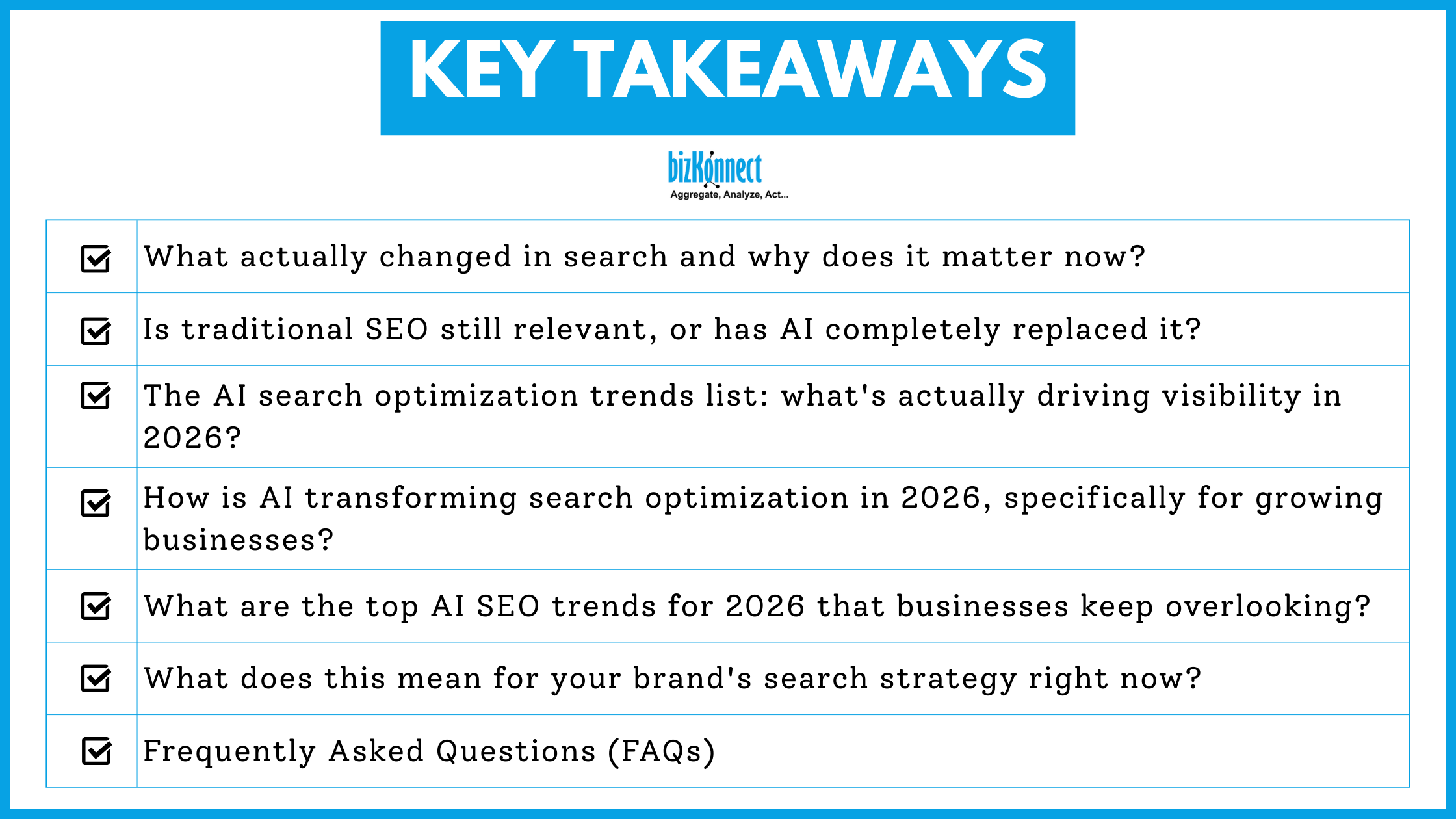
So what actually changed in search and why does it matter now?
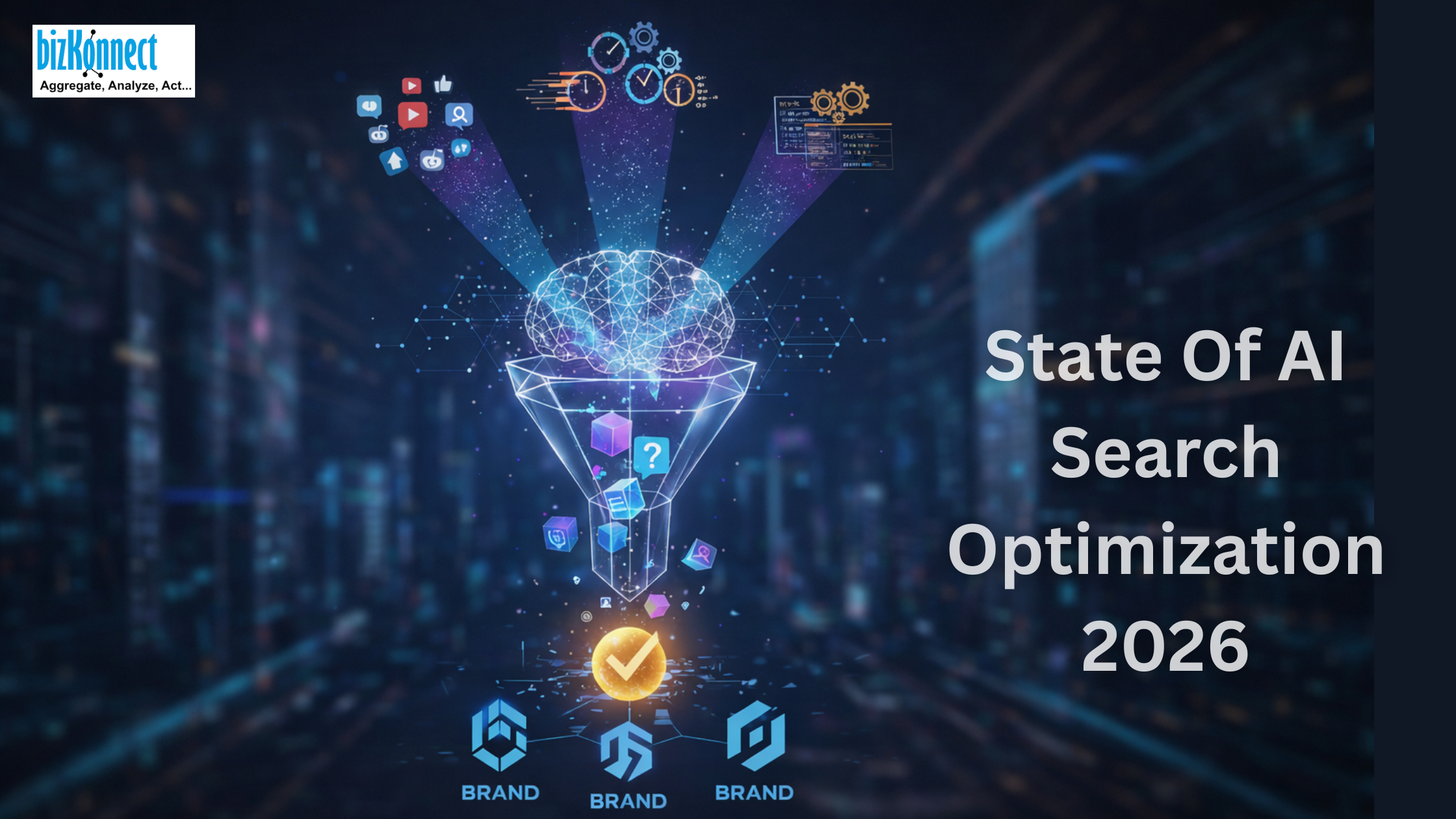
Google's search experience has moved from showing users “where to find answers” to simply “giving them the answer”. Before your content ever reaches a user, the AI model beneath the surface runs a three-stage process:
- Retrieved
- Cited
- Trusted
Your content must first enter the candidate pool, the set of pages an AI retrieval system considers. From that pool, the model selects which sources to cite. Then users decide whether to trust and act on what was cited.
Miss any one of these stages, and your SEO investment produces nothing. The signals that move you through each stage are what the rest of this blog breaks down.
But, before that, is traditional SEO still relevant, or has AI completely replaced it?
Traditional SEO is not dead but it works in the background. Pages ranking in Google's top 10 show a strong correlation with LLM (Large Language Model) mentions, and approximately 76% of AI Overview citations pull from top-10 search positions. If your organic rankings have dropped, your AI visibility has likely dropped with them.
But the type of content that ranks well for AI is different from what once dominated traditional SERPs (Search Engine Results Pages). Prompts sent to AI tools average five times the length of a typical keyword search.
That means:
- Single-keyword pages underperform against conversational, multi-part content
- FAQ (Frequently Asked Question) formats receive significantly higher citation rates
- Long-tail and question-based coverage matters more than dominating a single head term
If your content strategy was built around head-term keyword volume, it needs a rebuild from scratch.
The AI search optimization trends list: what's actually driving visibility in 2026?
Here is the AI search optimization trends list that directly determines whether your brand gets cited or ignored:
- Selection Rate and Primary Bias
Before your content is retrieved, LLMs already carry pre-existing brand associations built during training. These associations are called primary bias which influence citation likelihood even when you appear in the candidate pool. Brands with strong, specific attribute associations like "most reliable" or "enterprise-ready" get cited more frequently than those with vague positioning.
- Server Response Time
LLM retrieval operates under tight latency budgets. Pages that respond slowly miss the retrieval window entirely. Maintaining a TTFB (Time To First Byte) under 200ms is foundational, not optional.
- Content Freshness
Over 70% of pages cited by ChatGPT were updated within the past 12 months, and content updated within the last three months performs best across all search intents.
- Content Structure
Clear H-tag hierarchies, comparison tables, and list-based formatting make content easier for machine learning SEO models to parse. High fact density such as the number of verifiable and specific claims per page, directly increases citation probability.
- Third-Party Mentions
For high purchase-intent prompts, 85% of brand mentions in AI search come from third-party sources and not your own website. Review platforms and authoritative external domains carry far more weight than self-published content when a buyer's intent is high.
- Organic Search Position
Traditional rankings remain a strong predictor of AI visibility. Being in the top 10 is still one of the clearest trust signals an AI retrieval system uses.
How is AI transforming search optimization in 2026, specifically for growing businesses?
Apart from understanding these signals, the challenge for businesses in a growth phase is operationalizing them at speed. When you are scaling a sales team, entering new markets, or launching a product line, your content strategy needs to move with the business.
The role of generative AI in search ranking has introduced a new category of risk: “Content Decay”.
Pages that were once authoritative become stale within months. FAQ sections built two years ago no longer reflect how users query AI tools today. Brand mentions that once came organically now need to be actively cultivated.
Businesses in growth mode face three compounding pressures:
- Volume pressure to update more pages simultaneously
- Validation pressure to build third-party presence across new categories
- Expertise pressure to keep author credentials and proof points current
The future of AI search SEO belongs to brands that treat visibility as an ongoing operational function.
What are the top AI SEO trends for 2026 that businesses keep overlooking?
The most commonly missed AI SEO trends for 2026 fall into two categories: “what is underinvested” and “what is completely absent”.
Underinvested areas:
- User-generated content on Reddit and YouTube.
When AI Overviews appear, clicks on these platforms increase from 18% to 30% as users seek social proof. If your brand has no presence there, citations you earn have no human validation behind them.
- FAQ coverage built from real customer questions.
Support tickets, sales calls, and community forums outperforms content built from keyword tools because it captures the exact language users type into AI search.
Completely absent areas:
- Metadata optimization for AI retrieval.
Title tags and meta descriptions are not just for Google anymore, LLMs parse them to assess page relevance before retrieving content. Including the target concept in both title and description, and signaling freshness through year-specific URLs, has a measurable impact on citation likelihood.
What does this mean for your brand's search strategy right now?
Search has moved from giving users a “list of choices” to delivering a “single conviction”. The brands that earn that conviction consistently across topics, platforms, and at the moment a buyer is closest to a decision, are the ones that will own the next phase of digital growth in 2026.
The mechanics have changed: retrieval windows have replaced crawl budgets, selection rate has replaced PageRank, and third-party validation has replaced anchor text. But the strategic imperative is identical to what it has always been: be visible where your users search.
The window to build that visibility is now before the compounding advantages of early movers become too wide to close.
Addressing your real questions, a focused FAQ section
Q1: Does high domain authority still help with AI citation?
It is not a direct AI signal, but it correlates strongly with third-party mentions and organic rankings that are. A high-authority domain earns more external citations and ranks higher, both of which feed AI visibility.
Q2: Our content ranks well but doesn't appear in AI responses. Why?
The most common cause is content structure. Well-ranked pages that lack semantic HTML, FAQ sections, or sufficient fact density are regularly bypassed by AI retrieval systems in favor of more machine-readable sources.
Q3: How do we prioritize owned content improvements versus building third-party mentions?
For informational queries, owned content structure comes first. For high-intent, purchase-adjacent queries, third-party mentions dominate and that gap widens as buyer intent increases. Fix your structure to enter the candidate pool, then build external presence to ensure you are cited when it matters most.
If you want to align your content strategy with the way AI search actually works in 2026, CLICK HERE to explore how BizKonnect can help your team build the visibility, structure, and third-party presence your brand needs to show up and stay there.