


Most tech vendors approaching Apple are still pitching headcount but Apple is no longer buying it.
The shift is structural because Apple's IT company org structure is quietly moving away from labour-intensive delivery models toward a framework where AI agents, not human teams, are the primary execution layer. For B2B marketers and GTM teams, this creates a hard problem: the buyer you knew in the Time & Material (T&M) era is not the buyer making decisions today. The titles are the same but the mandate is entirely different.
This blog breaks down what the end of the labour pyramid actually means inside Apple, why T&M vendors are losing ground to outcome-based firms, and how GenAI-driven Apple org charts help you find the people who now control the conversation: the Head of Partnerships and Ecosystem Leads.
What Does the "End of the Labour Pyramid" Actually Mean at Apple?
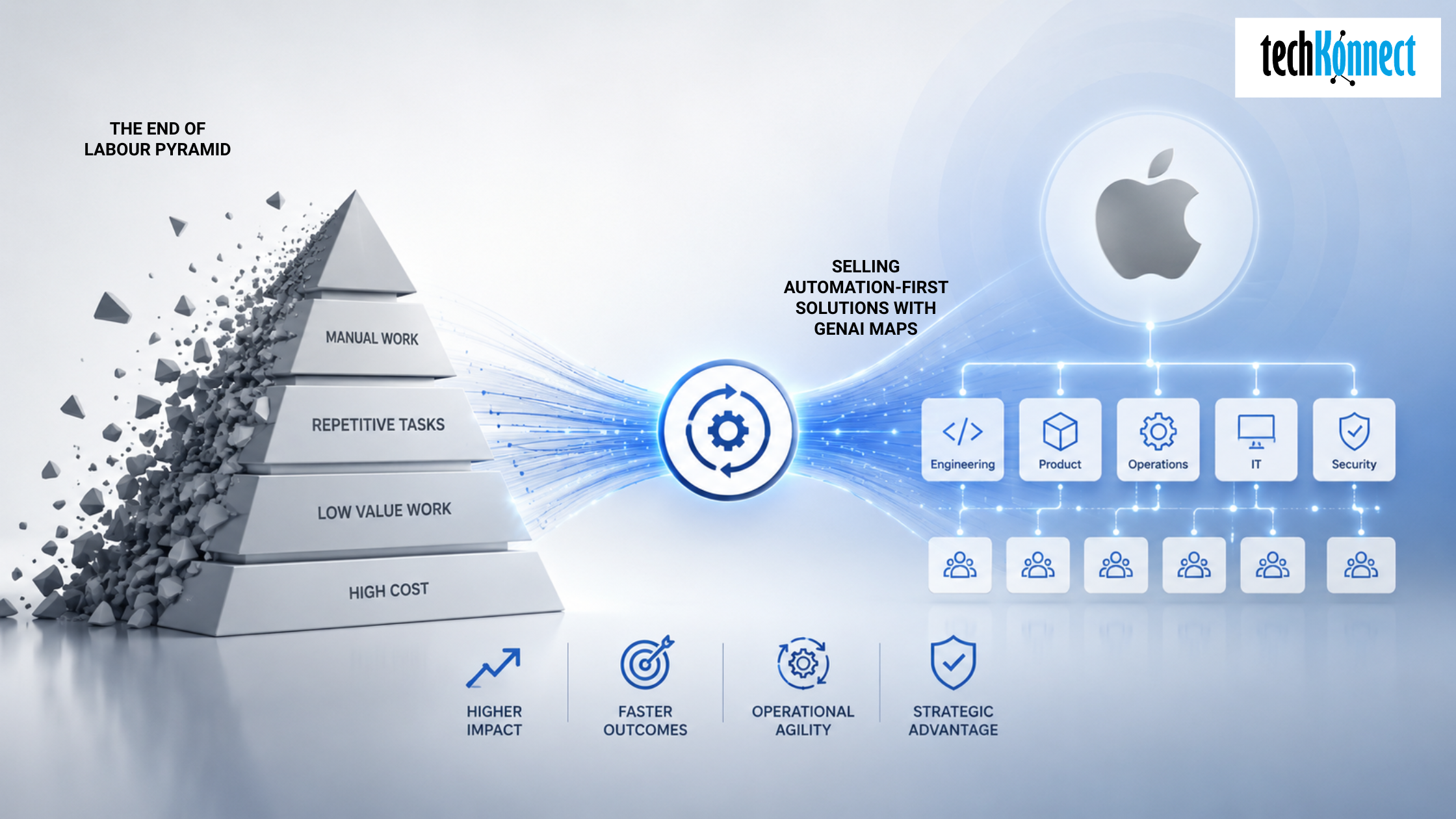
The labour pyramid is a delivery model.
- At its base: large teams of junior resources.
- In the middle: project managers and solution architects.
- At the top: a thin layer of senior strategists.
For decades, tech services firms sold into this model where more engineers meant more capability and more headcount meant more revenue. Apple, like most large technology buyers, paid for time and the material cost of human effort.
That model is collapsing because AI agents can now perform the base and middle layers of that pyramid at a fraction of the cost.
This how it looks like inside Apple's org today:
| Layer (Old Model) | What It Did | What Replaces It |
|---|---|---|
| Junior developer pool | Code generation, testing, QA | GitHub Copilot-class agents |
| Mid-tier project management | Task tracking, status reporting | Agentic workflow tools |
| Solution architects | Pattern matching, integration design | LLM-driven design assistants |
| Senior strategists | Outcome ownership | Still human but now the buyer |
The implication for sellers is accurate.
If your pitch leads with team size, delivery bandwidth, or resource availability, you are selling into a layer Apple has already automated or is actively automating. As the tech company hierarchy structure eliminated the business problem your pitch was designed to solve.
Why T&M Contracts Are Losing Ground and What Apple Is Buying Instead?
"Time and Material" pricing works when the input is the value. You pay for hours because hours produce the outcome.
When AI agents compress the hours required to near-zero, the pricing model breaks. Apple does not want to pay T&M rates for work an AI completed in minutes. More importantly, Apple's procurement leadership is now asking a different question: not "how many people will you assign?" but "what outcome do you guarantee, and how do we measure it?"
The vendors still winning T&M contracts at Apple are doing so on legacy relationships. That runway is shorter than most sales leaders believe.
What outcome-based looks like in practice at Apple's scale:
- A vendor commits to reducing a defined workflow's processing time
- Pricing is tied to model accuracy hitting a defined threshold
- Contracts include clear measurement windows and termination triggers if outcomes are not met
This is a structural shift in how Apple defines vendor value and it requires your GTM motion to lead with measurable impact.
Who Now Controls the Budget Inside Apple's IT Company Hierarchy?
Apple's internal reorganization around Agentic AI has produced a meaningful shift in where budget authority now sits. Two functions have gained disproportionate influence:
- ModelOps and AgentOps Leadership
These are the teams managing AI agent infrastructure such as deployment, monitoring, retraining, performance. They control the technical selection criteria for any vendor whose offering touches AI execution. If your solution involves an AI agent, a workflow automation, or an LLM-integrated service, this function has to approve the architecture before procurement ever sees the proposal.
- Ecosystem and Partnerships Leads
This is the more critical insight for GTM teams. Apple has rebuilt significant parts of its technology strategy around Hyperscaler partnerships including AWS, Google Cloud, and Microsoft Azure. The Ecosystem Leads inside Apple manage these alliances. Critically, they also determine which external vendors fit inside the ecosystem Apple has already committed to.
It means that if your firm is not positioned inside or adjacent to a Hyperscaler Apple has already validated, you are asking Apple's Ecosystem Lead to build a new evaluation lane from scratch. That rarely happens.
What really happens? Vendors who enter as part of an existing alliance close faster, face fewer procurement hurdles, and reach contracts earlier.
How Do You Actually Find Ecosystem Leads Inside Apple Using GenAI Org Charts?
LinkedIn titles at Apple are frequently generic or deliberately vague. A static IT company hierarchy chart built from scraping will give you names, instead of context.
GenAI-driven org charts solve a different problem. They process multiple signal layers simultaneously:
- Hiring data: Which teams are expanding, and what skills are they hiring for?
- Conference and developer programme participation: Which Apple leaders are actively engaged in Hyperscaler ecosystem events?
- Partnership announcement patterns: Which internal functions own the public-facing relationship with AWS, GCP, or Azure?
- Leadership movement: Who has shifted from a delivery-focused role to an ecosystem-facing one in the last 12 months?
The output is a functional map that tells you which person with "Partnerships" in their title is actually in active procurement mode versus which one manages a legacy relationship with low budget influence.
Here’s what to look for when reading a GenAI-generated Apple org chart for GTM:
- Titles containing "Ecosystem," "Platform Alliance," "Strategic Partnerships," or "Developer Relations" connected to a Hyperscaler programme
- Recent hires into ModelOps or AgentOps functions as these indicate active build-out and vendor evaluation cycles
- Leaders who have moved from Apple's internal engineering functions to external-facing alliance roles because they understand both the technical and commercial criteria
This research step, done manually, takes weeks. GenAI-driven tools compress it to days and flag the signals a manual search would miss.
Now Let’s Address Some Frequently Asked Questions (FAQs)
Q1. How do I know if Apple is evaluating our category under an outcome-based lens or still using T&M?
Look at the contract language in any existing vendor relationships Apple has publicly disclosed. If their technology partner announcements reference "platform outcomes," "performance milestones," or "AI-driven efficiency benchmarks," the procurement model has shifted. For most AI-adjacent categories at Apple, it has.
Q2. Is ModelOps or AgentOps the right function to target first for an AI infrastructure pitch?
Depends on your offering. If your solution touches model deployment or retraining, ModelOps is the technical qualifier. If it is an agent-based workflow automation, AgentOps is closer. Both sit upstream of commercial procurement and should be engaged before finance or CXO conversations begin.
Q3. How quickly is Apple's IT company hierarchy changing as AI adoption accelerates?
Fast enough that org data older than six months carries real mapping risk. GenAI org chart tools with live signal processing are more reliable than static snapshots for accounts with Apple's rate of internal change.
If you want to map Apple's ecosystem and partnerships function in real time and identify the specific Ecosystem Leads and ModelOps stakeholders active in your category, CLICK HERE to see how BizKonnect builds GenAI-driven org charts for enterprise technology accounts.
CLICK HERE to know more with BizKonnect.