


Six weeks. That is how long Lucid Group operated under an interim chief executive before the role changed hands again in June 2026. For most automakers, a gap that short barely registers. For a software-defined EV manufacturer trying to scale production and convince enterprise buyers it can deliver consistently, six weeks is enough to stall a sales cycle already in motion.
This is the quiet problem behind every leadership transition: the announcement is instant, the org chart underneath it is not. Reporting lines shift, budget owners change, and the contact who greenlit a pilot last quarter may no longer hold authority to renew it. B2B teams selling into automotive accounts are left reconciling a static contact list against a company reorganizing in real time.
The gap between what the Lucid Motors data says and what is true is where deals quietly die.
Why Does Pipeline Visibility of Lucid Motors Collapse the Moment a CEO Changes?
Lucid Group confirmed that Silvio Napoli assumed the role of CEO effective immediately in June 2026, completing a transition previewed weeks earlier. Marc Winterhoff, who had served as interim CEO, returned to his prior post as Chief Operating Officer, now reporting directly to Napoli.
On paper, it is just two sentences but operationally, a cascading reorganization.
Every executive who reported to the interim CEO now answers to someone new. Napoli signaled where scrutiny would land, stating the focus going forward would be strengthening customer engagement, operating with consistency and accountability, achieving cost competitiveness, and streamlining the organization to better use the existing team.
That phrase rarely means the chart keeps its shape with a new name on top. It usually means:
- Consolidated departments where overlapping mandates existed under interim leadership
- Renewed scrutiny on vendor contracts signed during the transition window
- A pause on new initiatives until reporting structures stabilize
- Procurement authority shifting toward whoever now owns cost competitiveness
A seller working from March's chart is, by June, selling into a company that no longer exists in that configuration. This is what happens at any automotive company organizational structure when leadership change outpaces documentation of it.
What Breaks First When an Auto Company Org Chart Goes Stale?
The instinct is to treat an org chart as a reference document, refreshed quarterly. That breaks down exactly where the executive layer is being rebuilt, as it is at Lucid now.
Napoli's background underscores the scale of the shift: decades in global industrial leadership, most recently as Chairman and CEO of Schindler Group, an operation built on heavy industrial discipline rather than consumer software.
An executive arriving from heavy industry typically brings tighter reporting cadences and harder cost accountability than one promoted from within a tech-native EV culture.
Winterhoff's move back to COO, now reporting upward to Napoli, is itself a signal: operations is being separated from the CEO's direct span, which often means new layers of leadership get added beneath the COO to absorb that accountability.
This is where automotive company org charts stop being a courtesy lookup and start being a competitive input:
- Outreach lands with someone who no longer owns the budget line, forcing a restart from zero
- A multi-thread deal loses its champion mid-cycle because that function got absorbed elsewhere
- Content built around a named executive's public priorities goes stale within one news cycle
None of these are catastrophic alone. Compounded across a quarter, they separate a forecast that holds from one that quietly erodes.
How Does GenAI Catch an Authority Shift In Lucid Motors Before the Org Chart Does?
A traditional org chart fails Lucid's situation for a structural reason, not a maintenance one. It is built to record titles at a point in time, then wait for someone to manually confirm the next one.
Winterhoff's title, Chief Operating Officer, never changed across the entire transition. A title-based chart has nothing to flag. Yet the authority behind that title moved the moment he started reporting to Napoli instead of functioning as the senior-most operating executive.
That is the gap a static chart cannot see, because it was never built to track relationships, only roles.
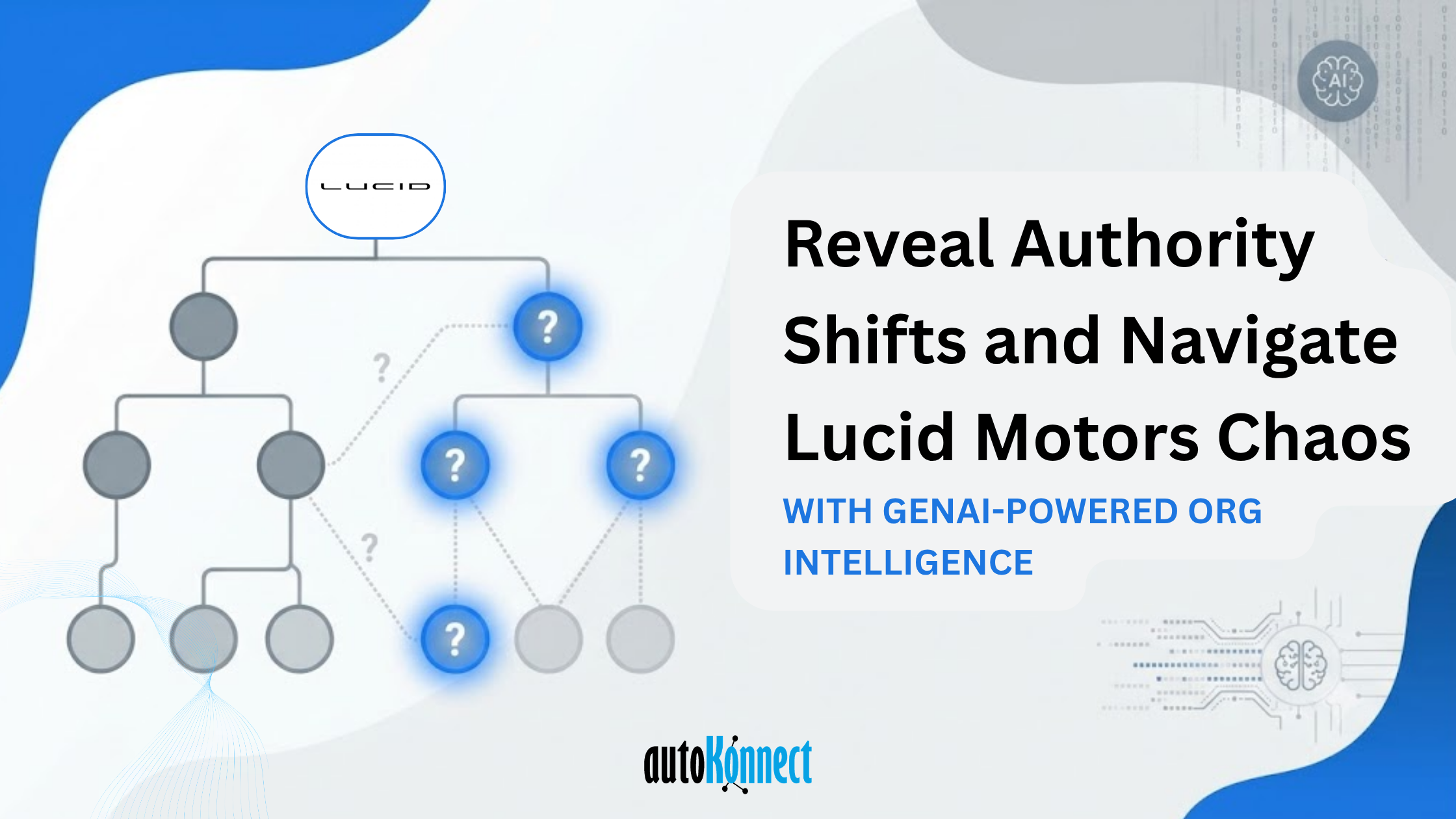
GenAI-driven org intelligence works from a different premise where authority is inferred from signal, instead of assumed from title. It continuously reads primary sources, press releases, SEC filings, executive statements, leadership pages, and cross-references new statements against the last known structure.
When Napoli's own remarks named cost competitiveness and organizational streamlining as priorities, that language becomes a signal in itself, flagging which functions are likely to see budget re-review even before a single reporting line is publicly confirmed. The model maps the new chain of command, Winterhoff to Napoli, and propagates that change outward to every function known to roll up through the COO, updating the dependent structure in one pass rather than waiting for each downstream title to be individually re-verified.
For marketers and sellers, that translates directly into speed and accuracy where it matters most:
- Accounts get re-scored the week a leadership announcement breaks, not the quarter after
- Champions who quietly lose decision authority get flagged before a deal stalls on them
- Outreach gets re-routed to whoever the new structure indicates actually owns the budget
Closing deals faster in this environment is all about working from a chart that updated itself the moment the company did.
Why Are Buyer Expectations Shifting Faster Than Sales Playbooks?
Lucid's transition sits inside a broader shift, premium EV makers moving from growth-at-any-cost narratives toward operational discipline ones. Napoli's stated priorities aren't unique to Lucid; they are the current vocabulary of an EV sector under margin pressure.
That vocabulary shift changes what resonates internally.
A pitch built around innovation velocity, which landed well in a growth-phase era, now competes against an internal mandate for cost discipline.
Sellers need messaging calibrated to whichever phase an account's leadership is actually in, not the phase it was in when the relationship started. Accounts going through visible leadership change carry the highest deal risk and the highest opportunity, depending on whether the seller's read on new priorities is accurate.
How Should Sales Teams Evaluate Lucid Motors Org Chart Before Acting on It?
A few criteria separate useful org intelligence from a static directory:
- Event-triggered updates, not calendar-triggered ones. A quarterly refresh always lags a leadership announcement.
- Reporting-line clarity, not just title confirmation. Who someone reports to often matters more than their title.
- Context on functional consolidation. What changed underneath a returning title matters as much as the title.
- Cross-referencing against primary announcements, not a single secondary source.
Teams that hold to this standard treat the org chart as a living input to GTM motion, separating a targeting strategy that survives a transition quarter from one rebuilt every time a company makes news.
With these operational shifts in mind, a few practical questions tend to surface during evaluation. Let’s address them:
Frequently Asked Questions (FAQs)
Q. How does the June 2026 CEO transition at Lucid Motors change how enterprise software vendors should position their products?
The transition to a CEO with a heavy industrial background shifts corporate focus from pure technical innovation to operational efficiency and cost competitiveness. Software vendors must pivot their value propositions away from open-ended innovation and explicitly focus on cost reduction, supply chain visibility, and resource efficiency.
Q. How should teams respond to a target account's CEO transition?
Treat it as a trigger event. Reassess reporting lines and confirm whether existing champions still hold prior authority.
Q. Who holds the ultimate budget authority for enterprise technologies during a major automotive leadership transition?
While the CIO or CTO evaluates technical compatibility, ultimate budget sign-off during an operational streamlining phase typically requires cross-functional validation from the COO or finance leadership. A dynamic org chart clarifies these joint approval workflows.
Q. How often do automotive organizational structures actually change?
More often than CRM records reflect. A transition like Lucid's can restructure reporting lines within days, even with titles unchanged.
To successfully navigate complex corporate structures, your sales team needs accurate, real-time visual intelligence. To discover how advanced account mapping can help your enterprise team identify the right decision makers and close deals faster, CLICK HERE to explore the latest enterprise solutions from BizKonnect.
CLICK HERE to know more with BizKonnect.