


Many energy asset tech companies reach a point where growth slows, just because their market access is poorly defined. Teams often rely on fragmented contact data, outdated CRM entries, or broad industry lists that fail to reflect how renewable portfolios are actually managed. This is where a structured renewable energy companies email list becomes critical.
Besides finding companies, the real challenge is identifying the right asset owners, operators, and engineering partners, then mapping decision makers who influence technology adoption. Without this clarity, outreach becomes inconsistent, sales cycles lengthen, and expansion into new regions stalls.
This article explains how actionable sales intelligence-driven databases support a more effective GTM strategy for energy asset technology companies, with practical frameworks for building and using high-quality target lists.
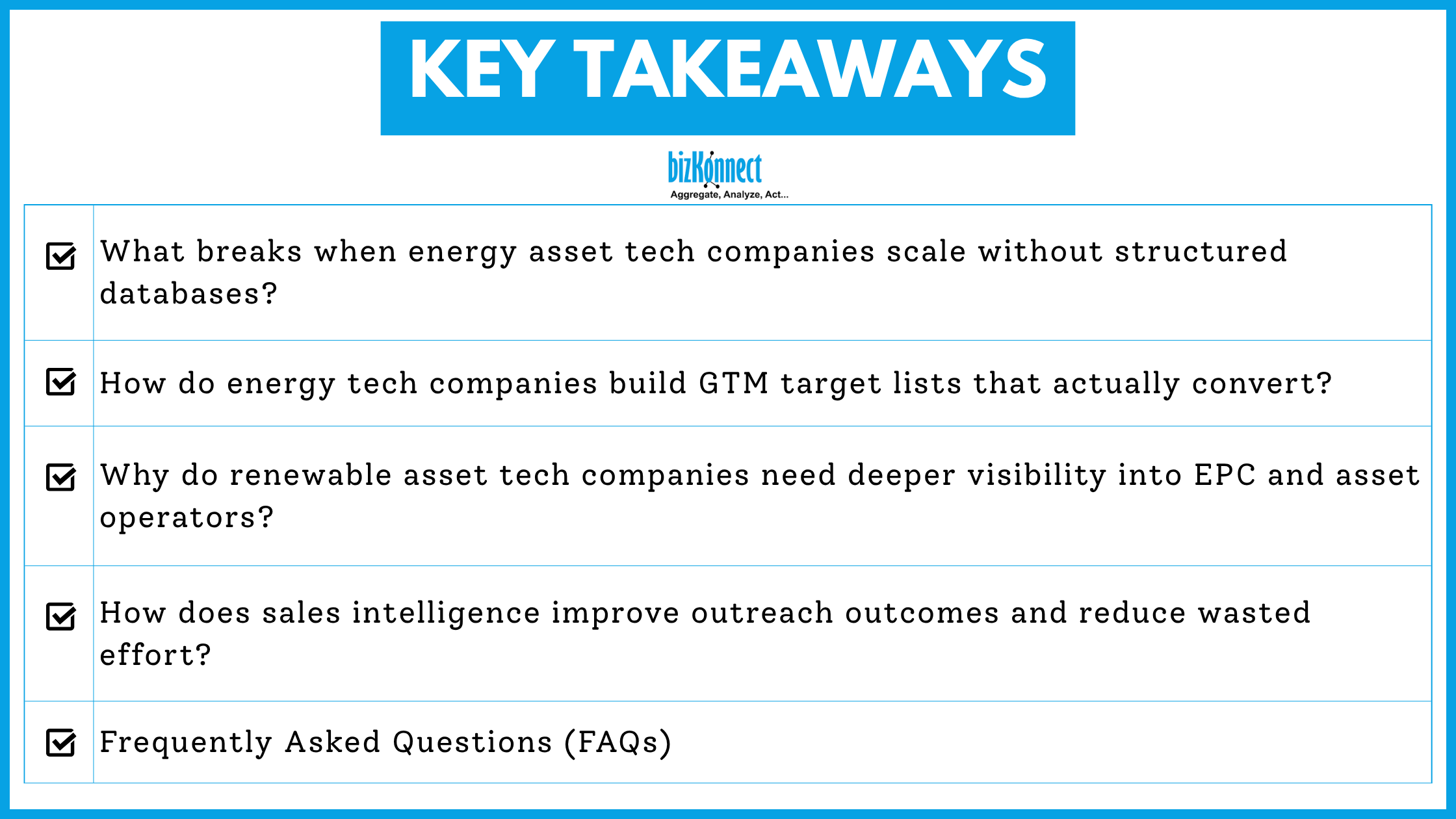
What breaks when energy asset tech companies scale without structured databases?
Growth exposes weaknesses in how target markets are defined. Early-stage outreach may rely on personal networks or a small set of known accounts. But as expansion begins, these informal systems stop working and three common breakdowns occur:
- Misaligned targeting across teams:
Sales, marketing, and partnerships often operate with different definitions of the ideal customer. One team targets EPC firms, another targets asset owners, while a third focuses on utilities. Without a shared database, efforts overlap or miss key segments entirely.
- Incomplete visibility into renewable portfolios:
Renewable markets are asset-driven. A company managing 500 MW of solar capacity has very different needs from one operating distributed rooftop systems. Without structured data on solar, wind, and storage assets, outreach lacks relevance.
- Inefficient pipeline development:
Generic lists result in low response rates. Teams spend time contacting companies that are either too small, not active in target regions, or not currently investing in new technologies.
A structured database addresses these issues by organizing:
- Installed capacity and asset types
- Geographic footprint
- Ownership and operational structure
- Technology adoption stage
This level of detail allows energy asset tech companies to move from broad outreach to precise engagement.
How do energy tech companies build GTM target lists that actually convert?
Building effective target lists requires more than collecting company names. It involves layering multiple dimensions of intelligence to reflect how decisions are made in renewable organizations.
A practical framework includes:
Step 1: Segment by asset ownership and role
Not all renewable energy companies operate the same way. Key segments include:
- Independent power producers (IPPs) managing large portfolios
- Utilities integrating renewable assets into grids
- Renewable energy EPC companies responsible for project execution
- Asset managers overseeing performance and optimization
Each segment has different buying triggers and timelines.
Step 2: Map asset-level data
Leading GTM strategies focus on where assets exist and how they are managed. This includes:
- Solar farms, wind parks, and battery storage sites
- Commissioning dates and lifecycle stages
- Capacity expansion plans
For example, a company expanding its wind portfolio is more likely to evaluate predictive maintenance tools or performance analytics platforms.
Step 3: Identify decision makers across functions
The focus on decision makers in renewable energy companies reflects a key challenge. Buying decisions rarely sit with a single individual. Typical stakeholders include:
- Heads of asset management
- Operations and maintenance leads
- Digital transformation or IT leaders
- Procurement teams
A strong email list connects these roles within the same organization, enabling coordinated outreach.
Step 4: Align lists with GTM motion
Different go-to-market approaches require different data structures:
- Account-based strategies need deep, multi-contact mapping
- Volume outreach requires broader but still segmented lists
- Partner-led expansion depends on EPC and developer networks
Without aligning the database to the GTM model, even accurate data can be underutilized.

Why do renewable asset tech companies need deeper visibility into EPC and asset operators?
Many technology providers focus heavily on asset owners while overlooking the influence of EPC firms and operators. This creates blind spots in market entry.
- EPC companies play a critical role in technology selection: During project development, EPC firms often recommend or integrate technology solutions. Being absent from their ecosystem means missing early-stage opportunities.
- Operators shape long-term technology adoption: Once assets are commissioned, operations teams drive decisions around monitoring, analytics, and optimization tools. These teams prioritize reliability and measurable performance gains.
- Asset managers influence portfolio-wide decisions: In larger organizations, asset management teams standardize tools across multiple projects. Engaging them can unlock multi-site deployments rather than single-project wins.
A well-structured database provider includes EPC involvement in specific projects, operator contracts and responsibilities, and ownership transitions over time. This helps energy asset tech companies understand who owns an asset as well as who influences its technology stack.
How does sales intelligence improve outreach outcomes and reduce wasted effort?
Sales intelligence-driven email lists incorporate ongoing updates and signals that reflect market activity, offering:
- Better timing of outreach
Instead of contacting companies randomly, teams can act on signals such as:
- New project announcements
- Capacity expansions
- Mergers or acquisitions
- Regulatory changes affecting renewable deployment
- Higher relevance in messaging
With detailed data, outreach can reference:
- Specific assets or regions
- Known operational challenges
- Recent investments
This shifts communication from generic introductions to informed conversations.
- Reduced sales cycle friction
When the right stakeholders are identified early, fewer handoffs are required. Conversations start with relevant teams, which shortens evaluation timelines.
- More predictable pipeline building
Structured databases enable:
- Consistent account prioritization
- Clear segmentation for campaigns
- Measurable conversion benchmarks
For example, teams often observe that targeted lists with asset-level data produce significantly higher response rates than broad industry lists.
Now let’s address some frequently asked questions:
Q1. How can teams audit the quality of their renewable energy database?
Review bounce rates, contact accuracy, and completeness of fields such as asset type, capacity, and decision-maker roles. Cross-check a sample of accounts against public project data.
Q2. What are early signs that target lists are misaligned with GTM strategy?
Low conversion rates across campaigns, repeated outreach to irrelevant roles, and inconsistent account selection between teams indicate misalignment.
Q3. When should a company rebuild its database instead of refining it?
If more than 30 to 40 percent of contacts are outdated or key data fields are missing, rebuilding is often more efficient than incremental fixes.
Conclusion:
For energy asset tech companies, growth depends on more than product capability. It requires precise access to the right organizations and stakeholders managing renewable assets. A structured, intelligence-driven renewable energy companies email list provides the foundation for this access.
When databases reflect real asset ownership, operational roles, and market activity, GTM efforts become more focused and effective. Teams spend less time searching for opportunities and more time engaging in relevant, timely conversations.
CLICK HERE to explore how BizKonnect can help you build a verified, role-mapped renewable energy companies email list tailored to your GTM target profile.
CLICK HERE to know more with BizKonnect.