


When marketing to Morgan Stanley, the cost of a misplaced pitch is measured in months of wasted sales cycles.
What if your team spends six months nurturing a senior relationship management executive, only to find that an internal restructuring has quietly shifted the budget and ownership of your product category to a newly created digital infrastructure unit. The legacy account maps your sales team relied on did not signal the shift until your competitor had already secured the master services agreement.
This GTM execution gap is a direct result of relying on static organizational data.
A massive firm like Morgan Stanley is a prime example of visible, ongoing leadership movement. For business-to-business (B2B) marketers and sales teams, managing a financial services GTM strategy requires deeper insight than basic LinkedIn updates can provide.
This guide explores how a GenAI-driven Morgan Stanley org chart solves the core structural challenges of BFSI account mapping, enabling enterprise sales teams to navigate executive-level shifts and reach the right decision-makers at the precise moment of maximum relevance.
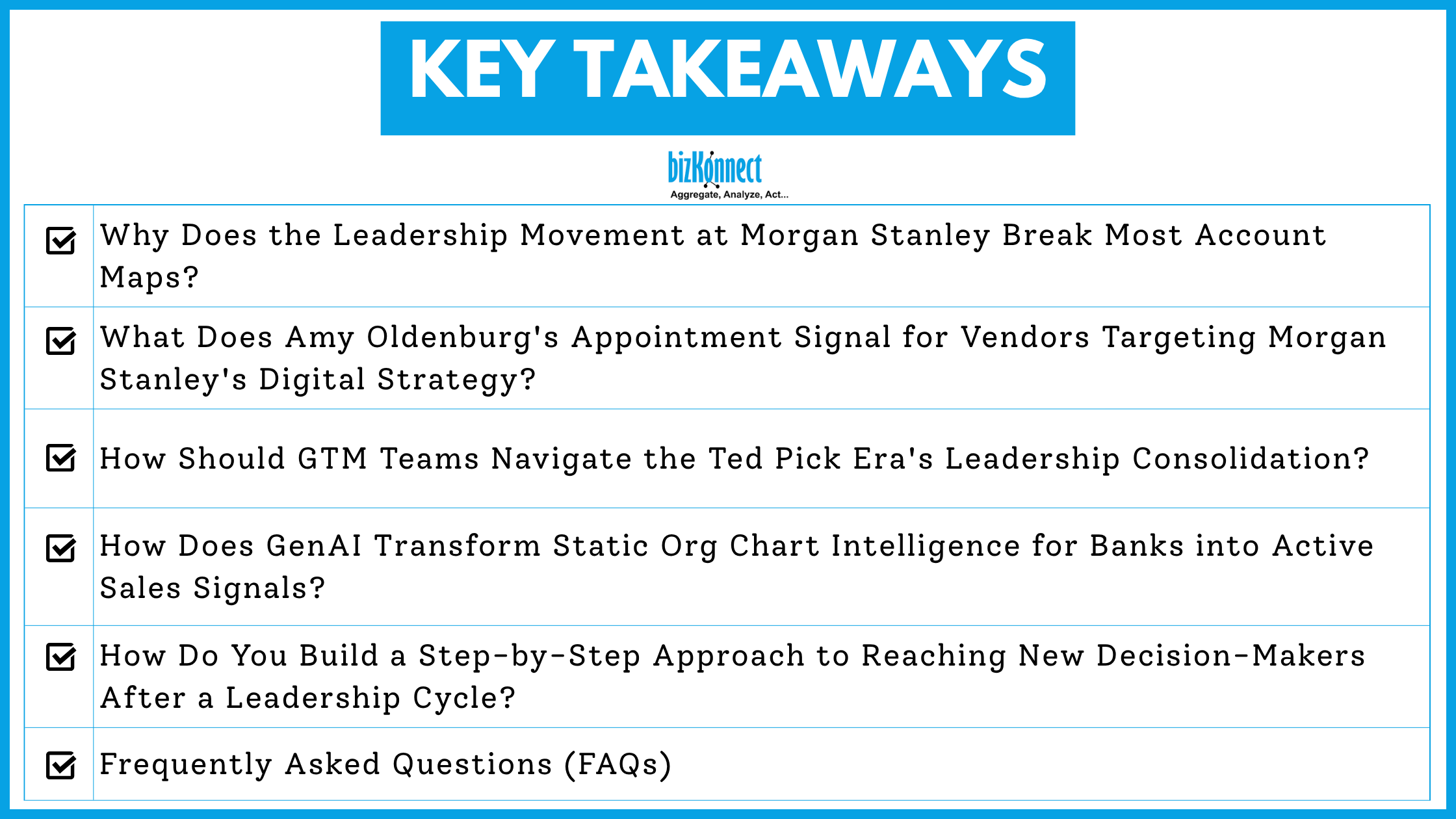
Why Does the Leadership Movement at Morgan Stanley Break Most Account Maps?
The instinct when a large bank announces promotions is to update a CRM field and move on. That approach misses the actual problem: org chart disruption at this scale isn't one event, it's a cascade.
Here's what actually shifted at Morgan Stanley and why each move carries GTM implications:
- Amy Oldenburg appointed Head of Digital Asset Strategy, a newly created, firmwide role announced via internal memo from Co-Presidents Andy Saperstein and Dan Simkowitz. Previously led emerging-markets equity within Morgan Stanley Investment Management. Signals a centralized push into tokenized assets and digital finance infrastructure with cross-unit buying authority.
- 184 new Managing Directors appointed roughly a 6% increase from the prior year's class of 173. Seventy percent work in revenue-generating, client-facing roles; 30% in middle- and back-office or corporate functions. One of the firm's largest annual senior promotion rounds, spanning investment banking, wealth management, trading, operations, and technology.
- Leadership consolidation under Ted Pick's operating model is stronger power concentration among Co-Presidents Andy Saperstein and Dan Simkowitz, CFO Sharon Yeshaya's continued influence over strategic spend, and operating-committee restructuring that pushes final authority upward.
Most account maps break here because they track names and titles, instead of context.
A new Managing Director in wealth management technology has different buying triggers than one elevated in investment banking operations. Static org charts treat both the same. GenAI-driven org chart intelligence reads the signal behind the appointment: who they reported to before, what initiatives they now own, and which spend categories fall within their new remit.
The less obvious problem:
In firms operating across 42 countries and multiple business units, role transitions often create temporary authority gaps. A departing senior leader's vendor relationships don't automatically transfer. If your account map doesn't reflect who currently holds sign-off authority, your outreach reaches the wrong inbox at the wrong stage and often the wrong country.
What Does Amy Oldenburg's Appointment Signal for Vendors Targeting Morgan Stanley's Digital Strategy?
Oldenburg brings over 20 years at the firm. Her new role is a mandate to build something from scratch, firmwide. For vendors in fintech, blockchain infrastructure, tokenization platforms, or compliance technology, this appointment is a trigger event, but only if you read it correctly.
Here's where most financial services GTM strategy gets it wrong.
Teams target the newly appointed leader immediately with generic outreach. What they miss is that a newly created role means the decision architecture around it is also being built. Alongside Oldenburg's appointment, Morgan Stanley is actively hiring for:
- An executive director focused on portfolio enablement and governance
- A vice president role tied to crypto and digital asset advisory compliance
These hiring signals tell you the support structure is being staffed and those incoming leaders are often more accessible and more influential in early vendor evaluation than the senior executive above them.
Oldenburg's role reports through firmwide strategy and execution, coordinated via the co-presidents, which means her decisions carry cross-unit visibility. That matters for vendors whose products need sign-off across investment management, wealth, trading, and compliance simultaneously.
A GenAI-driven org chart surfaces the internal coalition she needs to build: who needs to approve, who will be consulted, and who can accelerate or stall. That's the intelligence that turns a press release into a qualified pipeline entry.
How Should GTM Teams Navigate the Ted Pick Era's Leadership Consolidation?
The leadership shifts at Morgan Stanley aren't isolated appointments. They reflect a deliberate organizational model.
Ted Pick, as Chairman and CEO, has concentrated decision-making through a tight operating-committee structure, with Co-Presidents Andy Saperstein and Dan Simkowitz holding substantial authority over cross-functional initiatives, and CFO Sharon Yeshaya maintaining visibility into strategic spend.
For vendors in financial services, the implication is structural:
Reaching a Managing Director without understanding whether their initiative has co-president sponsorship means engaging a stakeholder without the authority to close.
This is where static BFSI account mapping consistently fails as it builds stakeholder lists without mapping the actual approval pathway.
What this means practically for GTM teams:
- A deal that needs cross-unit support: say, a data platform that touches wealth and trading, requires awareness at the co-president level before it can progress
- A newly appointed MD may champion your product but lack the internal capital to push it through without upward sponsorship
- Operating committee restructuring means the person you mapped as a decision-maker 18 months ago may now be two approvals away from the actual authority
GenAI-driven org chart intelligence maps those upward dependencies, not just the org chart as it appears on paper, but the real approval chain based on role scope, budget category, and initiative type.
How Does GenAI Transform Static Org Chart Intelligence for Banks into Active Sales Signals?
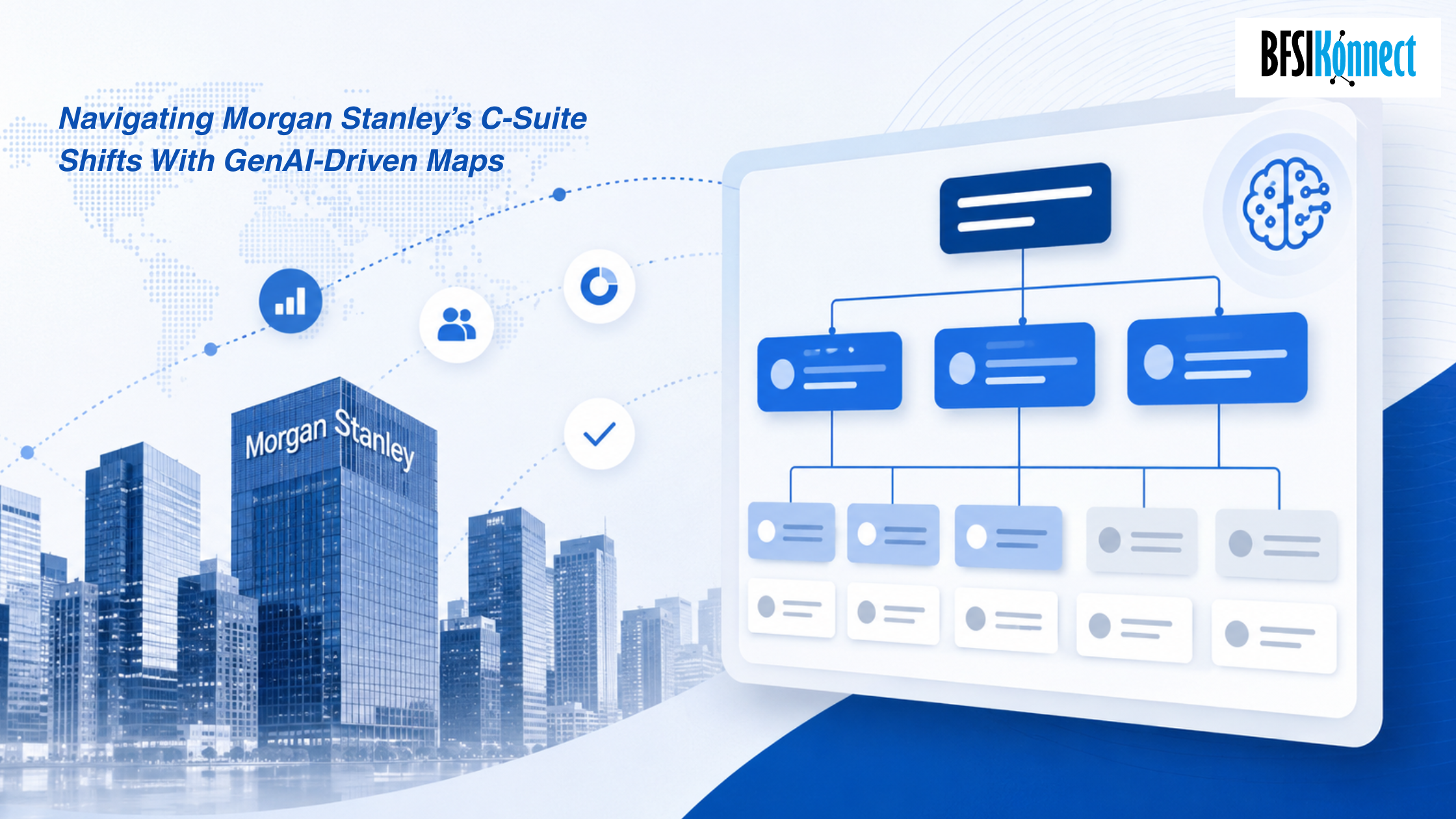
Traditional org charts are lagging indicators as they only tell you who held a position last quarter. GenAI-driven org chart intelligence for banks transforms this static visualization into a predictive, real-time data engine.
Instead of manually scraping executive bios, Generative AI models ingest thousands of unstructured data streams such as press releases, board governance updates, financial filings, earnings call transcripts, and executive shifts to map out the true hierarchy of power.
It delivers actionable reframings for marketing teams by:
- Reporting Line Velocity: It maps how rapidly a specific division (like wealth management or digital strategy) is expanding its headcount relative to other units, signaling where capital expenditure is concentrated.
- Contextual Power Mapping: It goes beyond lines on a chart to correlate executive promotions with institutional mandates, allowing you to see exactly which co-president or operating committee member controls the ultimate sign-off for a new technology vendor.
- Relationship Continuity Tracking: When an executive moves from a traditional equity role to a digital asset strategy role, GenAI connects their historical vendor preferences and past internal initiatives to predict how they will shape their new department's tech stack.
How Do You Build a Step-by-Step Approach to Reaching New Decision-Makers After a Leadership Cycle?
To successfully engage newly promoted or transitioned executives within Morgan Stanley, sales and marketing teams must abandon cold, generic outreach. This practical resolution path outlines how to utilize dynamic BFSI sales intelligence platform insights to build high-converting pipelines.
Step 1: Identify the trigger type
Not all leadership movements carry the same GTM signal. A promotion creates a relationship gap, a newly created role signals a new budget or initiative, and a lateral move often means the successor to the prior role is still being determined. Each requires a different entry approach and a different timeline.
Step 2: Map the authority change, not just the title change
Who previously held the decisions this person now owns? If it was a more senior executive, you've gained a more accessible point of contact. If it's a newly centralized function like Oldenburg's, you need to understand whether the authority is real or still being negotiated internally.
Step 3: Identify the support structure being built around them
New senior roles rarely act alone. The team being hired around a new leader is often your better initial point of contact with fresh eyes, no incumbent vendor loyalty, and active evaluation happening in real time.
Step 4: Align your outreach to their mandate, not your product
A new Head of Digital Asset Strategy needs to demonstrate strategic value to co-presidents quickly. Your outreach should speak to her current priority: coordination, infrastructure, and partnerships.
Step 5: Use org chart intelligence to track downstream decisions
As the team fills out, new stakeholders acquire budget influence. A live, GenAI-driven org chart updates those signals so your engagement strategy evolves in step with the account's structure.
Step 6: Time re-engagement at the 60-to-90-day mark
New leaders typically enter their first real vendor evaluation cycle around 60 to 90 days into a role. That's when initial priorities have been set, the team around them has taken shape, and the organizational map becomes legible enough to act on.
Navigating leadership transitions at institutions like Morgan Stanley requires more than updated contact lists. It requires real-time intelligence on who holds authority, who is building influence, and when the window to engage is open.
Let’s Address a Few Frequently Asked Questions (FAQs)
Q1. What makes a newly created role like Amy Oldenburg's different from a standard promotion for GTM purposes?
A newly created role has no incumbent, no established vendor relationships, and no pre-set evaluation criteria. It's a clean slate and a high-velocity opportunity if you reach the right supporting stakeholders before preferences are set.
Q2. How do you identify which new Managing Directors are relevant to your product category?
By mapping their prior role, their current reporting line, and the functional area of their promotion. An MD elevated from wealth management operations technology has different relevance to a data infrastructure vendor than one promoted from M&A advisory.
Q3. What signals should trigger an account re-map at a firm like Morgan Stanley?
Any of the following: a co-president memo announcing a new role, a senior appointment outside the normal promotion cycle, a firmwide strategy announcement, a newly created function, or a hiring pattern indicating a new initiative is being staffed.
To streamline your institutional sales cycles and gain access to continuously updated, highly accurate organizational insights for major global financial institutions, CLICK HERE to explore how BizKonnect can transform your enterprise prospecting strategy.