


AI adoption in sales is accelerating but most teams are struggling with something they didn't expect: the tools are live, the models are trained, and yet pipeline quality hasn't improved and forecasts still feel like guesswork.
The problem is actually what’s feeding AI.
Actionable sales intelligence which is specific, current, and decision-ready is what separates AI deployments that generate results from those that generate reports nobody uses. Without it, even the best sales intelligence platform becomes a pattern-matching engine working on stale data.
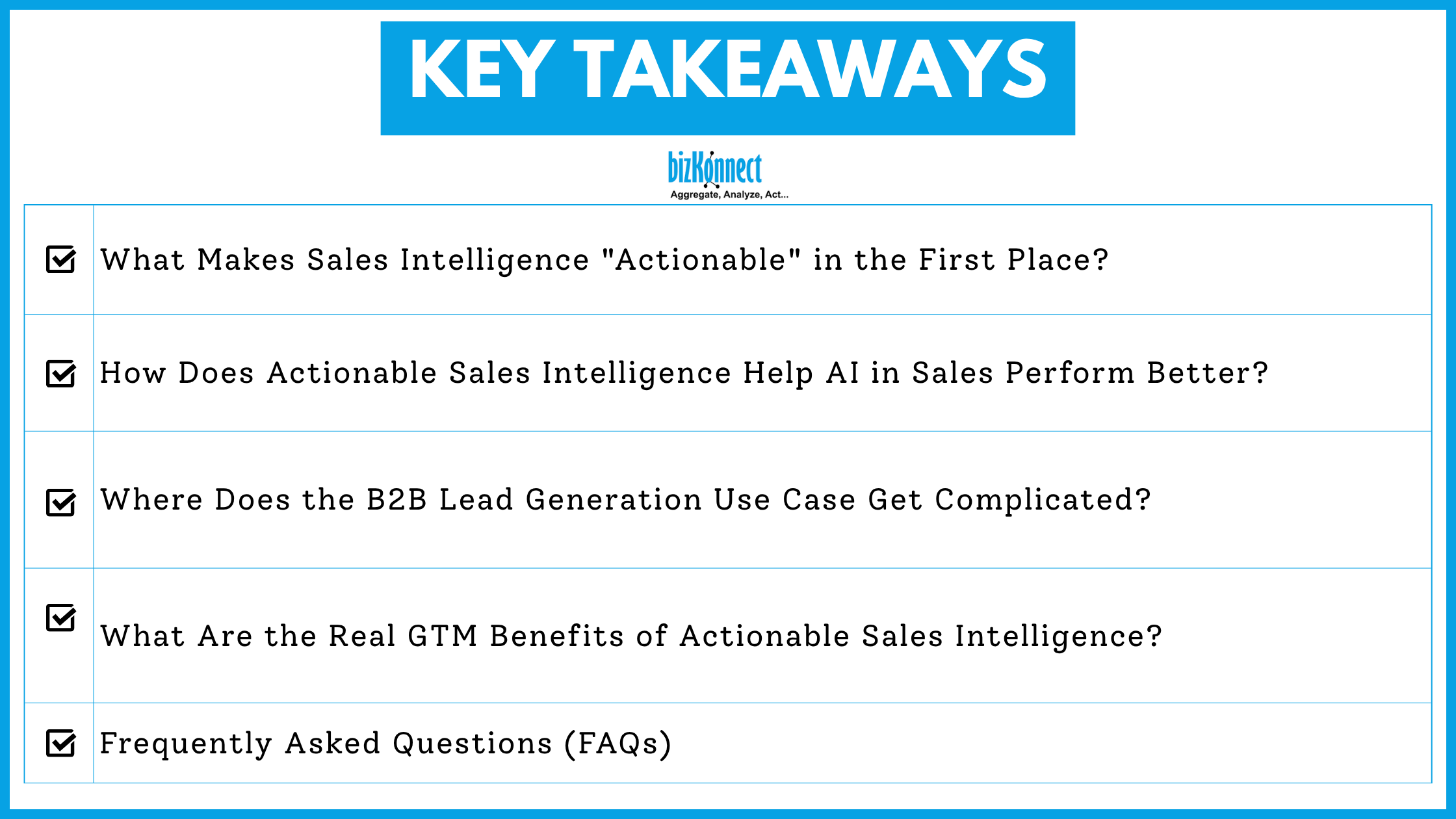
What Makes Sales Intelligence "Actionable" in the First Place?
Most sales teams have access to data such as company size, industry, revenue range, and technology stack. The problem is that descriptive data doesn't tell a rep what to do next. It describes a company but it doesn't explain why they'd buy now.
Actionable sales intelligence captures change: leadership transitions, hiring patterns, product launches, and expansion moves. These are the triggers that turn a dormant account into an active opportunity.
The distinction matters because AI in sales runs on pattern recognition. Feed it static firmographic profiles and it scores accounts that look like past customers. Feed it trigger-based intelligence and it identifies accounts that are behaving like buyers.
One common misconception: more data equals better intelligence. But, overcrowded data environments introduce noise that degrades model accuracy and overwhelms reps. Input quality determines how well AI performs.
How Does Actionable Sales Intelligence Help AI in Sales Perform Better?
AI tools in sales share one dependency: structured, relevant, timely signals. When those signals are weak, AI defaults to surface-level correlations. A scoring model trained on incomplete data ranks accounts by website traffic rather than purchase intent. A personalization engine without context produces emails that are customized in format but generic in substance.
Actionable sales intelligence gives AI the context it needs to move from pattern-matching to genuine inference:
- Lead prioritization: Trigger-based signals such as hiring sprees, new executive mandates, and recent funding give scoring models real behavioral inputs rather than proxy metrics.
- Outreach timing: Intelligence tied to buyer events lets AI recommend who and when to reach out.
- Forecasting accuracy: Models built on engagement data plus external signals reflect buyer momentum.
Many teams connect a sales intelligence platform to their CRM and assume the AI will figure out what's relevant. It won't. Intelligence must be curated for decision-relevance, rather than just completeness.

Where Does the B2B Lead Generation Use Case Get Complicated?
Actionable sales intelligence for B2B lead generation is about identifying who fits your ICP as well as surfacing which ICP-fit accounts are in a moment of genuine receptivity, and that's where most approaches break down.
The standard approach: filter by industry, size, tech stack, and hand the list to a rep produces leads that are demographically correct but behaviorally cold.
Teams conclude their ICP is wrong but the real issue is timing.
Intelligence-driven prospecting asks a different question: not "who looks like our best customer?" but "who is in a situation that resembles when our best customers decided to buy?" That requires trigger-based data such as companies expanding into new markets, accounts that recently lost a key decision-maker, and organizations under margin pressure.
These signals are harder to surface than firmographic filters, which is exactly why teams that do it well gain a durable advantage. AI accelerates this significantly, but only when the underlying intelligence is current.
What Are the Real GTM Benefits of Actionable Sales Intelligence?
Most teams calculate the value of sales intelligence too narrowly, measuring lead volume or response rates and missing the structural impact. The real gains from sales intelligence for strategic decisions look like this:
- Shorter sales cycles: Reps with timely context spend less time establishing credibility.
- Better resource allocation: When intelligence surfaces which accounts are in-market, teams distribute effort more precisely. High-effort outbound stops going to accounts that aren't ready.
- Improved AI model performance: When reps log outcomes against actions grounded in real intelligence, the model learns from accurate signals.
- Reduced rep burnout: Reps working from noisy lists spend disproportionate time on dead ends. Better intelligence shifts effort toward accounts where something is actually happening.
Now Let’s Address Some Frequently Asked Questions (FAQs)
Q1. What is the difference between sales data and actionable sales intelligence?
Sales data describes static attributes. Actionable intelligence captures what's changing which includes triggers that indicate a buyer is entering a decision moment.
Q2. Can AI in sales work without actionable sales intelligence?
It can function, but not well. AI trained on generic data scores leads that look right on paper but aren't actually in a buying moment.
Q3. What signals matter most for AI-assisted lead scoring?
Organizational signals outperform firmographics: leadership changes, headcount growth in specific functions, geographic expansion, and budget-adjacent events like funding or restructuring.
Q4. Does actionable sales intelligence improve ROI on AI tools?
Yes. AI accuracy is a direct function of signal quality. Teams that upgrade their intelligence layer first consistently see better outcomes than those who assume AI will compensate for data gaps.
Looking to close the gap between AI investment and real sales outcomes? CLICK HERE to explore how BizKonnect helps sales teams turn intelligence into execution.