


Most B2B marketers entering the semiconductor space prepare a solid ICP, build a target account list, and launch campaigns. Then the pipeline stalls, not because the targeting was wrong, but because the deal was already moving through a committee no one had mapped.
- A process engineer evaluated the specs.
- A fab ops lead flagged operational compatibility.
- Procurement reviewed vendor risk.
- The marketer's message reached exactly one of them.
…this is the core execution gap in semiconductor go-to-market:
The buying committee is multi-layered, role-specific, and largely invisible without structured account intelligence.
This guide breaks down how the semiconductor buying committee actually functions, why standard outreach falls short, and how semiconductor account maps backed by GenAI give marketers the visibility to engage the right stakeholders at the right stage.
Who Actually Sits on a Semiconductor Buying Committee?
The instinct in most B2B marketing is to find the economic buyer and build toward them. In semiconductor deals, that logic misses at least half the room.
A single purchasing decision involves process engineers evaluating yield data, procurement directors assessing supply chain resilience, and CTOs weighing roadmap alignment. Each function enters at a different stage, applies a different filter, and can stall a deal without being the formal decision-maker.
Each role is not just differently ranked, they are differently motivated.
The process engineer wants technical depth. The fab operations lead is thinking about integration risk. Procurement is pricing the total supplier relationship, not just the product. A message built for one rarely lands with the others.
Besides, the stakeholder who kills semiconductor deals most often isn't the economic buyer who rejects. It's the mid-level technical evaluator who quietly deprioritizes your solution because the content they received wasn't built for their criteria.
Why Does Standard B2B Outreach Break Down in Semiconductor Sales?
Qualifying a new supplier takes 12 to 24 months. That timeline makes standard demand-gen metrics like MQLs and pipeline velocity nearly meaningless. A campaign flat at 90 days may be actively building preference at month 14.
But the timeline isn't the only gap.
66% of semiconductor manufacturers report their own content doesn't prompt action. Most reads like a spec sheet delivered to the wrong person. Content built for a CTO doesn't work for a process engineer evaluating yield compatibility.
There's also a research behavior issue. B2B buyers in semiconductors complete 57% of their buying journey before contacting sales. By the time a prospect engages, they've already shortlisted based on content they found or didn't from your brand. Marketers not reaching the full committee during that self-directed phase simply aren't on the shortlist.
How Do Semiconductor Industry GenAI-driven Account Maps for B2B Sales Change the Execution?
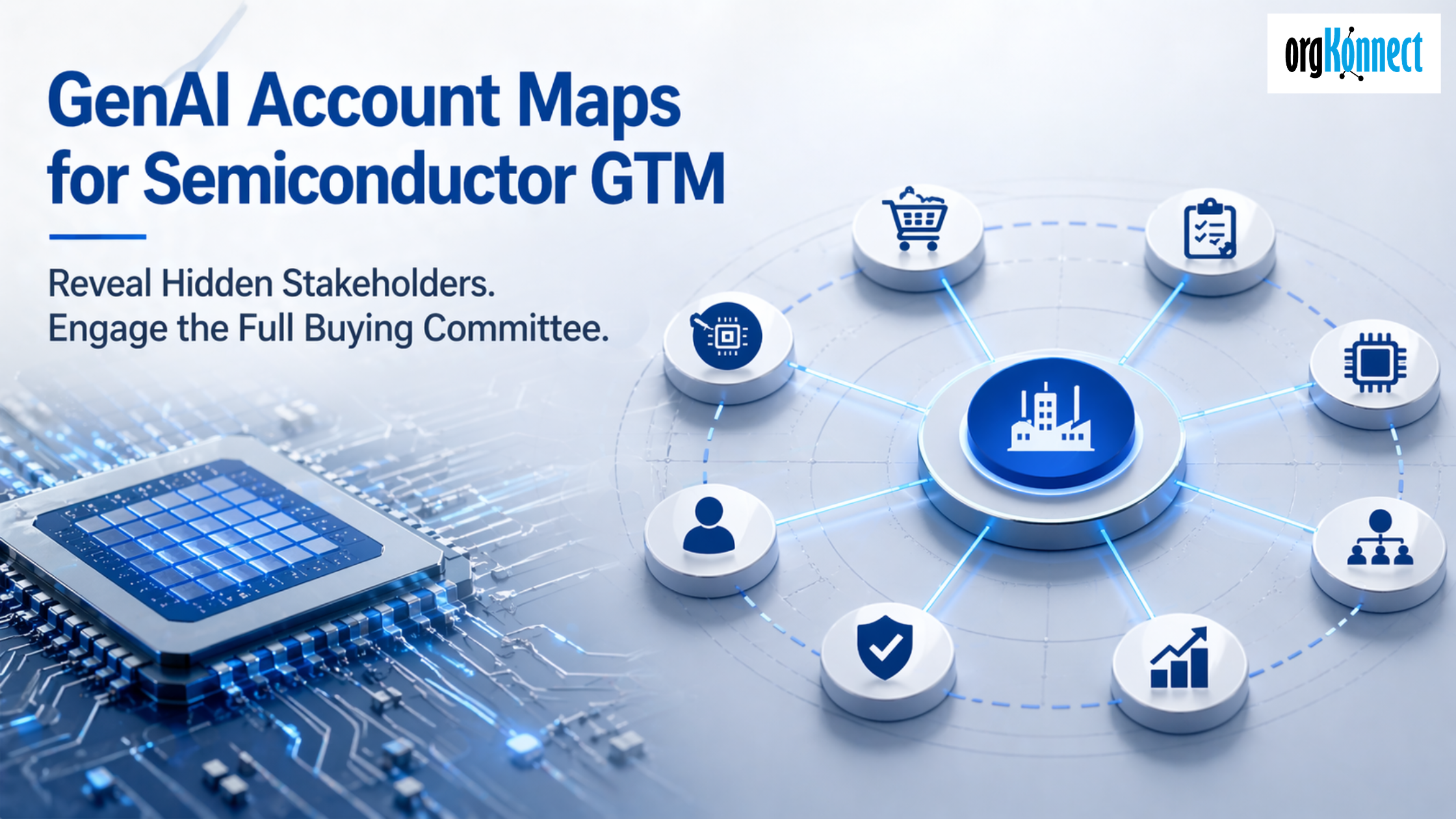
Semiconductor account maps backed by GenAI show the actual human structure inside a target account. Persona frameworks describe who to target and GenAI account maps show who is actually there and how they connect.
A well-built, dynamic B2B account map for semiconductor accounts identifies:
- Which roles are active in the current evaluation phase
- Influence paths across engineering, fab ops, and procurement
- Contacts who've gone quiet and what that signals about deal stage
- Coverage gaps: stakeholders with influence who've received no relevant outreach
The practical shift is moving from account-level targeting to stakeholder-level orchestration. A mapped account powered by GenAI lets marketing deliver role-specific content in sequence, tied to where each person sits in the decision process.
For ABM targeting data, this is the difference between knowing an account is in-market and knowing which committee members are actively evaluating. ABM without intelligent account mapping is expensive segmentation. With it, the same budget reaches the people who actually advance the deal.
GenAI account maps work best as a shared intelligence layer where marketing aligns content to stakeholder role and stage, while sales prioritizes outreach and avoids channel conflict.
When both teams work from the same map, the buying committee becomes a navigation system.
What Signals Tell You the Account Map Is Incomplete or Outdated?
Semiconductor buying committees shift constantly. A fab expansion triggers new procurement stakeholders, a design cycle introduces new process engineers, and leadership changes in operations can reshuffle influence entirely.
Signals your semiconductor account maps need refreshing:
- Engagement drops from contacts who were previously responsive
- New names surface in deal conversations that weren't in your CRM
- Content is being forwarded internally, meaning there are readers you haven't mapped
The CHIPS Act, European Chips Act, and regional programs in Japan and South Korea are creating new fabs and entirely new buyer relationships. For marketers, this means accounts with buying committees that have no prior relationship history.
Getting semiconductor industry contacts for sales right in greenfield accounts depends on current, structured account intelligence.
Addressing a Few Frequently Asked Questions (FAQs)
Q1. What makes semiconductor buying committees harder to map than other B2B industries?
Long evaluation cycles, technical gatekeepers across multiple functions, and role-specific criteria create more active stakeholders with more divergent needs.
Q2. How many stakeholders should a typical semiconductor account map include?
Enterprise deals routinely involve five to eight active decision influencers across engineering, fab operations, procurement, and executive oversight. Missing even one technical evaluator can stall a deal.
Q3. When in the sales cycle should account mapping begin?
Before outreach starts. Building a map after nurture emails have gone out means you've already missed the early touchpoints that shape vendor shortlists.
Q4. How does account mapping strengthen ABM targeting data in semiconductors?
It gives ABM the stakeholder-level precision it needs. Without role-level mapping, ABM defaults to account-level blasting within the right company but wrong people.
Navigating a semiconductor buying committee without a clear GenAI-driven account map means running campaigns with half the contacts missing. The deal is happening and you're just not in all the rooms where it's being decided.
If you want role-level visibility into your target semiconductor accounts, CLICK HERE to explore how BizKonnect can help you map the full buying committee and activate your pipeline.
CLICK HERE to know more with BizKonnect.