


The traditional "spray and pray" model of fintech sales is now taking a back step. In times where Tier-1 banks and NBFCs are shifting from broad digital transformation to "Governed Intelligence," the decision-making unit has fundamentally scattered.
You aren't just selling to a CTO anymore, instead you are selling to a complex web of leaders in data sovereignty, AI ethics, and cloud orchestration.
Here, the primary failure point for most vendors is an architectural misunderstanding of the organizational structure of targeted BFSI accounts. Without a verified, GenAI-driven BFSI industry org chart of this new leadership tier, sales teams waste months chasing ghost stakeholders while their competitors secure direct access to the actual budget holders.
This guide breaks down how GenAI-driven sales intelligence is rewriting the rules of engagement for financial services.
What Is the Organizational Structure of a Bank in the Age of AI?
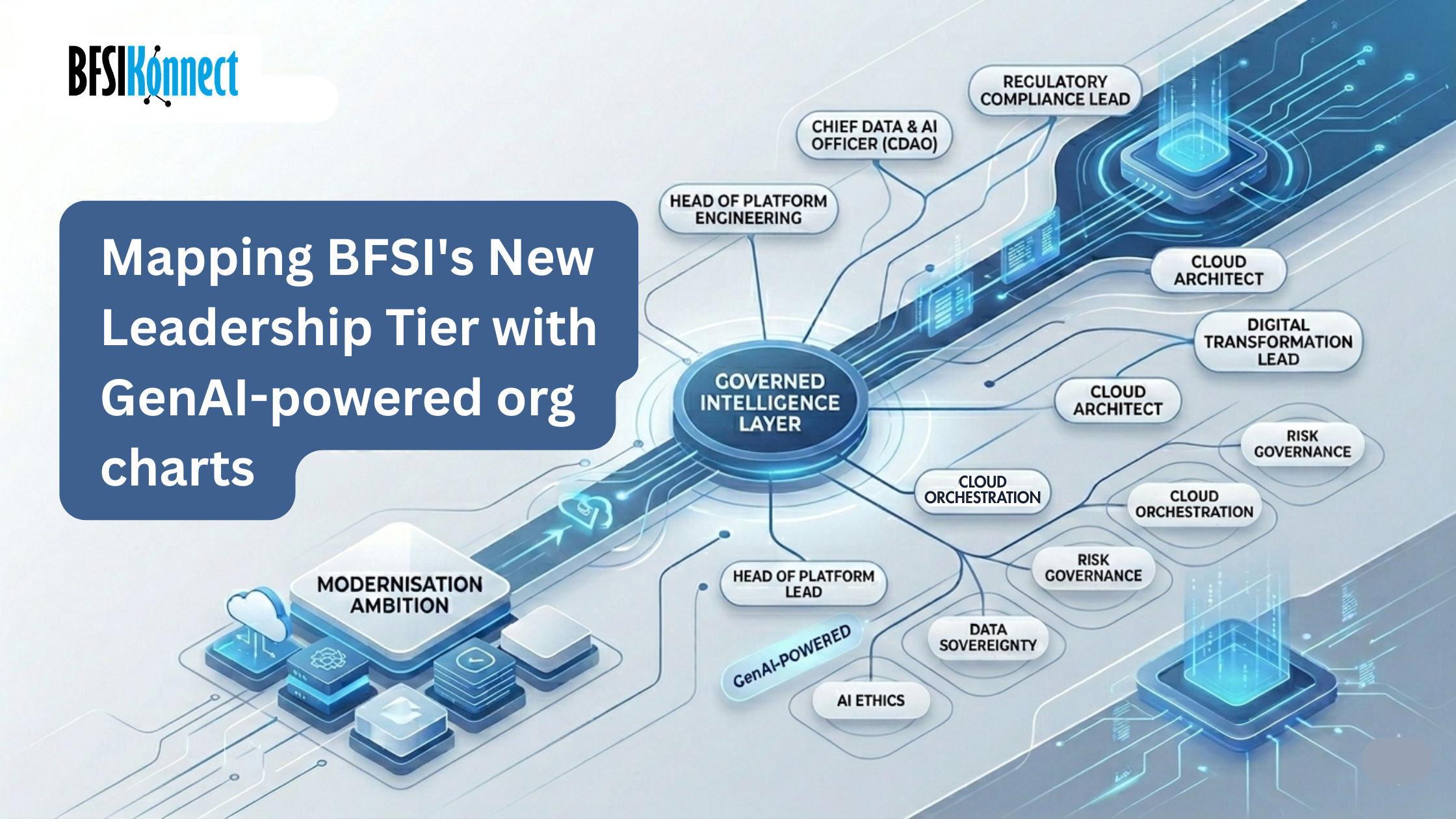
The legacy hierarchy of "Retail" vs. "Corporate" banking has been superseded by a functional layer dedicated to data fluidity and algorithmic governance. Understanding the organizational structure of a bank today requires looking past traditional titles to identify the "New Power Trio":
- The Chief Data & AI Officer (CDAO): Unlike the old Data Head, the CDAO now owns the "Governed Intelligence" mandate. They care about data lineage and how your fintech solution plugs into their existing LLM ops.
- The Head of Platform Engineering: In modern BFSI org charts, this role bridges the gap between the CIO and the DevOps teams as they are the gatekeepers of integration.
- The Digital Transformation Lead (Line of Business): These are the individuals at NBFCs or insurance companies who own the P&L for specific digital products.
When analyzing bank org charts, vendors must realize that the ambition (the vision) is often held by the CEO, but the governance (the reality) is managed by this middle-tier leadership.
Leading sales teams use dynamic BFSI org charts to identify these sub-departments such as "Cloud Security & Compliance" or "Customer Experience Orchestration" to ensure their pitch aligns with the specific technical debt that leader is currently solving.
Why Are GenAI Org Charts Important in the BFSI Industry for Sales and Marketing Alignment?
The friction between marketing and sales usually stems from a lack of account-based clarity. Marketing generates leads based on broad personas, while sales needs a specific "who’s who" to navigate a 12-month procurement cycle. BFSI industry org charts for sales and marketing alignment serve as a single source of truth that synchronizes these two functions.
Using actionable org charts for financial institutions allows teams to move from generic outreach to "Trigger-Based Engagement." For example, if an insurance company appoints a new "Head of Cloud Migration," that is a clear signal of an impending infrastructure overhaul.
Here’s the Framework for Alignment:
- Unified Account Mapping: Both teams agree on the top high-intent accounts.
- Persona Verification: Mapping the specific insurance company org chart to see if they have a decentralized or centralized procurement model.
- Content Personalization: Marketing creates content for the "Compliance Officer," while Sales uses the org chart to find the specific person in charge of "Regulatory Reporting."
By using BFSI org charts for B2B lead generation, companies can stop measuring success by "open rates" and start measuring it by "stakeholder penetration." It is the difference between emailing a generic inbox and having a multi-threaded conversation with the three people who actually sign the contract.
How Do Org Charts Drive BFSI Sales Intelligence and Shorten Deal Cycles?
The complexity of a financial institution's hierarchy is a feature which is designed to mitigate risk. However, for a vendor, this complexity creates deal lag. The difference between bank, financial, and insurance org charts often dictates the speed of the sale:
Bank org charts tend to be hierarchical and compartmentalised. Digital and technology decisions involve multiple verticals such as retail banking, corporate banking, and treasury, each with their own tech procurement preferences. A vendor targeting loan origination automation may need to engage separately with retail banking ops, the digital team, and risk. The buying process is long, and entry point matters.
NBFC org charts are flatter and faster-moving. Decision-making is more centralised, often sitting with a Head of Technology or a Chief Product Officer who has broader authority than an equivalent role at a traditional bank. Vendors who can identify and reach this single decision-maker shorten their sales cycle considerably.
Insurance company org charts introduce a unique complexity: distribution and claims operate as near-independent entities with separate technology roadmaps. A platform that serves claims automation and a platform that serves agent distribution may be evaluated by entirely different teams, under different budget cycles.
How to use BFSI org charts to combat this lag involves identifying the "Economic Buyer" versus the "Technical Champion." In a bank, the Technical Champion might be the Head of APIs, but the Economic Buyer is the Head of Digital Banking. A GenAI-driven org chart shows names as well as reporting lines and influence paths.
When you understand the insurance company org chart, you can see if the "Innovation Lab" has a direct line to the CEO or if it’s buried under IT. This insight tells you whether to pitch a "Visionary Partnership" or a "Transactional Utility."
This level of sales intelligence for BFSI companies ensures that your first touchpoint is already verified by the logic of their internal structure.
How to Leverage GenAI to Navigate the "Governed Intelligence" Tier?
The "Governed Intelligence" tier is characterized by leaders who are tasked with making AI safe, compliant, and profitable. To reach them, traditional lead lists are insufficient because these roles are evolving too fast for static databases. This is where GenAI-driven BFSI org charts change the game.
GenAI scans data points such as LinkedIn moves, annual reports, press releases, and job postings to reconstruct an insurance company org chart or a bank’s hierarchy continuously. It identifies "Decision-Maker Clusters."
So, here’s the verified access checklist:
- Role Evolution Tracking: Does the "Head of Digital" now have "AI" in their title?
- Departmental Spend Signals: Has the "Data Governance" team expanded by 20% in the last quarter?
- Cross-Functional Links: Who does the Chief Information Security Officer (CISO) report to in this specific bank?
Using GenAI-driven actionable org charts for financial institutions allows you to skip the gatekeepers. Instead of a cold email to a generic VP, you are reaching out to the "Lead Architect for Sovereign Cloud" with a message that acknowledges their specific reporting structure and current project load. This is called precision engineering of the sales process.
Let’s Address Some Frequently Asked Questions (FAQs)
Q1. How can I audit the accuracy of BFSI org charts?
Cross-reference multiple data sources and verify roles against recent press releases, annual reports, and regulatory filings. GenAI platforms often offer confidence scores for each entry.
Q2. What are the early warning signs that our sales team is chasing the wrong stakeholders?
If your emails are being forwarded more than three times internally, or if your "Champion" cannot explain the budget approval process, you are likely missing the "Governed Intelligence" tier. You need to re-map the BFSI industry org chart for that account.
Q3. When should an organization rebuild its BFSI contact database?
Significant mergers, leadership shifts, or strategic transformation programs are key triggers for a comprehensive rebuild.
CLICK HERE to access verified, actionable insights into the BFSI leadership tier with BizKonnect, ensuring every engagement reaches the right decision-maker before a single cold email is wasted.