


Entering the Japanese enterprise market is often seen as a significant challenge as it is a land of meticulous decision-making and slow sales cycles. The traditional approach of high-volume lead generation simply fails to penetrate the complex layers of corporate trust and consensus.
As the final weeks of 2025 tick away, global Software-as-a-Service (SaaS) providers are racing to finalize their strategies and budgets before Japan’s critical 2026 Q1 begins. And the key to exploring this complex market lies in leveraging tailored Account-Based Selling (ABS) with GenAI-driven org charts for an effective ABM strategy in Japan.
It allows your sales and marketing teams to navigate the unique landscape of Japanese B2B trust-building with unprecedented accuracy.
Why is account-based selling important in Japan for SaaS?
The Japan SaaS buyer behavior 2026 is characterized by a few non-negotiable elements:
- Slower sales cycles
- More decision-making committees
- Higher proof requirements.
Japanese enterprises, especially the major conglomerates (Keiretsu), prioritize risk mitigation and vendor reliability. They are not looking for the newest feature set; they seek a stable, committed, long-term partner.
ABS addresses this psychology directly by shifting from a volume-based approach to a highly targeted, relationship-first approach. It demonstrates the diligence and respect that Japanese buyers expect. Besides, it's the difference between sending a generic pitch to an individual and executing a coordinated, multi-stakeholder engagement plan tailored to the account’s structure and needs.
This is the only reliable step-by-step ABM strategy for selling SaaS in Japan.
How can you pinpoint the right Japanese accounts amid complex structures?
Targeting in Japan goes far beyond industry and employee size. You need to identify key attributes like Keiretsu affiliations, whether purchasing authority resides in the headquarters or subsidiaries, and alignment with their fiscal year timeline. This is where advanced intelligence becomes invaluable.
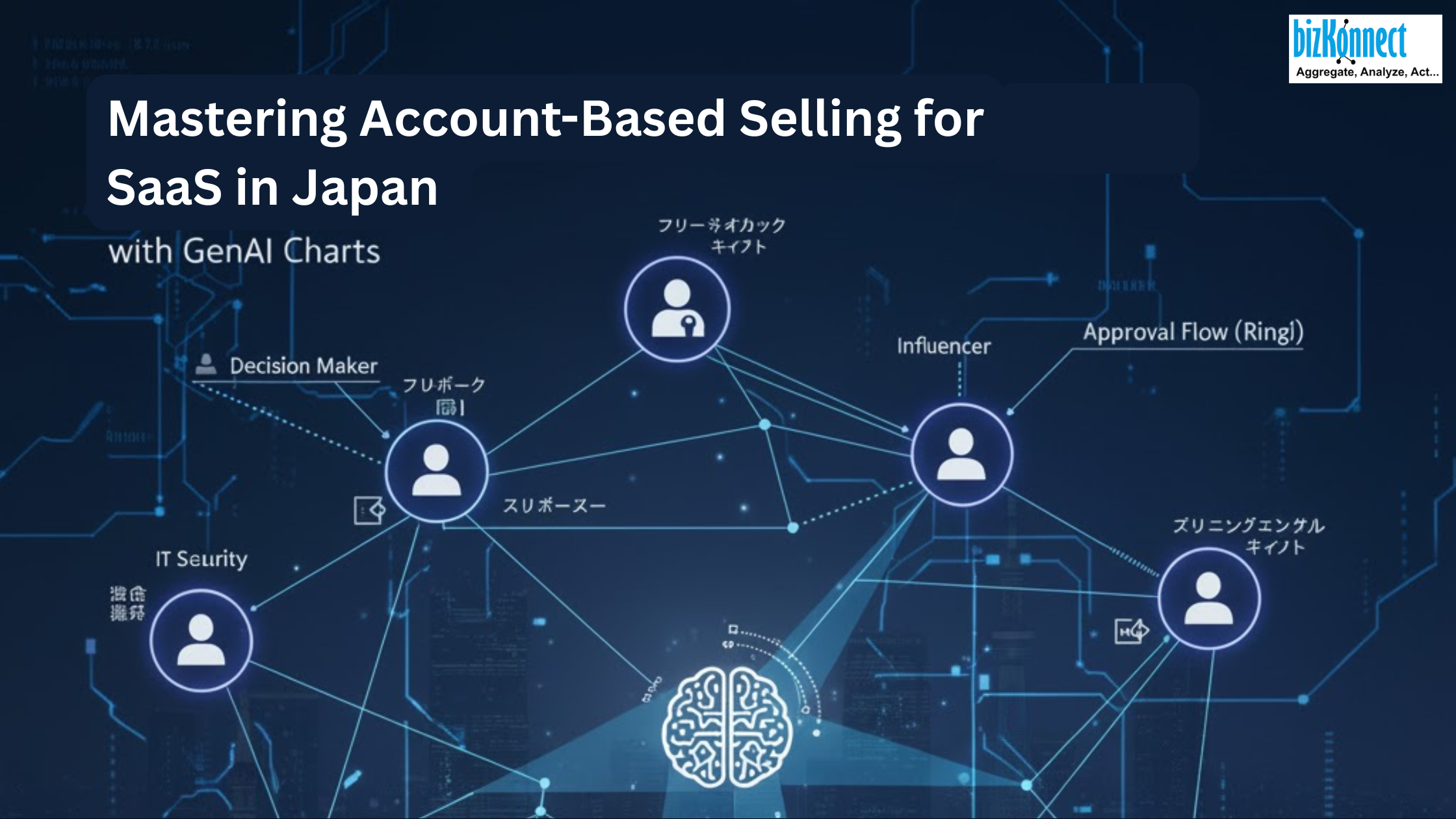
Dynamic GenAI-driven org charts serve as an integrated strategic map because they offer a contextualized view of the account:
- Decision Makers and Influencers: Clearly identifying who holds the veto power and who drives the internal consensus.
- Pain Point Indicators: Mapping individuals or business units that have recently expressed a need or concern relevant to your solution (e.g., a recent investment or a speech on digital transformation).
- Connection Mapping: Highlighting existing connections your sales, marketing, or management team may have within the target account, providing the fastest sales track.
This level of detail enables your team to craft executive-ready messaging that resonates immediately, cutting through the noise that generic outreach creates.
But, what is the true bottleneck in SaaS sales in Japan and how can you solve it?
The core angle for success is understanding that the #1 bottleneck in Japan SaaS sales is proof, not features. While the West often buys based on future promise, Japanese enterprises buy based on validated history and zero-risk compliance. They need evidence to navigate their internal approval system, known as Ringi.
To solve this, you need to provide a complete "evidence package" that includes:
- Japan-Ready Proof of Concepts (POCs): A meticulously planned and locally supported pilot with clear criteria, timelines, and measurable success metrics that directly de-risks the investment.
- Compliance Evidence: Localized security and compliance FAQs that directly address Japan's regulations and standards, often reviewed by multiple departments (IT, Security, Procurement).
- Localized Case Studies: Proof assets, in Japanese, featuring familiar industry peers or demonstrating success in environments that mitigate perceived vendor risk.
The insights from the GenAI org chart help you know exactly which proof point, be it a security document or a specific customer testimonial, is needed by which stakeholder, making the Ringi process smoother and faster.
How do you get your Market Development Funds (MDF) and co-marketing planning right for 2026 Q1?
With the fiscal year rapidly approaching, leveraging your MDF and co-marketing planning must be finalized now to maximize 2026 Q1 impact. Since partnership is critical for high-growth SaaS sales in Japan, you should leverage:
- Strategic Co-Selling: Identify System Integrators (SIs) and local resellers whose expertise and existing trust within your target accounts (as mapped by the GenAI charts) align with your solution.
- MDF Utilization: Allocate funds towards joint activities that build Japan B2B trust-building, such as local events, webinars on compliance, or the co-creation of localized proof assets.
- Messaging Alignment: Ensure your partner's outreach and your direct ABS team's efforts use the exact same, formal keigo (honorifics) and respectful communication style.
This coordinated effort creates the necessary nemawashi (informal consensus-building) and social proof that makes your offering a safe and compelling choice for the Japanese buying committee.
Now, addressing several questions that might emerge regarding the practical implementation of advanced ABS for SaaS in Japan.
Frequently Asked Questions (FAQs)
1. What is the difference between Ringi and Nemawashi in the sales cycle?
Nemawashi is the informal, behind-the-scenes process of building consensus and alignment before a proposal is formally written. Ringi is the subsequent formal process where a signed document circulates for approval across the necessary departments.
2. How does a GenAI org chart support nemawashi?
It identifies all key influencers and decision-makers, allowing your sales team to engage them individually and informally before the main meeting. This ensures no stakeholder is surprised and initial consensus is already built.
3. What kind of data should we use for an effective ABM strategy in Japan?
You should integrate global platforms (like your CRM) with Japan-native firmographic data (e.g., TSR, TDB) and local intent signals (e.g., Sales Marker, ITmedia) to build a truly targeted pipeline.
4. What should be prioritized for Q1 2026 planning?
Finalizing your MDF allocations with key channel partners, localizing your top three case studies, training your direct sales team on the appropriate keigo, and the use of the dynamic GenAI org charts for targeted outreach.
In short, by aligning ABM strategy Japan with GenAI-driven org mapping and preparing proof-heavy, culturally aware engagement, you can navigate Japan’s enterprise SaaS market as 2026 begins.
Discover what GenAI data-driven ABM really looks like for Saas in Japan. CLICK HERE to leverage it with BizKonnect.