


Modern business-to-business growth requires moving away from generic contact lists and spray-and-pray outbound tactics. B2B go-to-market strategies demand precision, real-time data, and aligned execution across all stages of revenue generation. A connected B2B GTM engine offers an end-to-end framework designed to align market strategy with reliable pipeline creation. By integrating business intelligence, org-level mapping, and automated execution, companies can consistently reach their precise Ideal Customer Profile (ICP) and drive predictable growth.
Step 1: Establish Light Sales Intelligence
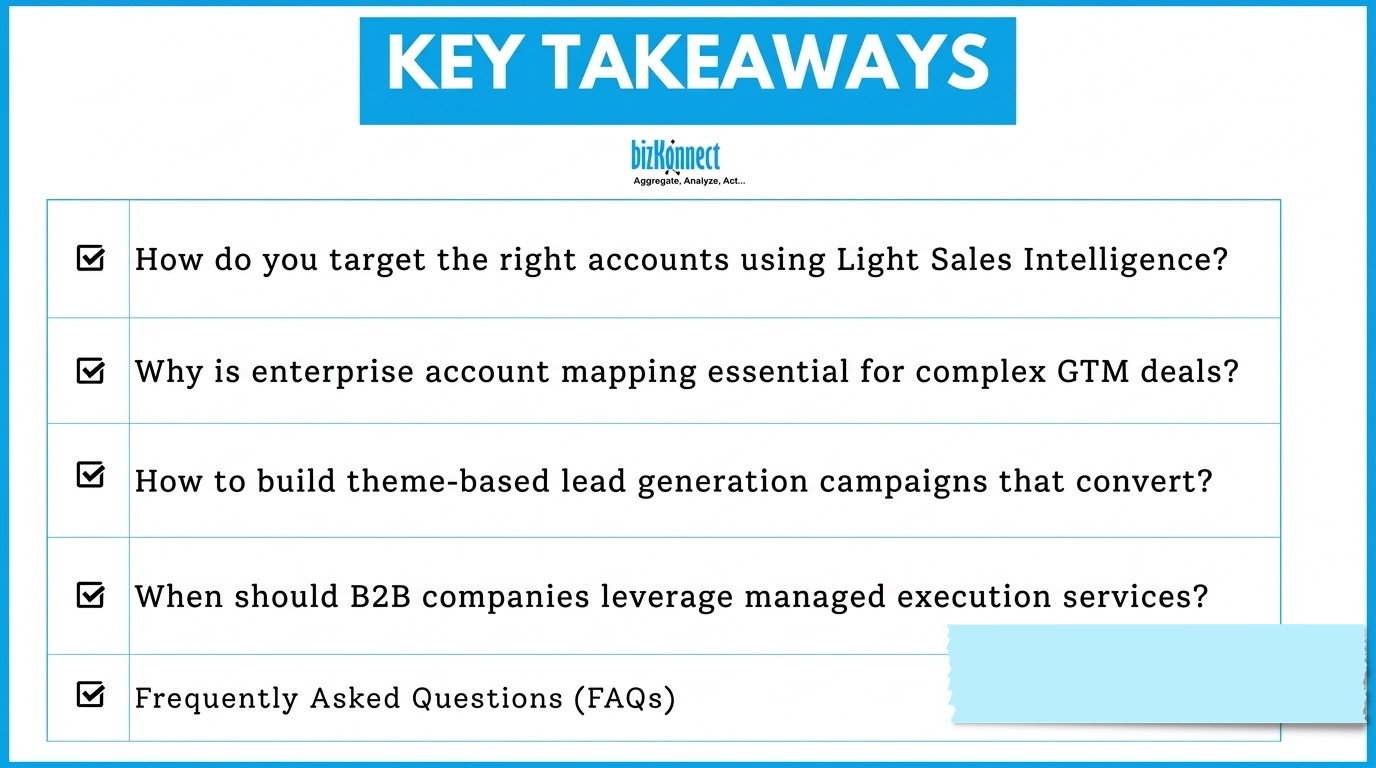
A successful outbound strategy begins with knowing exactly who to target and when to reach them. Light sales intelligence goes beyond demographic data by incorporating business triggers and operational signals. Identifying company-level events such as new job postings, technology stack changes, or expansion announcements allows B2B teams to reach decision-makers precisely when a relevant need arises.
Sales development representatives (SDRs), demand generation specialists, and market expansion leaders leverage trigger-based prospecting to build highly targeted lists. For instance, a software provider might target companies actively hiring for specific IT roles or using a legacy enterprise system ready for an upgrade. Targeting companies with actionable business signals improves response rates and establishes an insightful, value-first conversation.
Step 2: Navigate Complex Accounts with Account Maps
Reaching enterprise accounts often requires navigating intricate organizational structures with multiple stakeholders. Converting a single contact into a long-term client requires deep account penetration rather than high-volume outreach. Account maps solve this challenge by visualizing decision-making trees, reporting lines, and distinct buying centers within targeted enterprise organizations.
Strategic account managers and account-based marketing (ABM) teams rely on account mapping to multi-thread conversations across divisions. By identifying key influencers, functional decision-makers, and untapped business units, revenue teams can successfully cross-sell, expand existing footprints, and avoid relying on a single contact point within high-value accounts.
Step 3: Run Theme-Based Lead Generation Campaigns
Connecting intelligence to direct outreach requires structured lead generation campaigns built around specific value propositions. Outbound execution operates best when data, people, and technology work together as a single engine. Instead of broad promotional messaging, theme-based campaigns deliver contextual messaging tailored to specific industries, geographies, or business triggers.
A complete outbound campaign engine combines campaign strategists, researchers, multi-channel outreach tools, and data analytics. By testing themes, measuring engagement, and continually iterating based on campaign insights, sales teams can test new verticals, scale outreach capacity, and build predictable sales pipelines.
Step 4: Scale Execution with Managed Services
Scaling sales operations often creates resource constraints. Internal teams may possess CRM tools and marketing platforms but lack the execution bandwidth required for data cleanup, continuous account research, and campaign delivery. B2B managed services act as an extension of internal sales and marketing teams, providing dedicated bandwidth without increasing permanent headcount.
Managed services support RevOps, marketing operations, and sales leaders by maintaining sales-ready CRM data, running deep-dive org-chart research, and executing custom ABM workflows. This flexible execution layer allows growth teams to execute strategy efficiently while staying focused on closing deals.
Step 5: Implement the Connected GTM Flow
A cohesive GTM strategy relies on a simple, continuous flow: Find, Navigate, Engage, Execute, and Generate Pipeline.
- Find: Define your ICP and track relevant business signals to isolate high-intent opportunities.
- Navigate: Map enterprise buyer structures to identify decision-makers and functional influencers.
- Engage & Execute: Launch personalized outbound campaigns supported by dedicated execution capacity.
- Generate Pipeline: Measure results, iterate campaign messaging, and scale successful channels to drive revenue growth.
By aligning sales intelligence, structural account insight, theme-based execution, and flexible operational bandwidth, B2B organizations establish a predictable, repeatable model for sustainable market expansion.
Frequently Asked Questions (FAQ)
What is a connected B2B GTM engine?
A connected B2B GTM engine is an integrated go-to-market framework that combines actionable B2B data, strategic account mapping, multi-channel outbound execution, and flexible managed services into a single operational system designed to generate revenue.
How do business signals improve lead generation conversion?
Business signals such as job openings, technology stack updates, and management changes provide context on when a company is actively experiencing a problem. Outreach timed around business signals achieves higher response rates because the message aligns with current organizational priorities.
Why is account mapping necessary for enterprise ABM strategies?
Enterprise deals involve complex buying committees across multiple departments. Account mapping provides a visual structure of reporting hierarchies, buying centers, and decision-makers, enabling sales teams to execute multi-threaded ABM strategies and find expansion opportunities.
How do managed services complement internal sales and marketing teams?
Managed services provide dedicated execution capacity for labor-intensive tasks like CRM data enrichment, customized account research, and campaign management, allowing internal SDRs and account executives to focus on prospect interaction and deal closing.
Ready to Drive Predictable B2B Pipeline Growth?
Building a scalable outbound machine doesn't require juggling disconnected tools or overextending internal teams. Align your ICP, leverage real-time market signals, and execute targeted campaigns with an end-to-end B2B GTM engine designed for sustainable enterprise revenue generation.
Contact BizKonnect’s GTM specialists today to discover how integrated sales intelligence and managed execution can transform your sales pipeline.
CLICK HERE to know more with BizKonnect.