


Most B2B sales teams are losing deals today. Not because of poor messaging or weak products, but because they're acting on contact data that's anywhere from six months to two years out of date.
- A prospect has changed roles
- A company has been acquired
- An email address has been recycled
- Nobody caught it before the campaign went out
This is the core problem that CRM data refresh exists to solve
Not just "clean data" as an abstract goal, but the specific, measurable gap between the information your CRM holds and the reality your buyers are living. This guide walks through how GenAI-trained virtual assistants are changing the economics and accuracy of that refresh cycle and what it means for teams serious about a data-driven GTM strategy.
Why Does CRM Data Decay So Fast And What Does It Actually Cost?
The average B2B database degrades at roughly 22–30% per year. Job changes, company restructures, mergers, and role expansions mean that a contact list built in Q1 may already be partially unreliable by Q3.
The cost is misjudged sales territories, misallocated SDR time, and campaigns that hit the wrong decision-makers entirely. When a VP of Procurement becomes a Chief Operating Officer, the pitch that worked before now lands with the wrong framing, at the wrong seniority level, referencing a job title that no longer exists.
The deeper issue?
Most CRM systems are configured to capture data at a point in time. Without active maintenance, they become increasingly accurate about the past and increasingly unreliable about the present.
What good data maintenance actually requires:
- Continuous deduplication, not one-off cleanup projects
- Appending missing fields (phone, email, company size, SIC codes, employee count)
- Validation checks that verify contact and firmographic data
- Consolidation of company-level records that have fractured across multiple entries
Teams that treat this as a periodic project rather than an ongoing discipline consistently find themselves starting campaigns with a false sense of confidence.
How Do GenAI-Trained Virtual Assistants Actually Change the CRM Refresh Equation?
The traditional model for CRM data maintenance involved either overloaded internal teams doing manual updates, or expensive third-party list purchases that created new duplication problems while solving old ones.
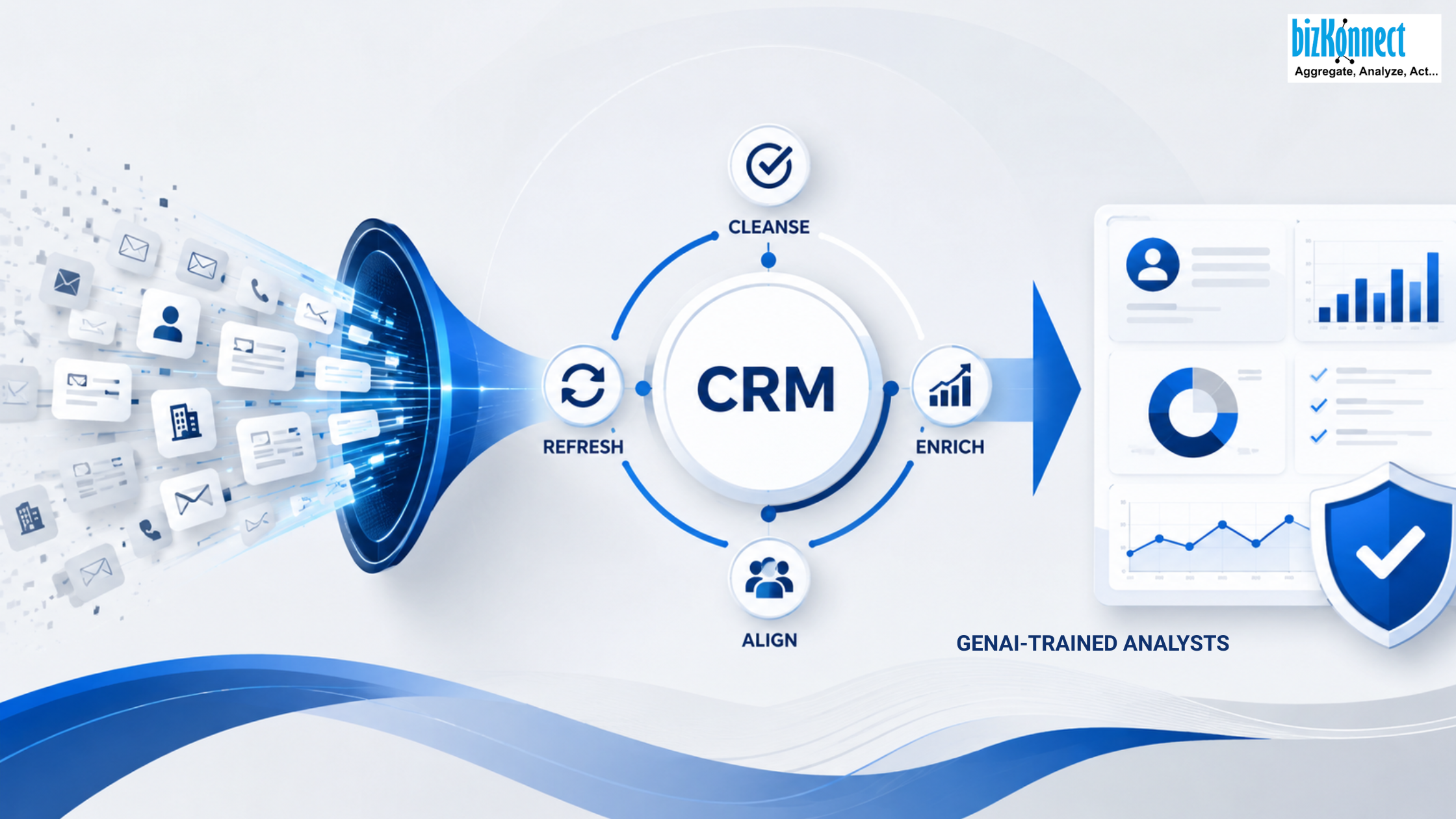
GenAI-trained virtual assistants change the equation in a specific way.
They function as an always-on research layer that processes and verifies at a volume no human team can match, while still applying the judgment that pure automation lacks.
Where this matters most in practice:
- Data verification at scale. Instead of sampling a database and extrapolating, AI-assisted analysts can work through full contact lists systematically, cross-referencing against live sources to flag records that have changed.
- Intelligent data append. Rather than bulk-appending fields from a generic list vendor, AI-assisted processes can identify which missing fields are highest-priority for a given ICP, then source and validate those specifically. The difference between appending 10,000 job titles and appending the right 10,000 job titles matters enormously in targeting.
- Visiting card and document processing. Field teams collect contacts at events, conferences, and meetings constantly. Scanning, cataloging, and importing that data has historically been a manual bottleneck. AI-assisted processing clears that backlog rapidly and links new contacts to existing account records without creating duplicate entries.
- CRM configuration alignment. Data quality also depends on how the CRM itself is set up, which includes field structures, terminology, form layouts, and reporting hierarchies. When these are misaligned with actual workflows, good data gets entered into the wrong places and becomes unfindable. Analysts working with AI support can identify and resolve these structural issues, not just surface-level record problems.
What Should a CRM Data Refresh Program Actually Include?
A complete CRM data refresh program has two distinct components: remediation and enrichment.
Remediation addresses what's wrong:
- Database scrubbing to remove invalid or malformed records
- De-duplication at both contact and account level
- Standardization of fields (formatting, capitalization, country codes, phone formats)
- Removal of contacts who have left their organizations with no forwarding record
Enrichment addresses what's missing:
- Appending contact names and verified decision-maker titles
- Adding SIC codes, company size bands, employee counts
- Filling gaps in account hierarchy (subsidiary vs. parent company relationships)
- Updating lead scoring models with refreshed behavioral and firmographic data
When these two components run together and feed directly into marketing automation and campaign execution the output isn't just a cleaner database. It's a more accurate picture of which accounts are actually worth pursuing, at what stage, with what message.
For investor-facing CRM environments specifically, this also includes tracking communication history, interaction preferences, and portfolio-level relationships with enough precision to personalize outreach meaningfully rather than generically.
What Are the Tangible Benefits of CRM Data Enrichment for Revenue Teams?
The ultimate goal of a data revamp is to increase the "yield" of every sales and marketing hour. When you invest in benefits of CRM data enrichment, you are essentially buying back time for your most expensive assets: YOUR TEAM.
| Feature | Impact on Sales | Impact on Marketing |
|---|---|---|
| Data Verification | Reduces bounce rates and "wrong person" calls. | Increases sender reputation and domain health. |
| Lead Nurturing | Provides context for personalized follow-ups. | Enables highly targeted A/B testing and segmentation. |
| Company Consolidation | Identifies parent-child relationships for enterprise selling. | Prevents duplicate messaging to the same account. |
When Should Teams Consider CRM Managed Services Over Internal Handling?
The honest answer depends on scale, not budget. Most teams can handle basic CRM hygiene internally when their database is under a few thousand records and their ICP is stable. The calculus shifts when:
- Campaign volumes increase and data decay starts affecting deliverability metrics
- New market segments require contact lists that don't yet exist in the CRM
- Event-driven outreach (conference attendees, webinar registrants, intent signals) needs to be processed and entered within hours, not days
- Integration with external systems (marketing automation, sales engagement platforms, data providers) creates duplication that internal teams don't have the bandwidth to resolve
CRM managed services, particularly those using GenAI-trained analysts as an extended team model, offer something specific: dedicated capacity that scales to assignment volume without the ramp time and overhead of internal hiring.
This model also covers campaign execution support: segment setup, A/B test configuration, lead scoring model maintenance, personalization logic, and reporting. Because the goal is to extend what's possible without proportionally expanding headcount.
Let’s Address Some Frequently Asked Questions (FAQs)
With these challenges and solutions in mind, a few important questions naturally arise for teams navigating similar situations.
Q1. Why do companies need CRM managed services instead of just buying a better data vendor?
Data vendors provide lists; managed services maintain your system. The distinction matters because vendor data needs to be merged, deduplicated, and aligned to your CRM's field structure, none of which happens automatically.
Q2. What does AI-driven CRM data enrichment actually improve beyond standard data append?
Standard append fills missing fields. AI-driven enrichment validates accuracy, prioritizes fields by ICP relevance, and cross-references multiple sources rather than relying on a single database.
Q3. What's the biggest risk of not maintaining CRM data actively?
Beyond deliverability damage, the deeper risk is misaligned GTM strategy, making territory and resource decisions based on account data that no longer reflects reality.
If you want to stop running campaigns on outdated contact records, CLICK HERE to explore how BizKonnect's GenAI-trained analyst team can help you refresh, enrich, and operationalize your CRM data without the overhead of building it in-house.
CLICK HERE to know more with BizKonnect.