


The traditional pharmaceutical sales model, characterized by physical rep visits and linear physician relationships, has hit a functional challenge.
At Johnson & Johnson, the strategic pivot toward a "decentralized, BU-led" structure has fundamentally altered how the organization consumes innovation. For marketers, the trigger is no longer about securing a 15-minute slot with a physician, rather it is about navigating a complex web of E-health platforms and AI-driven clinical workflows.
If your Go-to-Market (GTM) strategy still treats J&J as a centralized hierarchy rather than a digital-first ecosystem, you are likely hitting the wrong doors.
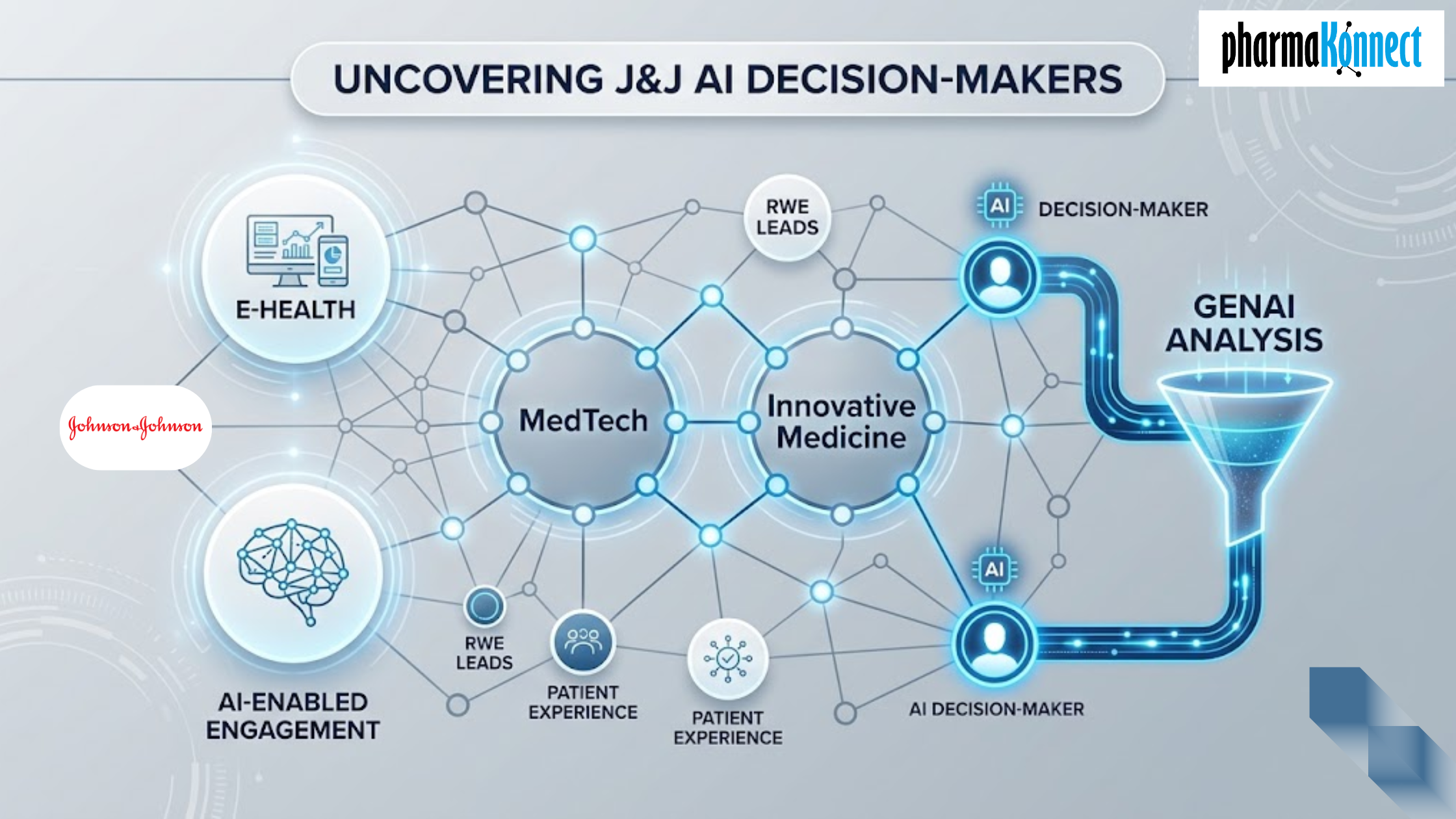
As J&J moves from AI pilots to enterprise-wide implementation, the "Buying Committee" has expanded. It now integrates Heads of Patient Experience and Real-World Evidence (RWE) Leads, creating a multi-layered decision-making process. To succeed, your approach must transition to "Digital Orchestration."
This requires an expert understanding of a Johnson and Johnson org chart backed by GenAI to identify the specific AI-Adoption Leads who hold the mandate for digital transformation.
What Is a Pharma Company Org Chart in the Context of J&J’s Digital Pivot?
Today, a pharma company org chart is a dynamic blueprint of influence and budget authority. For a global giant like Johnson & Johnson, the global pharma company org structure has shifted toward a model that prioritizes agility within its specific Business Units (BUs).
J&J MedTech and Innovative Medicine (formerly Janssen) have increasingly decentralized their digital procurement. This means a solution for orthopedic surgery AI might be championed by a different "Digital Orchestrator" than a solution for oncology E-health. Understanding what is pharma company org chart functionality today means recognizing the intersection of therapeutic expertise and technological adoption.
Key shifts in J&J’s 2026 structure include:
- The Rise of the "Medical-Digital" Liaison: A hybrid role that bridges the gap between clinical requirements and AI infrastructure.
- Decentralized BU Autonomy: Individual business units now have greater latitude to implement AI-enabled HCP engagement tools tailored to their specific patient demographics.
- RWE Integration: Real-World Evidence leads are now foundational to the buying committee, ensuring that any new digital platform provides measurable patient outcomes data.
How to Read a Johnson and Johnson Org Chart to Identify AI-Adoption Leads?
Navigating a top pharma company org structure like J&J requires looking beyond C-suite titles. While the Chief Digital Officer sets the vision, the "Buying Committee" at J&J is driven by functional leads who are currently scaling AI from pilot programs to full-scale operations.
To identify these leads, marketers must filter the pharma leadership hierarchy through the lens of digital orchestration. You are looking for individuals who sit at the nexus of:
- Platform Integration: Leads responsible for E-health platform interoperability.
- HCP Engagement Strategy: Personas focused on "Omnichannel Orchestration" rather than just sales operations.
- Patient Experience: Executives tasked with alleviating HCP burnout through medical technology.
According to recent J&J MedTech insights, there is a surging confidence in AI’s ability to address the needs of an aging population while reducing administrative burdens on doctors.
Therefore, a marketer’s "hook" must align with these specific pain points. When you access top pharma company org charts, look for the "Innovation Hubs" within J&J that are specifically funded for "Personalized Medicine" and "Surgical Robotics."
These are the departments currently moving from experimental AI to enterprise implementation.
Why Is Digital Orchestration Replacing Traditional Sales Rep Models Now?
The move toward "Digital Orchestration" is a response to a documented shift in HCP behavior. J&J’s recent updates highlight a move toward more "AI-enabled HCP engagement." Doctors no longer want more information, instead they want better-orchestrated insights delivered through the platforms they already use.
For your GTM strategy, this means:
- From Push to Pull: Instead of "pushing" sales messages, you must "orchestrate" value across digital touchpoints.
- The Buying Committee Expansion: Inclusion of the "Head of Patient Experience" ensures that any digital tool improves the patient journey as well as the sales cycle.
- AI-Driven Insights: Using pharma org structure data of J&J backed by GenAI allows marketers to see the "hidden" influencers, those RWE leads who validate the clinical efficacy of your digital solution before it ever reaches a procurement desk.
Recent J&J global surveys reveal a high degree of confidence among HCPs in medical technology that addresses burnout. If your GTM strategy doesn't speak to this specific priority, it will be deprioritized by the AI-Adoption Leads who are currently vetting enterprise-wide tools.
How Can GenAI-Backed Account Mapping Accelerate Your J&J Market Entry?
The complexity of J&J's structure makes manual prospecting obsolete. To effectively target the right personas, you need a global pharma company org structure analysis that is updated in real-time. This is where GenAI becomes a force multiplier.
A GenAI-backed platform allows you to:
- Filter by Functionality: Access in-depth departments specifically aligned with the Pharma vertical (e.g., Clinical Trials, Regulatory Affairs, Digital Health).
- Map "Buying Committees": Automatically group the RWE Leads, Patient Experience Heads, and IT Orchestrators for a specific product launch.
- Identify Transition Signals: Spot leads who are moving from "Pilot Management" roles into "Enterprise Transformation" roles, a clear signal of budget readiness.
Using these dynamic charts, a marketer can pivot from a generic "spray and pray" approach to a 1-to-1 engagement strategy. Because you are viewing a functional map of how J&J intends to solve HCP burnout and patient outcomes.
Navigating the Transition: A Strategic Checklist for Marketers
To move from a traditional GTM to a digital orchestration model within J&J’s decentralized structure, teams should audit their strategy against the following criteria:
- Identify the "Orchestrator" Persona: Move beyond the Chief Digital Officer. Use a pharma company org chart of J&J to locate the "Head of Digital Clinical Operations" or "VP of Omnichannel Patient Experience" within specific MedTech or Innovative Medicine BUs.
- Map the RWE Influence: Ensure your value proposition includes a "Real-World Evidence" component. If your platform doesn't generate data that an RWE Lead can use to prove clinical outcomes, it will likely fail today’s buying committee review.
- Verify Platform Interoperability: J&J is prioritizing E-health platforms that "talk" to existing hospital ecosystems. Your technical documentation must lead with how you integrate into their GenAI-enabled HCP engagement workflows.
- Solve for "Burnout" Metrics: Align your messaging with J&J’s mission to alleviate HCP administrative load. If your tool adds a new login or a manual data entry step, it contradicts their current "Confidence in AI" initiatives.
- Pivot to "Trigger-Based" Engagement: Instead of scheduled email blasts, set up triggers based on "Pilot to Enterprise" shifts. When a J&J lead moves from a regional pilot role to a global implementation role, your GTM should automatically escalate to a "Decision-Stage" personalized outreach.
Addressing Some Frequently Asked Questions (FAQs)
Q1. Who are the "AI-Adoption Leads" at Johnson & Johnson?
These are senior executives within the MedTech Digital and Innovative Medicine sectors (reporting toward the CIO or Global VPs) responsible for scaling AI from R&D pilots to clinical and commercial workflows.
Q2: How is J&J's org structure different from other top pharma companies?
J&J's dual-segment model (Innovative Medicine and MedTech) with horizontal digital functions creates a more complex stakeholder environment, making persona-specific targeting more critical than in single-segment pharma organizations.
Q3. What role do E-health platforms play in J&J’s GTM strategy?
Platforms like Polyphonic™ serve as the "digital glue" that connects J&J to the HCP's daily workflow, facilitating telepresence, surgical planning, and post-operative patient tracking.
If your team needs to find the right AI-adoption leads within J&J or other top pharma companies, CLICK HERE to see how BizKonnect's GenAI-driven pharma org charts work in practice.
CLICK HERE to know more with BizKonnect.