


Over the past two years, B2B sales teams invested heavily in LinkedIn outreach tools, automated sequences, and AI-assisted messaging. Campaigns launched faster and yet
- Conversion from outbound LinkedIn activity to qualified pipeline has softened
- Reply rates dropped
- Acceptance rates became inconsistent
- Conversations that happened were shorter and harder to close
It is a structural shift most teams did not account for when they scaled. As a result, the platform tightened, buyer behavior adapted, and playbooks still being refined in 2024 had already lost relevance before they were fully deployed.
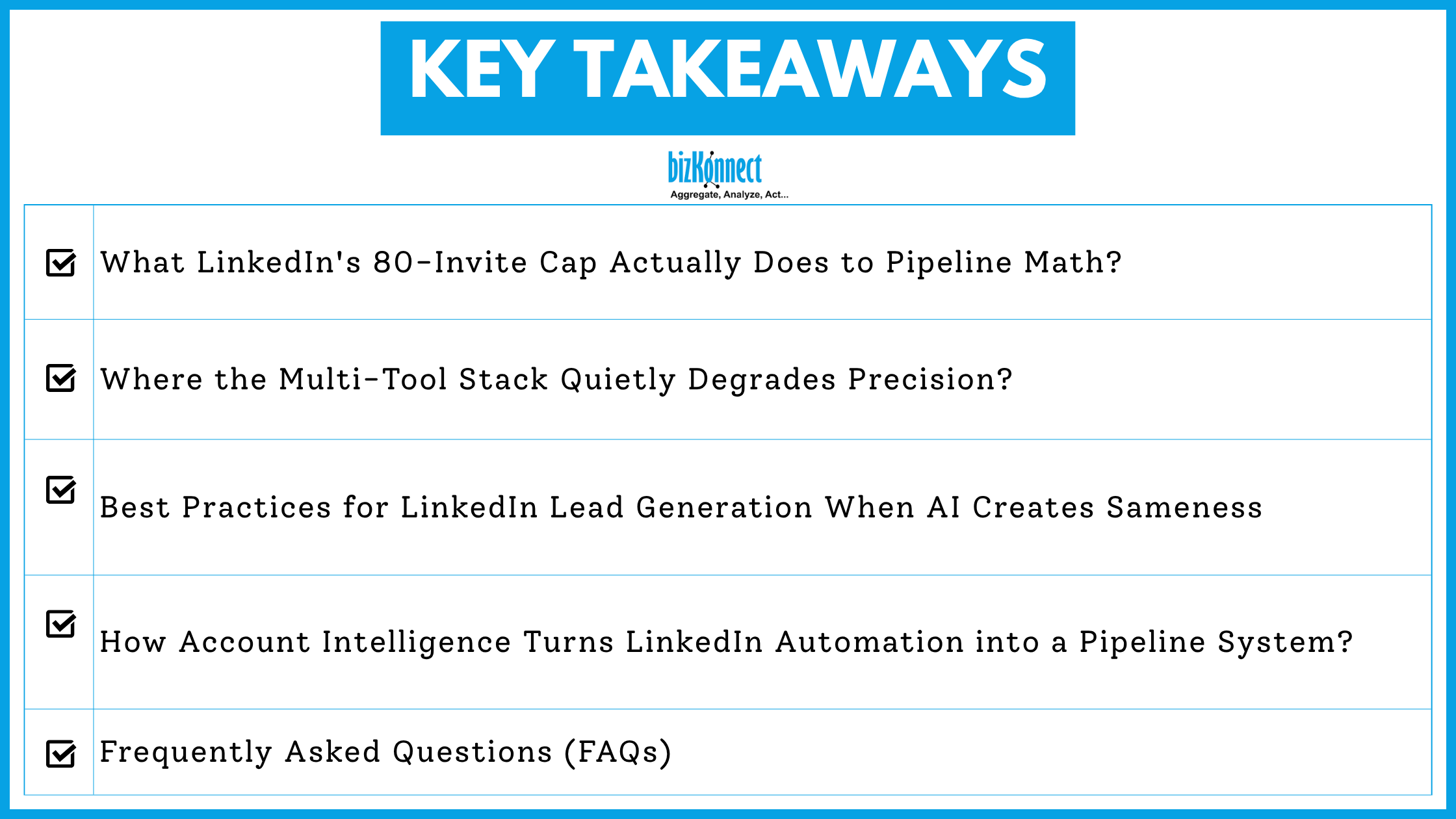
What LinkedIn's 80-Invite Cap Actually Does to Pipeline Math?
The number in every serious discussion of LinkedIn automation tools today is 80. It is the practical daily limit for connection invitations per account, enforced through behavioral detection systems that read pattern consistency, not just raw volume.
The math compounds fast:
- 80 invitations/day × 5 working days = ~400 connection requests per week
- At a 30% acceptance rate (generous in most verticals) = ~120 new connections per seat
- Conversion to meetings typically runs 5–15% depending on ICP alignment
A single-account program generating 3-6 qualified conversations per week is not underperforming, rather it is hitting a structural limit.
The correction high-performing teams have moved to is multi-account stacking.
Two to four warmed LinkedIn seats running in coordinated cadences, scaling total daily reach to 200–320 invitations without any single profile crossing the detection threshold. This is a foundational architecture.
The less-discussed variable here is that cloud-based LinkedIn automation tools survive roughly four times longer than Chrome extension tools at equivalent volumes. Extensions share the actual browser IP and session cookie with LinkedIn's detection layer. Cloud-native tools with dedicated IPs create session separation that reduces behavioral fingerprinting.
For teams evaluating LinkedIn automation tools today, this is a durability calculation with direct pipeline consequences.
Where the Multi-Tool Stack Quietly Degrades Precision?
Ask a B2B sales ops leader to describe their LinkedIn outreach workflow, and you will hear a familiar sequence of disconnected tools:
- Sales Navigator for research and list-building
- An automation tool for connection requests and follow-ups
- A CRM for activity logging
- An enrichment layer for pulling verified emails
- A separate email sequencer for multichannel follow-up
Each was chosen because it performed its function reasonably well. Together, they create data handoff gaps that degrade precision at every stage.
The contact from Sales Navigator does not always transfer cleanly into the automation platform. The CRM log reflects what was sent, instead of what was read. The enrichment data may be months old by the time outreach fires.
A message sent to a VP of Procurement three weeks after a role change, using a copy written for their previous function, is actually a trigger for quiet disengagement.
High-performing teams are consolidating sourcing, sequencing, enrichment, and CRM sync into a single workflow layer. When LinkedIn and email execute from a unified inbox against a shared contact record, reply signals suppress further outreach immediately.
The distinction between tools built for volume and tools built for account intelligence becomes decisive at scale: the former runs faster, the latter produces more pipeline.
Best Practices for LinkedIn Lead Generation When AI Creates Sameness
There is a quiet crisis developing at the intersection of AI personalization and LinkedIn outreach because it is all about convergence.
When most sales teams draw on the same publicly visible signals such as funding rounds, headcount growth, and job title changes, AI-generated output converges regardless of which tool produces it. A VP of Marketing at a Series B company may now receive five connection requests per week referencing the same funding announcement in slightly different sentence structures which are technically personalized and operationally identical.
The differentiating variable is not whether AI personalization is used. It is the depth and currency of the account intelligence informing what the AI writes against. Paired with that: multichannel coordination.
LinkedIn combined with email as a coordinated sequence produces roughly triple the reply rate of LinkedIn outreach alone. But only when both channels share the same contact record and suppress together the moment a reply arrives.
The practices that separate effective programs from high-volume noise:
- Source contact data natively because stale data produces irrelevant outreach and irrelevant outreach trains buyers to ignore you.
- Warm every account individually before adding it to a stack. 20 invites/day in week one, 50 by week three, 80 from week four.
- Randomize message timing within sequences. Consistent intervals look automated because they are and detection systems notices.
- Coordinate LinkedIn and email from a single inbox. When a prospect replies on either channel, both channels should pause instantly.
- Track acceptance rate health per account. A persistently low rate quietly reduces future invite capacity before any hard restriction is applied.
How Account Intelligence Turns LinkedIn Automation into a Pipeline System?
The problems outlined above such as pipeline math against a hard limit, tool stack fragmentation, and AI-generated sameness, share a common root:
Most LinkedIn automation tools were built to execute outreach faster, instead of smarter.
The evaluation logic has to shift accordingly.
Account intelligence before outreach fires. An account intelligence platform maps buying groups and decision-maker hierarchies before a single connection request is sent, so outreach reaches the right person at the right seniority, not just whoever matched a job title filter on a stale list export.
Intent-signal prioritization. Rather than treating every ICP-matching contact as equally worth reaching, the platform surfaces accounts showing active buying signals: technology evaluations, hiring patterns, and leadership transitions. Teams concentrate outreach where purchase likelihood is highest, instead of where the list happens to be longest.
Multichannel coordination built in. LinkedIn and email sequences run from a unified layer. Reply detection on either channel suppresses further outreach immediately, preventing the friction of follow-ups reaching a prospect who has already responded.
GTM strategy optimization, not just execution. Enriched account intelligence feeds back into CRM and sales workflows so the data informing outreach decisions improves with every cycle, rather than degrading between export refreshes.
The result is outreach that compounds because the intelligence layer gets sharper as the program matures.
Addressing Some Frequently Asked Questions (FAQs)
Q. What are LinkedIn automation limits in 2026?
The daily cap is approximately 80 connection invitations per account. LinkedIn's detection monitors behavioral patterns like timing, pacing, and acceptance rate.
Q. How does a multi-account stack scale reach without triggering restrictions?
Two to four warmed seats run simultaneously, each under the 80-invite limit, bringing team reach to 200–320 daily invitations. Ramp each account: 20 invites/day week one, 50 by week three, 80 from week four.
Q. Why do Chrome extensions get restricted faster than cloud-based tools?
Extensions share your real browser IP and session with LinkedIn's detection systems. Cloud-native tools with dedicated IPs survive roughly 4x longer at equivalent volumes.
Q. What is the real cost of running LinkedIn and email as separate tools?
Manual handoffs introduce data lag and split the engagement signal. Pipeline output drops when both channels are not coordinated from a single sequence layer.
The evaluation logic has changed. Safety architecture is now a durability question. Differentiation lives in account intelligence depth, instead of just automation volume.
Teams still running 2024 playbooks are falling behind at the rate of every campaign cycle running against tighter limits, smarter detection, and a buyer landscape where AI-generated sameness is the default output of generic outreach stacks. What replaces that is not louder automation, it is more precise intelligence, applied consistently enough to compound.
If your team is evaluating LinkedIn outreach tools or account intelligence platforms, CLICK HERE to explore how BizKonnect supports intelligence for LinkedIn at the depth your GTM strategy requires.
CLICK HERE to know more with BizKonnect.