


For decades, Tier-1 suppliers and SaaS vendors relied on stable relationships with procurement heads and engineering leads. But as the industry pivots toward the Software-Defined Vehicle (SDV), those legacy maps have been rendered obsolete. In 2026, the power has shifted to new executives:Chief Software Officers, Heads of Cloud Architecture, and Data Monetization leads who operate under a mandate that prioritizes silicon and code over steel and chrome.
For automotive SaaS vendors, the challenge has now become a visibility crisis.
Identifying the decision-makers within shifting OEM hierarchies, Tier-1 suppliers, and emerging mobility platforms is now the primary barrier to entry. This is where GenAI-driven auto company org charts become the critical differentiator. By mapping these newly created roles and their reporting lines before competitors even recognize the structural shift, vendors can transition from cold-calling to strategic partnership.
This article explores how to navigate the new automotive leadership hierarchy and capture the SDV opportunity through precision intelligence.
What is a Software-Defined Vehicle, and why is it restructuring the automotive C-suite?
A software-defined vehicle is often mistaken for "a car with a big screen." In reality, it represents a fundamental shift where the vehicle’s functions and features are primarily enabled through software, allowing for over-the-air (OTA) updates and continuous value addition post-sale.
This technological leap has forced a radical restructuring of the automotive industry org chart. OEMs are no longer organized by mechanical components (powertrain, chassis, interior) but by horizontal software layers:
- The "New" C-Suite: We are seeing the rise of the Chief Industry Officer (CIO) and specialized R&D heads. At Toyota Motor Corporation, the April 2026 executive shift sees Koji Sato move to Vice Chairman and the newly established role of Chief Industry Officer (CIO), while Kenta Kon assumes the CEO role to focus on internal management. This "Industry-First" mandate signals a shift toward ecosystem-wide software collaboration.
- Cross-Brand Consolidation: Volkswagen Group has introduced a "Brand Group Core Board of Management" starting in January 2026. This body now oversees Production, Technical Development, and Procurement across Volkswagen, Škoda, and SEAT/CUPRA brands.
- The Sales Trigger: For a SaaS vendor, this means your historical contact in "Brand-Specific Procurement" likely no longer has sole budget authority. The budget has moved to the Brand Group Core level, where decisions are made for millions of units across multiple brands simultaneously.
How can automotive org charts identify high-value triggers within OEMs and Tier-1 suppliers?
In a volatile market, an automotive contact database is only as good as its recency. The winners in 2026 are those who can spot a reorganization before the first press release is cold.
Recent industry shifts provide a roadmap for how these triggers manifest:
- The Shift to Software-Defined Factories (SDF): Hyundai Motor Group’s 2026 executive appointments promoted 219 executives, with nearly 30% of promotions concentrated in R&D and advanced technology. Specifically, Juncheul Jung was promoted to President to lead the SDF approach. For a vendor selling factory-floor AI or robotics software, this is a multi-billion dollar budget signal.
- Decentralization for Speed: Stellantis recently underwent a major leadership reshuffle under new CEO Antonio Filosa. Key moves include appointing Emanuele Cappellano as Head of Enlarged Europe and elevating Grégoire Olivier to Head of China and Asia-Pacific. The mandate here is "regional autonomy."
- The Mobility Platform Trigger: Hyundai also promoted Manfred Harrer to President and Head of the R&D Division to spearhead SDV competitiveness.
By utilizing automotive org chart data providers, vendors can track these "micro-pivots."
If a Tier-1 supplier suddenly promotes a "Global Head of Manufacturing" (like Stellantis did with Francesco Ciancia, rejoining from Mercedes-Benz), it’s a signal that the OEM is looking to overhaul its legacy production lines with cloud-integrated SaaS solutions.
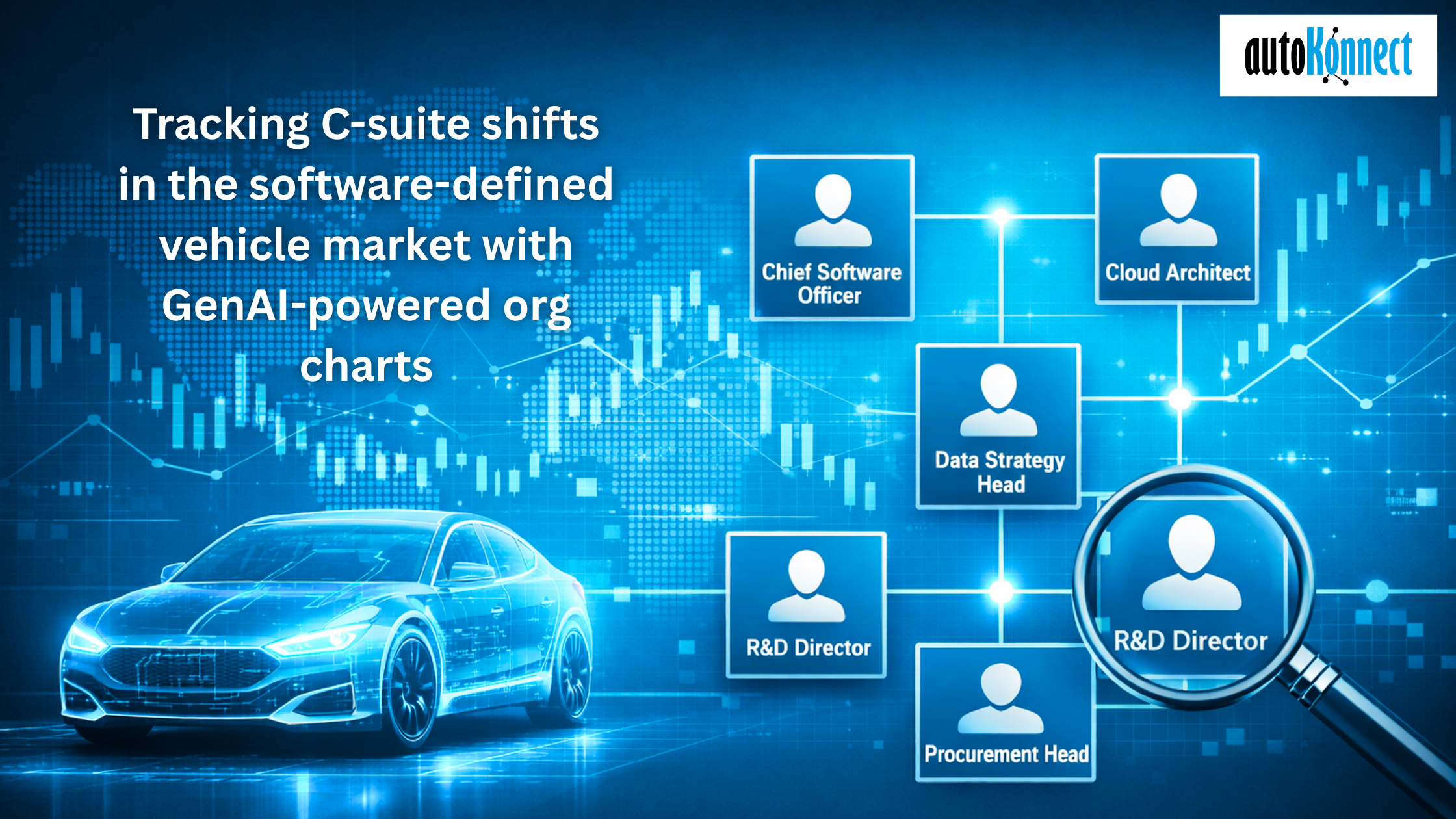
What is automotive org chart data, and how does GenAI transform it into a competitive edge?
Standard databases provide a list of names; automotive org charts powered by GenAI provide a map of influence. In the context of the SDV, understanding the "shadow org chart" is often more important than the formal one.
Traditional Data vs. GenAI-Driven Intelligence:
Static Lists: Tell you that a person is the VP of Procurement.
GenAI Intelligence: Analyzes that Volkswagen is reducing its brand-level board members by one-third by summer 2026 to streamline "Brand Group Core" steering. It identifies which leads are moving into the new "Iberian Peninsula" regional production hub and who reports to the new Chief Production Officer.
This level of insight allows SaaS vendors to map the roles within mobility platforms that competitors don't even know exist.
How to use automotive leadership hierarchy data to move from awareness to a closed deal?
Navigating the buyer journey in the automotive sector requires a dynamic and accurate approach to the automotive leadership hierarchy. You cannot use the same pitch for the CTO that you use for the Head of Procurement.
Phase 1: Mapping the "Power Center"
Use GenAI-driven charts to identify the "Software Hubs" within an OEM. At many companies, the power has shifted from the central headquarters to dedicated software entities (like VW’s CARIAD or Mercedes’ MB.OS teams).
Phase 2: Identifying the "Blockers" and "Champions"
- The Champion: Often a mid-level "Director of Software Integration" who is feeling the pain of legacy systems.
- The Blocker: A legacy Tier-1 account manager who fears your SaaS will disintermediate their hardware margins. Your data should tell you the tenure of these individuals. A new executive (like those recently appointed at Hyundai) is often more open to disruptive SaaS solutions than a 20-year veteran.
Phase 3: The Accurate Outreach
Instead of a generic demo, your outreach should reference the specific mandate of the new C-suite. If the mandate is "Platform Standardization," your pitch must focus on how your SaaS integrates across multiple vehicle lines, referencing the specific brand clusters identified in the automotive org chart.
With these challenges and solutions in mind, a few important questions naturally arise for teams navigating similar situations. Addressing some of them.
Frequently Asked Questions (FAQs)
Q1. How can teams audit the accuracy of their current automotive org charts?
Compare recent leadership announcements with your internal data. If updates lag by more than a few weeks, accuracy is already compromised.
Q2. When is the right time to perform a complete database rebuild for the automotive sector?
Ideally, during major industry inflection points. 2026 is a super-cycle year where many electrification and software goals are being operationalized. If your database hasn't been rebuilt since the rise of dedicated Software-Defined Vehicle divisions, you are missing the new decision-making layer.
Q3. How do we identify inefficiencies in our current GTM strategy for Tier-1 suppliers?
Analyze your win/loss data against the prospect's internal structure. Inefficiencies often stem from pitching "bottom-up" to engineers who no longer have budget autonomy, rather than "top-down" to the new C-suite roles who now control the software spend.
The shift toward software-defined vehicles is a structural reset of how automotive companies operate and make decisions. Vendors that rely on outdated automotive org charts will continue to miss the mark. Those that adopt GenAI-driven approaches gain visibility into leadership changes as they happen, and often before they are widely understood.
For teams looking to align with these shifts and improve targeting precision, CLICK HERE to explore how BizKonnect can support your strategy.
CLICK HERE to know more with BizKonnect.