


For years, digital transformation in B2B was synonymous with "more data" and "faster automation." But today, many organizations have hit a wall where more data no longer equals more deals.
The failure point is clear:
B2B buying is a human endeavor happening within complex social structures, and automation alone cannot navigate internal politics.
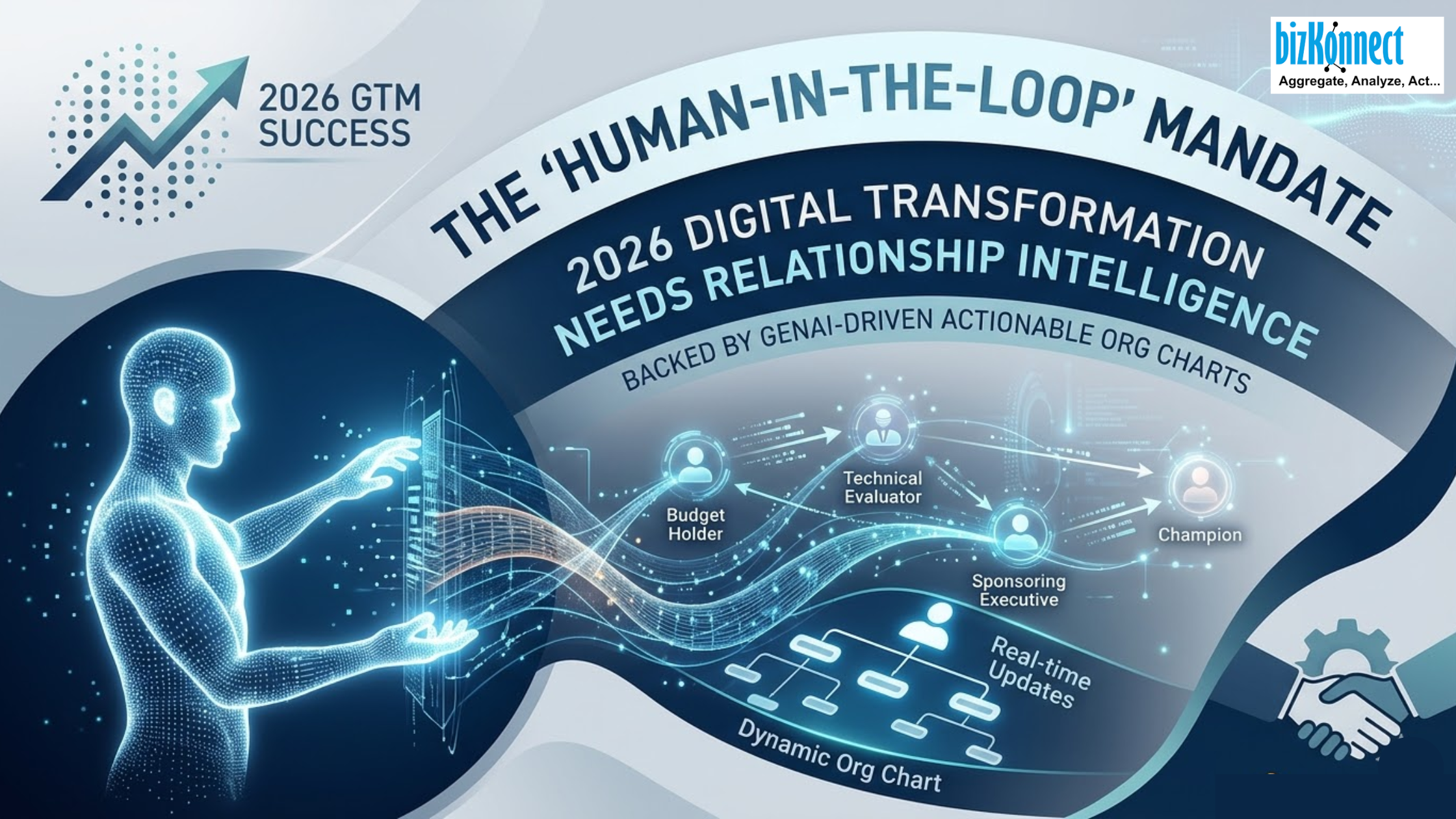
This has made the "Human-in-the-Loop" mandate, a strategy where GenAI is not used to replace the marketer, but to provide them with relationship intelligence. It is the "superpowers" to see internal company dynamics and invisible power structures that were previously hidden. This shift is central to 2026 digital transformation. By leveraging GenAI-driven actionable org charts, marketers can move beyond static job titles to understand the true "connective tissue" of a target account.
This blog explores why relationship intelligence is the missing layer and how GenAI org charts solves the enterprise blind-spot problem, turning account mapping into a high-intent competitive advantage.
Why Is Relationship Intelligence the Missing Layer in B2B Digital Transformation?
Most B2B teams enter a target account with firmographic data, a few named contacts, and intent signals. That's enough to launch a campaign but rarely enough to close a complex deal.
Enterprise buying decisions happen inside a web of internal relationships between budget holders and technical evaluators, champions and blockers, sponsoring executives and procurement teams that can delay or derail. However, most campaigns are built around just two or three.
That gap is where deals stall:
- A campaign reaches a VP who no longer owns the budget
- An internal champion shifts divisions mid-cycle
- A new executive joins and quietly reshapes the vendor shortlist
Relationship intelligence is the discipline of understanding these dynamics, including who matters and how that picture is changing. Digital transformation that skips this layer is optimizing execution while leaving strategy blind.
How Do GenAI-Driven Org Charts Give B2B Marketers Visibility They Previously Couldn't Have?
Static organizational charts capture hierarchy. A leadership change, a reorganization, a new hire with informal authority over a category decision: none of these update themselves in a database.
GenAI-driven actionable org charts work differently. They continuously synthesize business signals such as executive movement, job postings, role changes, department growth, and CRM engagement history to maintain a dynamic, relationship-aware map of who holds meaningful influence inside an account at any given moment.
What this surfaces is genuinely new intelligence:
- A new VP hired into a buying-relevant function who has never engaged with marketing
- An internal champion whose budget authority has quietly shifted to a different division
- A headcount surge in a specific department signalling a pending investment cycle
- A procurement stakeholder who consistently appears at late-stage deal reviews but hasn't been part of the current engagement at all
A marketer with GenAI-driven org chart visibility sees the full decision-making landscape as it actually exists and builds relationship strategy around it rather than discovering gaps after the fact.
What Does the Human-in-the-Loop Mandate Actually Require of B2B Teams?
The mandate is specific: AI handles scale and signal processing. Humans handle judgment, context, and relationship intuition.
About 51% of firms are now adopting AI copilot tools but only 39% report meaningful performance gains. The gap is a design problem where teams hand decisions to AI rather than using AI to sharpen human decisions consistently underperform.
For B2B account intelligence, the division is clear:
What AI manages:
- Continuously refreshing org maps across the full target account list
- Flagging trigger events such as executive departures, new hires in buying-relevant roles, and department restructuring
- Surfacing relationship paths between known contacts and newly identified stakeholders
What humans decide:
- Whether a flagged trigger is strategically significant for this specific account
- How to approach a newly identified stakeholder given existing relationship history
- When to shift messaging, timing, or escalate a signal to a direct sales conversation
The org chart is AI-generated but the relationship strategy is human-led. One without the other is either overwhelming with raw data and no judgment or blind with human judgment and no live intelligence.
How Should B2B Marketers Evaluate Whether Their Account Intelligence Supports Relationship-Led Digital Transformation?
A useful diagnostic runs across three dimensions:
- Stakeholder completeness: Does current account intelligence reflect the full buying committee, including stakeholders who have never engaged with marketing? If the org map only contains opted-in contacts, it is structurally missing the people most likely to influence late-stage decisions.
- Refresh cadence: How quickly does account intelligence reflect changes inside target accounts? A buying committee that shifts in January should not be driving campaign decisions in March.
- Human integration: Are AI-surfaced signals being reviewed by people with the context to interpret them? A new CFO joining a target account means different things depending on deal history and competitive context. That call requires a human.
Most account intelligence setups fail on at least one dimension, and frequently all three. GenAI-driven actionable org charts address all of them: continuous refresh, full stakeholder visibility, and structured signal delivery designed for human review.
That is what relationship intelligence looks like when operationalized correctly. And it's why the human-in-the-loop mandate is the condition that makes digital transformation work.
Addressing Some Critical Frequently Asked Questions (FAQs)
Q1. What is the right human-in-the-loop workflow for acting on AI org chart intelligence?
The most effective model has AI generate and update the org chart, with an account intelligence function, in-house or partner-supported, validating and contextualizing changes before the data reaches sales. This prevents teams from acting on AI output that lacks important industry or relationship context.
Q2. How does GenAI org chart mapping differ from standard CRM contact enrichment?
Contact enrichment adds details to records you already have. GenAI org chart mapping infers the relationships between contacts, identifies stakeholders not yet in your CRM, separates influence from formal authority, and updates dynamically as organizational changes occur. One adds data points; the other builds a model of account dynamics.
Q3. What roles should a complete enterprise org chart always include for B2B sales?
At minimum: the economic buyer, the technical evaluator, the operational champion, procurement or legal stakeholders, and likely blockers such as finance or IT security. Deals missing any of these roles in the mapping process carry substantially higher stall risk.
If your team is facing similar data and growth challenges, CLICK HERE to explore how BizKonnect can help you build accurate, decision-ready datasets.