


Selling enterprise software in 2026 isn't about convincing one person. Because the CTO needs to know how your solution integrates with their existing infrastructure, while the CFO wants proof that it reduces costs. Send the same generic pitch to both, and you'll watch your deal stall as they compare notes and realize you don't understand either of their requirements.
That’s why modern B2B sales demand a different approach.
One where you orchestrate multiple conversations across an organization without creating internal friction. Iterative email campaigns combined with GenAI-driven actionable org charts of target accounts make this coordination possible.
Instead of broadcasting identical messages, you're conducting a synchronized outreach where technical value propositions and ROI narratives support rather than contradict each other.
Let’s understand it step-by-step:
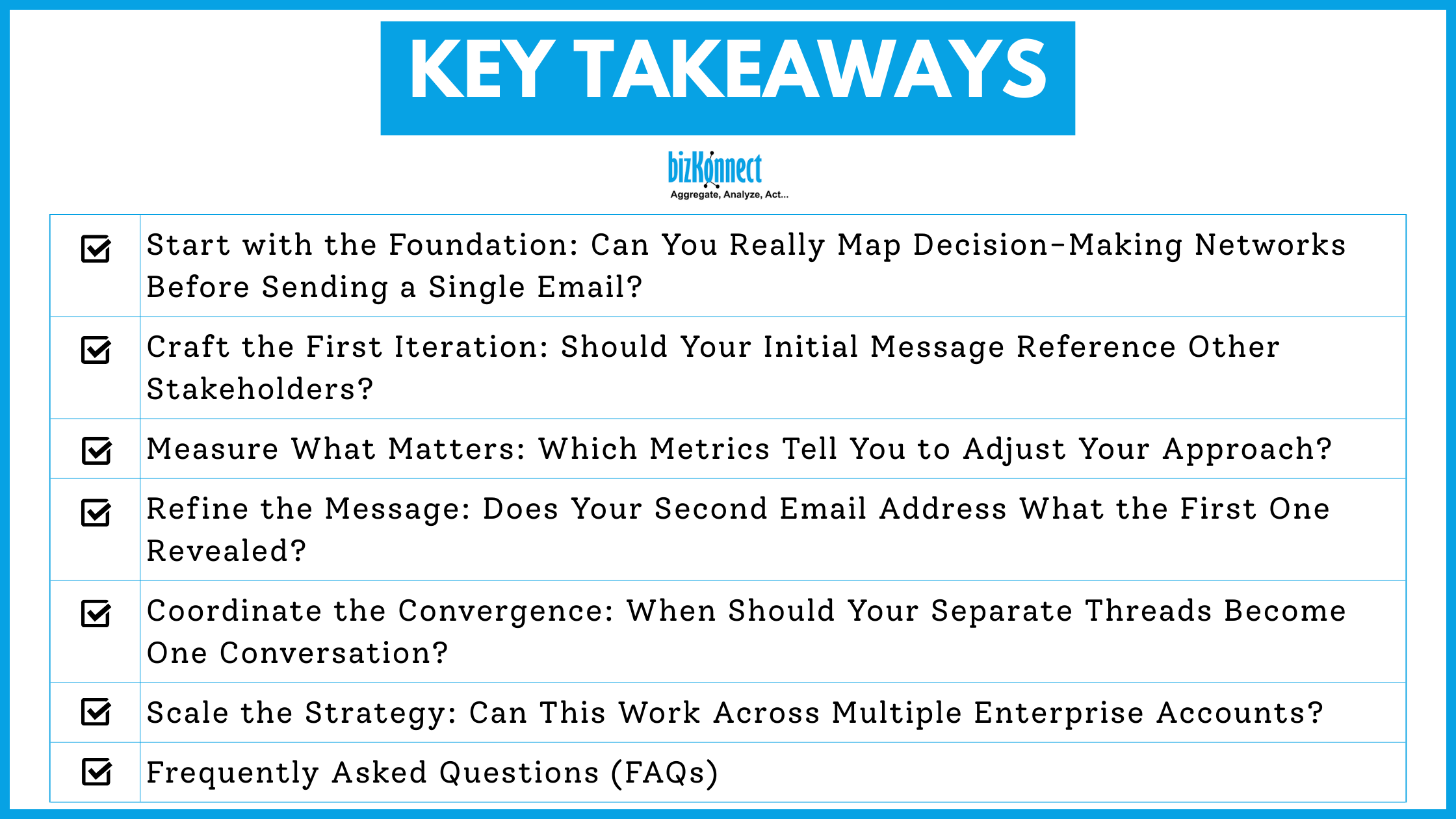
Step 1: Start with the Foundation: Can You Really Map Decision-Making Networks Before Sending a Single Email?
Before launching any outreach, you need visibility into who influences what within your target account. Traditional contact databases give you names and titles, but they don't show you that the VP of Engineering reports directly to the CFO, not the CTO, or that the Director of IT Operations has veto power despite being three levels down.
GenAI-driven org charts go beyond static hierarchies. They layer contextual intelligence on top of reporting structures:
- Recent project initiatives that align with your solution
- Pain point indicators based on public statements and company movements
- Reference connections showing which executives you're already connected to through mutual contacts
- Influence mapping that reveals who actually drives technology purchase decisions versus who signs the paperwork
When you know the CTO and CFO both sit on the same committee, you can ensure your messages acknowledge their collaborative role rather than positioning them as separate silos.
Step 2: Craft the First Iteration: Should Your Initial Message Reference Other Stakeholders?
Here's where most multithreaded outreach fails.
Sales teams send simultaneous emails to multiple executives with zero acknowledgment that these people work together. The CTO receives a pitch about API capabilities while the CFO gets budget optimization talking points, and neither message hints at the other's existence.
Your first iteration should establish context without creating confusion.
Email the CTO about specific technical challenges like integration complexity, scalability constraints, security compliance requirements. Reference business outcomes that matter to finance: "While this solves your API orchestration challenge, the broader impact is reducing infrastructure costs by eliminating redundant middleware."
Simultaneously, your message to the CFO leads with cost reduction and operational efficiency, but includes a technical credibility marker: "Our approach achieves these savings through automated API management, which your CTO would recognize as addressing the integration bottleneck your team faces."
In the end, you're not copying them on the same email, rather you're creating parallel narratives that acknowledge each other's existence and reinforce mutual value.
Step 3: Measure What Matters: Which Metrics Tell You to Adjust Your Approach?
Iterative email campaigns for B2B succeed because they're built on continuous refinement, not guesswork. After your first email, analyze engagement patterns across different titles and functions:
- Response rates by persona: Is the CTO ignoring you while the VP of Engineering responds? That tells you the real technical decision-maker.
- Click-through behavior: Did the CFO click your ROI calculator but not respond? The value proposition landed, but the call-to-action didn't.
- Cross-functional engagement: When the CTO forwards your email to someone, track where it goes. That reveals the actual approval chain.
This is where email marketing optimization separates effective campaigns from spam.
You're not just counting opens, instead you're mapping organizational behavior. If your technical message gets traction but financial stakeholders stay silent, your next iteration needs to strengthen the ROI narrative without diluting technical credibility.

Step 4: Refine the Message: Does Your Second Email Address What the First One Revealed?
Iterative email campaigns vs one-time campaigns deliver fundamentally different results because each iteration incorporates learning from the previous one. Your second email isn't just a follow-up, it's a strategically adjusted message based on actual engagement data.
If analytics show the CFO clicked through but the CTO didn't engage, your second iteration might:
- Send the CTO a more specific technical validation case study
- Email the CFO a message that says: "Since you reviewed our cost analysis, here's how three companies in your industry secured technical buy-in from engineering teams"
- Introduce a new stakeholder, perhaps the VP of Operations, who emerged in your org chart analysis as the connector between finance and technology
Step 5: Coordinate the Convergence: When Should Your Separate Threads Become One Conversation?
The goal here isn't to keep conversations separate forever, it's to build individual credibility before requesting collaborative evaluation. A dynamic org chart will reveal natural convergence points like a quarterly planning meeting, a technology steering committee, or an annual budget review cycle.
Timing your convergence message matters because once you've established separate rapport with the CTO and CFO, your third or fourth iteration can acknowledge the broader collaboration:
"I've shared technical validation with [CTO name] and cost modeling with [CFO name]. Would it make sense to discuss how both aspects come together in your Q2 planning process?"
This approach works because you've earned the right to request their time together. You're facilitating a conversation between stakeholders who've independently validated different aspects of your solution.
Step 6: Scale the Strategy: Can This Work Across Multiple Enterprise Accounts?
Manual coordination across multiple stakeholders in multiple accounts doesn't scale. That's the strategic advantage of combining iterative campaigns with GenAI-driven actionable org charts. Your campaign upgrades the execution while maintaining personalization:
- Schedule follow-ups based on engagement triggers, not arbitrary timelines
- Adjust messaging based on which content performs best with specific titles
- Track movement within accounts as prospects shift from cold to warm to active opportunities
Ultimately, each contact receives fewer, better messages that acknowledge their specific role and how it connects to others in their organization.
Conclusion:
B2B success in 2026 depends on the ability to remain visible to multiple stakeholders without being redundant. By combining iterative email campaigns with contextual org intelligence, you transform cold outreach into a strategic account entry. This method ensures that the CTO sees you as a technical ally while the CFO views you as a fiscal asset, creating a unified front for your solution to be adopted.
This is how modern teams enter accounts without friction. Not by saying more, but by saying the right things, to the right people, in the right sequence.
Now, let’s address some FAQs that might emerge while execution of such a high-level strategy
Q1. How do you ensure the CTO and CFO don't feel "pitted" against each other by your emails?
The GenAI-driven org charts provide the context needed to align your messages. By referencing the same corporate goal from two different angles, you position yourself as a partner to the entire organization rather than a disruptive vendor.
Q2. What happens if the org chart changes during the campaign?
The GenAI-driven actionable org charts are interactive and updated to track movement. This allows you to see when a prospect moves or if a new stakeholder enters the decision-making tree, allowing you to pivot your iteration immediately.
Q3. Can iterative campaigns work for niche industries with smaller target profiles?
Yes. The first step of any iterative campaign is configuring the specific business ecosystem. This ensures that even in niche markets, the messaging is tailored to the exact pain points of that specific industry.
If your outreach strategy already involves multiple stakeholders, the difference between progress and silence often comes down to orchestration.
Want to know how BizKonnect helps teams map that orchestration clearly and act on it intelligently? CLICK HERE.