


Most Go-To-Market (GTM) teams lose healthcare deals not because their product fails, but because their internal account maps are anchored to outdated stakeholders.
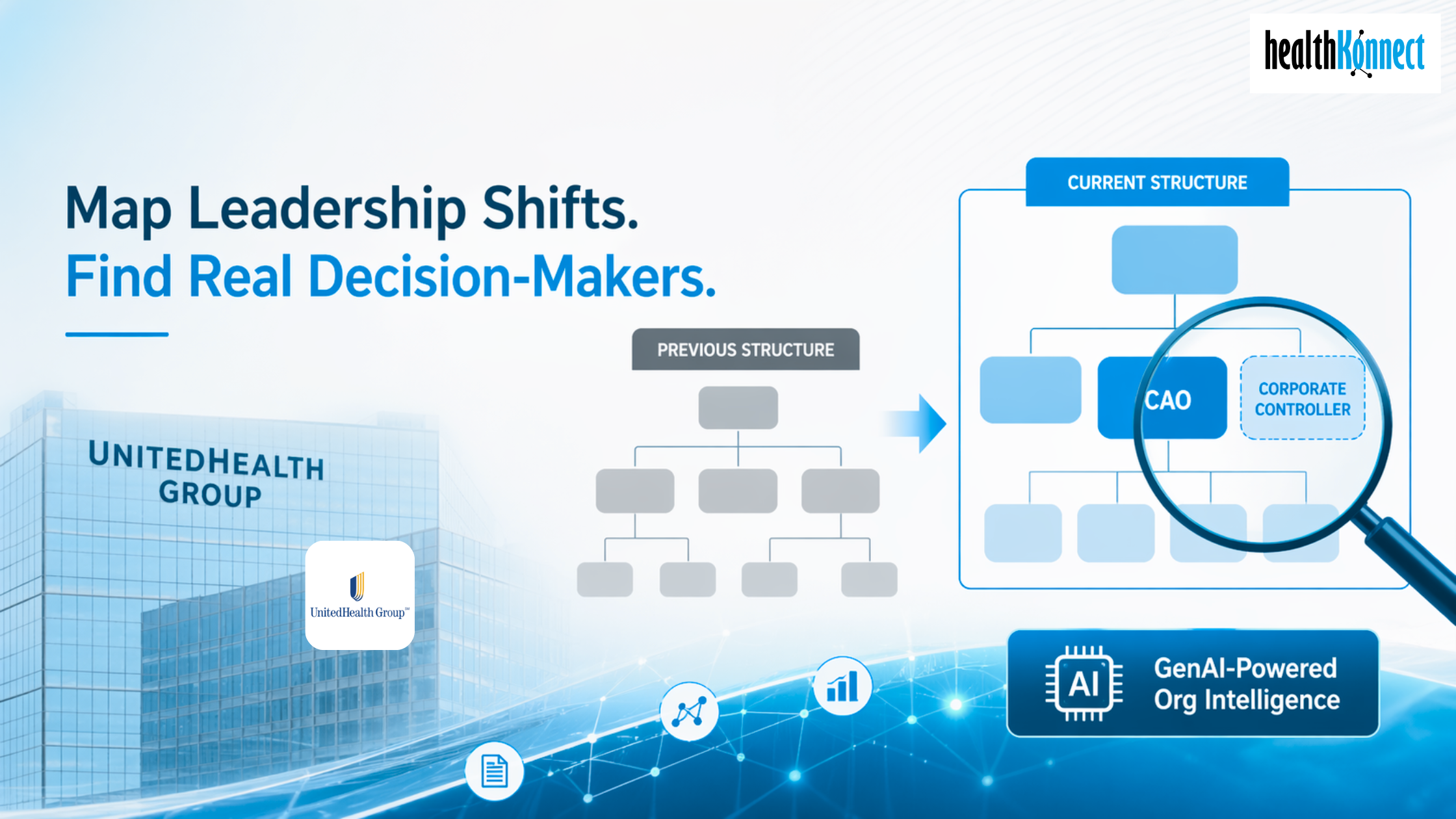
On March 2, 2026, UnitedHealth Group (UHG) executed a significant leadership transition: the Board appointed Dennis Stankiewicz as the new Chief Accounting Officer (CAO). For vendors selling audit, compliance, or financial IT solutions, it is a fundamental shift in the buying committee.
To map this shift and drive high-stakes outreach, you need GenAI-driven UnitedHealth org charts.
This transition highlights a critical GTM execution gap: the reliance on static data in a high-velocity enterprise environment. Dennis Stankiewicz now holds a dual mandate, continuing his responsibilities as Corporate Controller while assuming the CAO mantle. Health company org charts backed by GenAI help to explore implication of this shift within UnitedHealth Group in real time.
This guide explores how to navigate this specific leadership trigger and how GenAI-driven healthcare organizational chart mapping ensures you are engaging the actual decision-maker rather than a historical figurehead.
Why Does a Single C-Suite Appointment Change Your Entire Account Map?
The short answer: because it rarely travels alone.
When Stankiewicz moved from Corporate Controller to Chief Accounting Officer, Tom Roos simultaneously transitioned from CAO to CFO of Optum Insight. That is two decision-maker positions changing in a single SEC filing. In an organization generating $447.57 billion in annual revenue with a market cap of $265.66 billion, these shifts cascade downward. New budget owners emerge, existing relationships lose relevance, and approval chains that worked six months ago no longer reflect how finance decisions actually get made.
Most account maps do not capture this. They capture names and titles at a point in time. What they miss is the relational logic:
- Who reports to whom after the reorganization?
- Who now controls the relevant budget?
- Which stakeholders have picked up new purchasing authority?
- Which existing contacts have shifted focus to a different business unit?
This is what makes a robust healthcare leadership chart so operationally critical. It is not a contact list, rather it is a decision-making map.
What Is a Health Company Org Chart, and Why Does It Need to Be Dynamic?
A health company org chart backed by GenAI is a structured representation of reporting relationships and functional responsibilities within a healthcare organization. At the surface level, that sounds straightforward. In practice, for a company like UnitedHealth with wide business units spanning UnitedHealthcare and Optum, the organizational structure is a living system.
Stankiewicz's background illustrates why this matters for vendor targeting.
He joined UnitedHealth in August 2016, previously served as general auditor, and was a partner at Deloitte & Touche before that. He brings more than 24 years of professional experience to a role that now carries an annual base salary of $550,000, an 85% cash bonus target against that base, and long-term stock-based incentive participation.
That profile tells you something specific. He is not a political appointment, instead it is an audit-first, controls-oriented leader. For vendors, that background directly shapes what resonates:
- Risk and compliance platforms: his general auditor background makes him a natural evaluator
- Financial reporting and close management software: relevant given his Controller duties
- Internal audit and controls infrastructure: aligns with his Deloitte partner experience
- Regulatory reporting tools: UnitedHealth's scale and oversight requirements make this a live category
Why Are Org Charts Important in Healthcare Organizations, Especially at Enterprise Scale?
In global healthcare company organizational structures, the distance between a title and actual purchasing authority is significant.
A Chief Accounting Officer at UnitedHealth does not operate in isolation. Stankiewicz retains the Corporate Controller role alongside his new appointment. That dual responsibility matters: it means he holds both the oversight function and the operational execution function for financial reporting.
For vendors, this kind of structural detail reshapes the sales motion entirely. Here is where teams most commonly misread the account:
- They target the CFO by default. At Optum Insight, that is now Tom Roos. But Roos just transitioned out of the CAO seat. His priorities, relationships, and focus areas have shifted to a different business unit.
- They ignore the Controller layer. Because Stankiewicz is also Corporate Controller, he sits closer to day-to-day financial operations than a standard CAO might. Vendors with operationally-focused financial software should not bypass this level.
- They fail to map Optum vs. UnitedHealthcare. These are distinct entities with distinct leadership. A change in one does not immediately transfer to the other.
Benefits of organizational charts in healthcare companies go well beyond contact management.
Done properly, a healthcare organizational chart reveals buying committee structure, budget ownership, and where new priorities are likely to emerge following a leadership transition.
How Can GenAI-Driven Healthcare Org Charts Solve the Stale Data Problem?
The traditional alternative is manual research. Someone on the team watches SEC filings, cross-references LinkedIn, checks press releases, and updates a CRM field. At the pace UnitedHealth moves, that process is permanently behind.
GenAI changes the operational model. Instead of periodic manual updates, AI-driven org chart systems can continuously monitor public signals and reflect leadership movements in near real time. The data sources that matter most:
- SEC 8-K filings disclosing executive appointments and compensation
- Regulatory disclosures tied to role changes and reporting responsibilities
- Press releases from corporate communications teams
- LinkedIn profile updates from the executives themselves
For the Stankiewicz appointment specifically, the signal was embedded in an SEC filing dated March 2, 2026.
Most sales teams would encounter that information weeks later, if at all. A GenAI-powered system surfaces it immediately and maps its downstream implications: who moved, what role was vacated, what new authority was created.
More importantly, these systems can enrich the structural data. Stankiewicz's compensation structure, his prior tenure as general auditor, his Deloitte background: these are buyer-profiling inputs that shape outreach strategy. A GenAI-driven healthcare organizational chart turns raw appointment data into a usable account intelligence layer.
This is the practical gap that static healthcare org chart templates, however well-designed for 2025, simply cannot close at scale.
With these challenges and solutions in mind, a few important questions naturally arise for teams navigating similar situations. Let’s address a few of them:
Frequently Asked Questions (FAQs)
Q1. What makes Dennis Stankiewicz's dual role significant for vendor targeting?
He holds both the CAO and Corporate Controller positions simultaneously. This means he oversees both strategic financial reporting and operational financial controls, making him relevant to a wider range of vendor categories than a typical CAO appointment would suggest.
Q2. Does a CAO appointment affect vendors selling outside the finance function?
Yes. CAO-level changes often trigger downstream reviews of compliance tools, audit software, and reporting infrastructure. Even vendors with tangential finance touchpoints may find new evaluation cycles open up following a leadership change at this level.
Q3. How often do large healthcare companies like UnitedHealth change finance leadership?
More frequently than most account maps reflect. The same March 2, 2026 filing involved two leadership movements. At enterprise healthcare companies, leadership transitions across divisions happen on a rolling basis throughout the year.
If your account maps for UnitedHealth or similar enterprise healthcare companies are not reflecting this kind of real-time leadership intelligence, your outreach is likely landing in the wrong inbox. CLICK HERE to see how BizKonnect helps sales teams stay ahead of healthcare org changes with GenAI-powered decision-maker mapping.