


The voluntary carbon market is projected to hit €3 billion in 2026 and €15 billion by 2035. Compliance markets are expanding fast, with the EU ETS covering 11,000+ installations and new schemes launching across India, Singapore, and North America. The opportunity for carbon credit markets is significant.
But growth depends on answering one critical question:
who exactly should we be selling to, and how do we get to the right person inside each account?
Enterprise carbon credit buyers are not a monolith. An airline managing CORSIA compliance has different priorities and a different internal buying committee than a steel manufacturer under EU ETS, a bank building a carbon portfolio, or a tech company chasing a net-zero pledge. Reaching one person at each account is rarely enough. These deals involve Sustainability, Finance, Legal, Procurement, and Trading desks, often simultaneously.
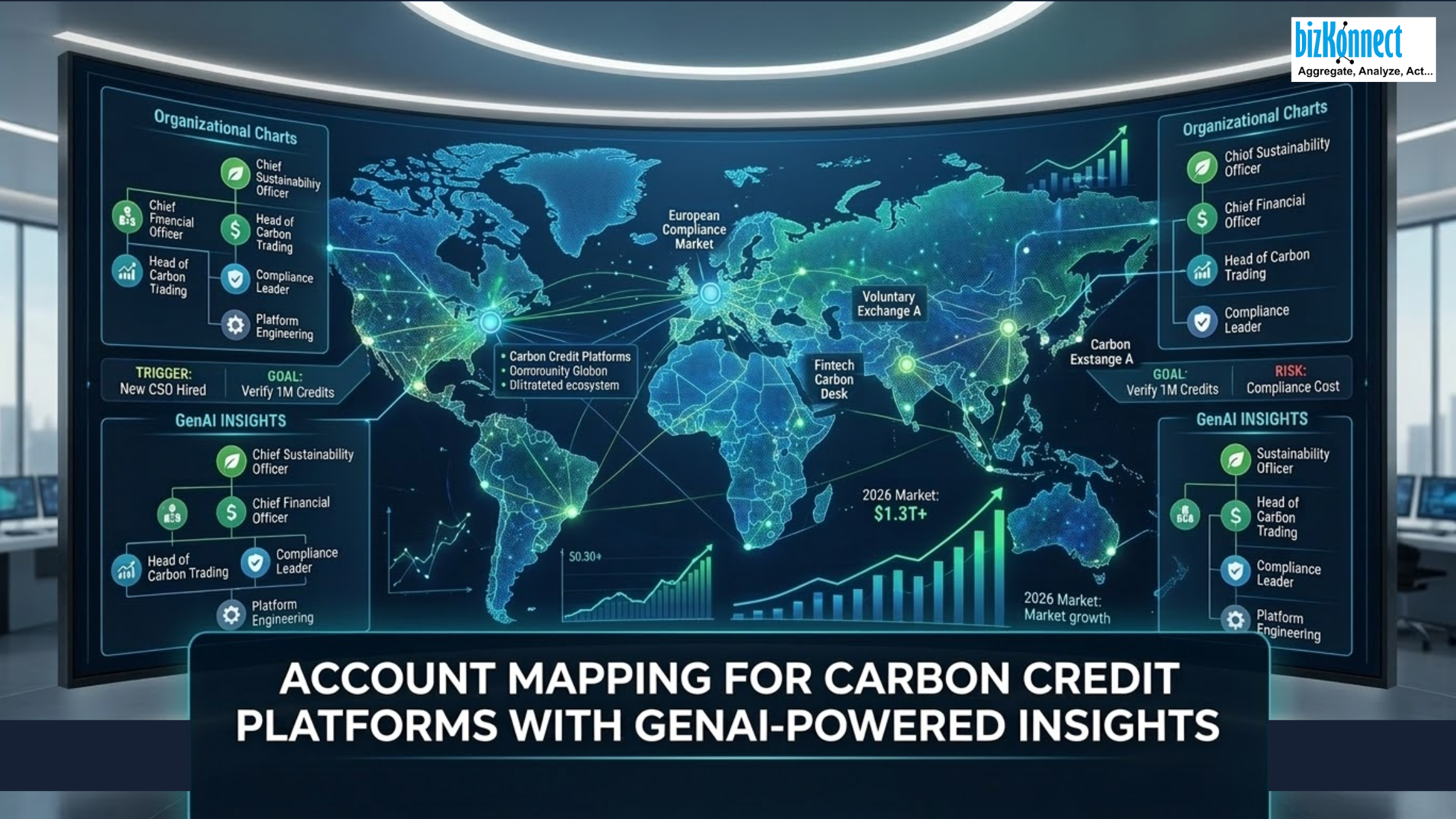
This is why leading carbon credit markets in 2026 are combining Account-Based Marketing (ABM) with GenAI-driven actionable org charts to identify, map, and engage the full buying committee inside each target enterprise.
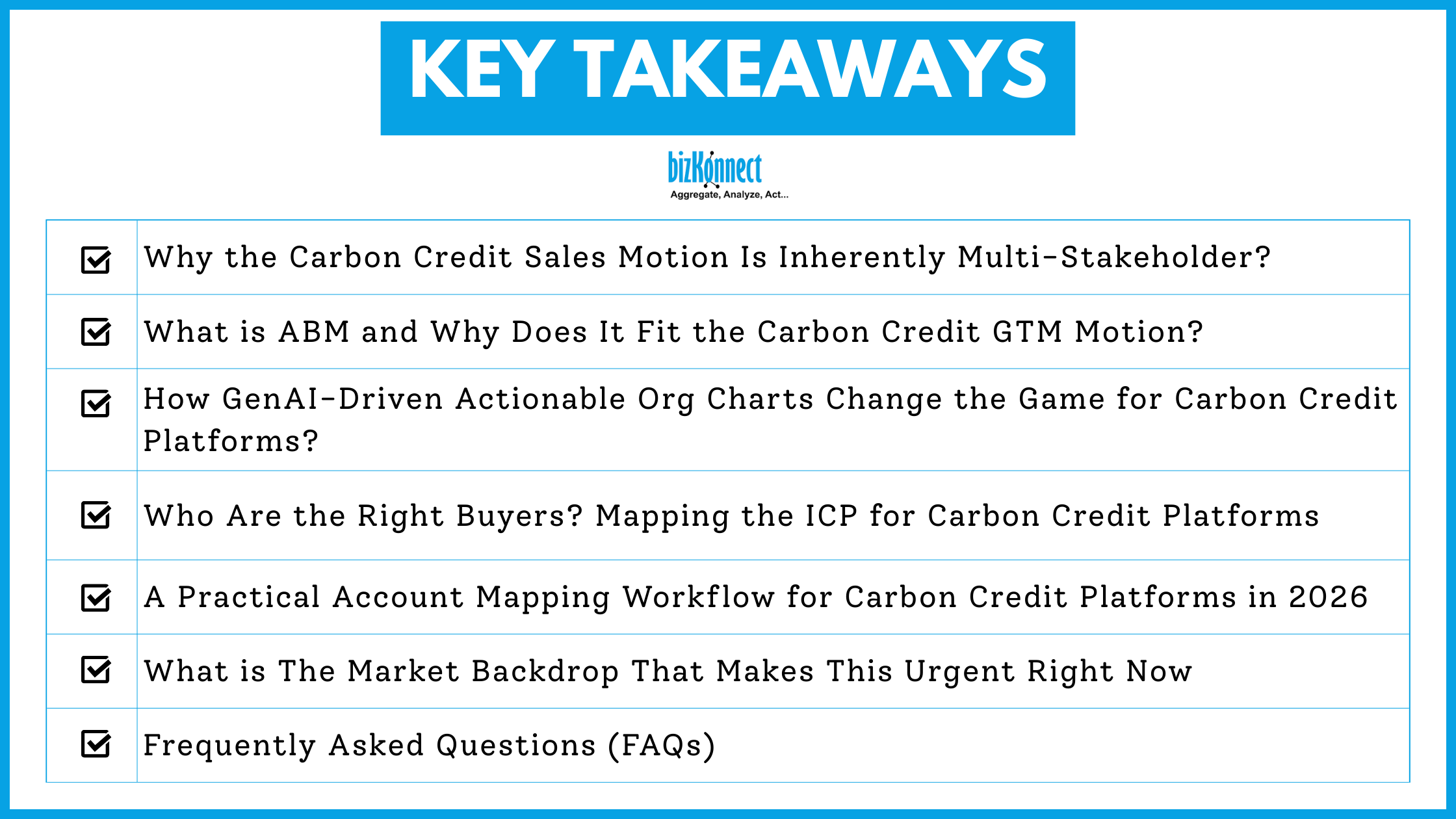
Why the Carbon Credit Sales Motion Is Inherently Multi-Stakeholder?
Unlike a SaaS subscription sold to a single budget holder, a carbon credit deal inside a large enterprise involves a web of decision-makers and influencers:
- The Chief Sustainability Officer champions the initiative and sets the net-zero strategy
- The CFO approves the budget and evaluates cost-per-tonne economics vs. internal abatement
- The Head of Compliance determines whether the credits meet EU ETS, CORSIA, or SBTi requirements
- The Head of Procurement negotiates terms and manages vendor relationships
- The Carbon Strategy Lead or ESG Analyst evaluates credit quality, vintage, and registry credentials
- Legal reviews contractual obligations and greenwashing liability
Miss any one of these stakeholders and a deal either stalls or dies.
This is the core sales challenge for carbon credit markets and it is exactly the problem that ABM combined with GenAI org chart intelligence is designed to solve.
What is ABM and Why Does It Fit the Carbon Credit GTM Motion?
Account-Based Marketing (ABM) is a go-to-market strategy where sales and marketing align around a defined set of high-value target accounts. For carbon credit platforms, ABM works because the buyer universe is concentrated and identifiable. So, you are selling to a few thousand large enterprises globally that have the regulatory exposure, the ESG commitments, and the balance sheet to become significant buyers.
These accounts can be identified by:
- Industry and emissions intensity (airlines, steel, cement, oil and gas, shipping)
- Regulatory exposure (EU ETS participants, CORSIA-obligated carriers, CBAM-affected importers)
- Public net-zero commitments (SBTi signatories, Race to Zero members, CDP reporters)
- Voluntary market signals (previous credit retirements, sustainability report disclosures)
- Geographic footprint (expansion into regions with new carbon trading schemes)
Once these accounts are identified, ABM allows platforms to concentrate resources, personalize outreach, and run coordinated multi-stakeholder engagement rather than chasing individual inbound leads.
How GenAI-Driven Actionable Org Charts Change the Game for Carbon Credit Platforms?
Knowing which companies to target is step one. Knowing who to engage inside each company and in what sequence is where most platforms still lose deals. GenAI-driven actionable org charts go beyond static contact lists. They map organizational structure, reporting lines, and real-time signals like executive hires, team restructures, and public sustainability commitments.
For a carbon credit market, this means being able to identify:
- The CSO or VP ESG who owns the net-zero mandate and champions the initiative internally
- The CFO who controls budget and evaluates cost-per-tonne economics
- The Head of Compliance who determines regulatory validity of credits
- The Carbon Strategy Lead who assesses credit quality, vintage, and registry credentials
- New hires in sustainability roles, the strongest buying signal in this space
When a company appoints a new Head of Carbon Strategy, that person typically arrives with a vendor evaluation mandate and a 60-to-90-day window to act. GenAI org charts surface these hires, allowing platforms to reach new decision-makers before competitors do.
Who Are the Right Buyers? Mapping the ICP for Carbon Credit Platforms
Carbon credit platforms should segment their target accounts into four distinct buyer tiers, each requiring a different entry point and messaging approach:
- Compliance-obligated emitters: Airlines under CORSIA, heavy industry under EU ETS, shipping companies, and manufacturers facing CBAM. These are the highest-urgency buyers with regulatory deadlines driving purchase timelines.
- Voluntary net-zero corporations: Fortune 500 companies with SBTi targets, tech giants with Scope 1-3 pledges, and consumer brands under investor pressure. They need high-integrity credits to cover residual emissions.
- Financial institutions: Banks building carbon trading desks, asset managers developing ESG products, and commodity trading firms with carbon portfolios. Entry point is Sustainable Finance and Risk, not Sustainability.
- ESG and SaaS platform partners: Software vendors integrating carbon credit access into ERP, procurement, or ESG reporting tools. Entry point is Partnerships and Product rather than Sustainability.
A Practical Account Mapping Workflow for Carbon Credit Platforms in 2026
Here is a step-by-step playbook for carbon credit platforms to operationalize ABM with GenAI org chart intelligence:
Step 1: Build a Carbon-Specific Ideal Customer Profile (ICP)
Define your target accounts by regulatory exposure, geographic market, emissions profile, and existing sustainability commitments. Separate compliance buyers from voluntary buyers, as they have different urgency levels, budget cycles, and internal decision-making structures.
Step 2: Identify Active Buying Triggers
Monitor for signals that indicate an active evaluation window: new CSO or carbon lead hires, publication of a corporate net-zero roadmap, regulatory deadlines approaching, participation in ICVCM alignment programs, or funding rounds earmarked for sustainability infrastructure.
Step 3: Generate GenAI-Powered Org Charts for Each Priority Account
For each target account, build a living org map that shows who owns sustainability decisions, who controls budget, who sits at the compliance gate, and who might serve as an internal champion. This is not a one-time exercise, GenAI keeps these maps current as roles change.
Step 4: Anchor Messaging to Each Stakeholder’s Specific Pain
The CSO cares about credit integrity, greenwashing risk, and alignment with ICVCM Core Carbon Principles. The CFO cares about cost-per-tonne efficiency and compliance cost containment. The compliance head cares about regulatory validity. The trading desk cares about liquidity and vintage flexibility. GenAI lets you build these tailored narratives at scale without a custom research team.
Step 5: Run Coordinated Multi-Stakeholder ABM Sequences
Engage multiple stakeholders simultaneously across LinkedIn, direct email, industry events, and webinars. Each touchpoint reinforces an account-specific narrative rather than a generic pitch. The goal is to build internal consensus across the buying committee before a formal RFP is ever issued.
What is The Market Backdrop That Makes This Urgent Right Now
Several 2026 developments are accelerating the need for this approach:
- CORSIA Phase I is now live, creating a wave of mandatory airline buyers who are simultaneously evaluating multiple credit suppliers
- EU carbon permits hit €82.85 per tonne in late 2025, driving compliance buyers to optimize procurement strategies urgently
- CCP-tagged credit retirements more than doubled in 2025, pushing platforms to articulate integrity credentials clearly to differentiated buyer segments
- India’s Carbon Credit Trading Scheme and Singapore’s regional cooperation frameworks are opening entirely new enterprise buyer pools that few platforms have mapped yet
- The voluntary carbon market stalled in 2025 despite surging corporate commitments, meaning platforms must go to buyers rather than wait for inbound demand
The platforms that build precise account intelligence and multi-stakeholder engagement capabilities now will be positioned to capture disproportionate share as the market accelerates toward its projected €15 billion scale by 2035.
Frequently Asked Questions (FAQs)
Q: What is the strongest signal to trigger outreach?
A new hire in a carbon, sustainability, or ESG compliance role. They typically carry a vendor evaluation mandate within their first 90 days.
Q: How do we handle accounts running both compliance and voluntary programs?
Treat them as two separate buying units with different budget owners and timelines. Map and sequence outreach for each track independently.
Q: How do we prioritize across a large account list?
Score on regulatory deadline proximity, public commitment specificity, and active hiring signals in carbon-related roles.
Carbon credit markets have a concentrated, high-value enterprise buyer universe but only if they can navigate the organizational complexity of each account. ABM provides the strategic framework for precision targeting. GenAI-driven actionable org charts provide the intelligence to execute it: reaching the right stakeholder, at the right moment, with a message built specifically for their role in the buying committee.
Want to see how BizKonnect maps the buying committees inside your top target enterprise accounts? CLICK HERE to explore our carbon credit account intelligence capabilities.
CLICK HERE to know more with BizKonnect.