


StandardAero, a dominant force in global aerospace engine maintenance and manufacturing components, has confirmed that Paul McElhinney will become Chief Executive Officer, succeeding the retiring Russell Ford.
Here’s what happens:
A press release goes out and a board confirms a new CEO. Inside the company, reporting lines start moving before anyone outside notices. Outside it, B2B teams are still working from contact records that describe a structure that no longer exists. That lag, between the announcement and the moment the org chart catches up, is where deals get lost.
The announcement takes thirty seconds to read but acting on it correctly takes a framework, not a notification.
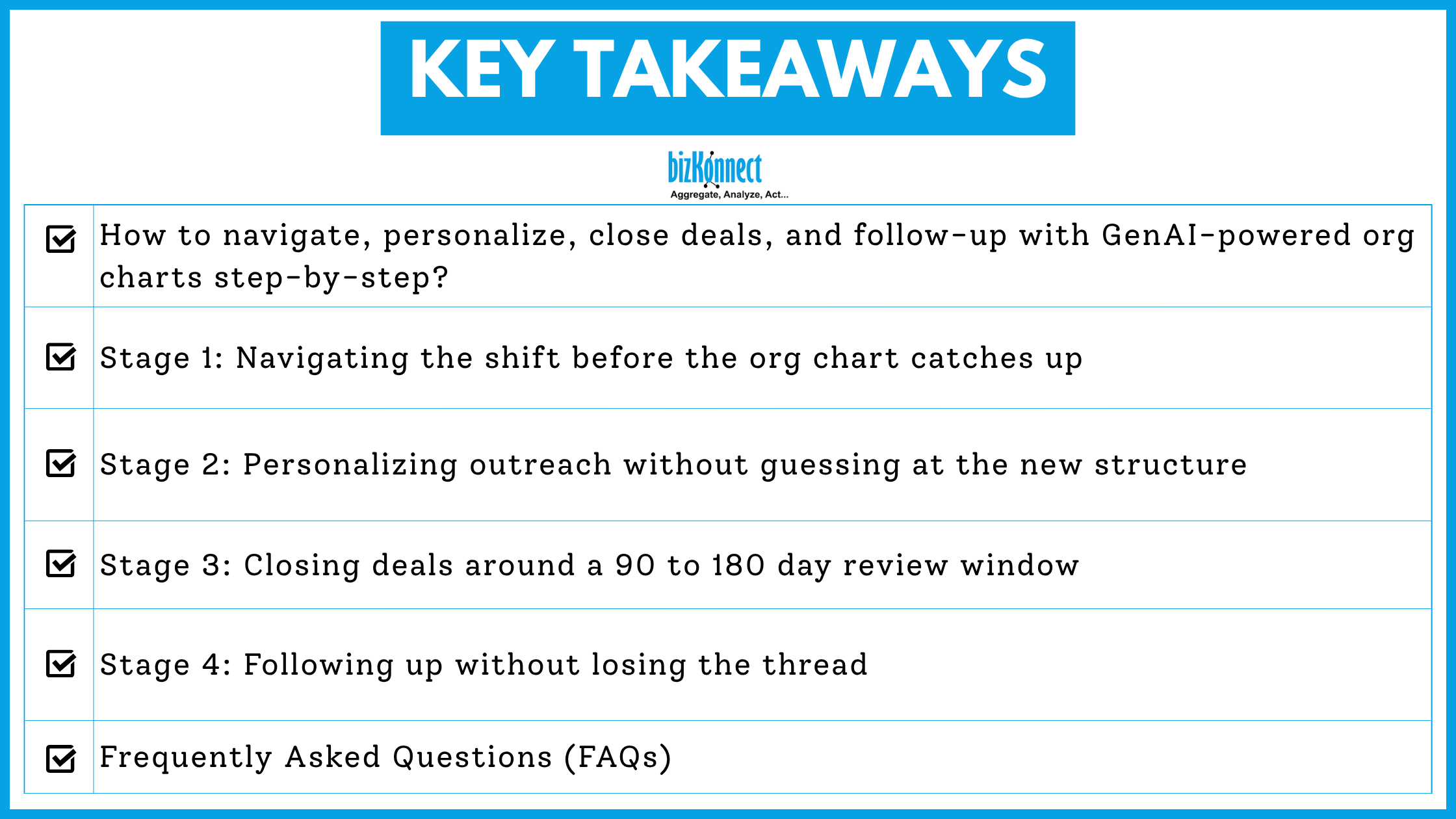
What follows is that framework: how to navigate the shift, personalize outreach around it, close deals through it, and follow up after it with GenAI-backed org charts, in that order, because skipping a stage is how good intentions turn into noise.
Let’s get into each stage one-by-one:
# Stage 1: Navigating the shift before the org chart catches up
Ford will retire after thirteen years leading the company, with McElhinney, a thirty-five-year industry veteran and the company's current Lead Independent Director, appointed to succeed him effective October 1, 2026. The detail easiest to skip past: the incoming CEO was already inside the boardroom. That changes what navigating the shift actually means.
A traditional approach treats navigation as a research task, someone manually checking LinkedIn, guessing at what changes next. A GenAI-driven org chart treats it as a live mapping problem instead:
- It cross-references McElhinney's board tenure since 2019 against the current leadership layer to flag which executives he's already worked alongside
- It pulls his prior roles, leading GE Power Services, a $15 billion aftermarket business, and GE Aviation Services, where he more than doubled its backlog to over $100 billion, to infer which operating disciplines he's likely to bring forward
- It timestamps the chart itself, so a team can see whether the structure reflects pre- or post-announcement reality
Skip this stage, and every later one inherits the error. The scale of what's being navigated is worth grounding in numbers:
| Year | Annual Revenue | Milestone |
|---|---|---|
| 2013 | $1.6 billion | Russell Ford becomes CEO |
| 2024 | - | StandardAero completes its IPO |
| 2025 | $6 billion+ | Revenue, earnings, and backlog growth sustained since |
A company that grows nearly fourfold in twelve years adds procurement layers that an annual chart refresh was never built to track in real time, which is exactly the gap GenAI-driven mapping closes.
# Stage 2: Personalizing outreach without guessing at the new structure
Once the shift is mapped, the need is to personalize immediately, drop McElhinney's name into a templated email, congratulate someone on a promotion that isn't confirmed. This is exactly where lead enrichment starts hurting targeting accuracy instead of helping it. Generic enrichment fills in titles and emails; it rarely captures which reporting lines have actually moved, only which existed last quarter.
A GenAI-driven org chart personalizes differently, generating outreach logic from confirmed structure rather than inferred structure:
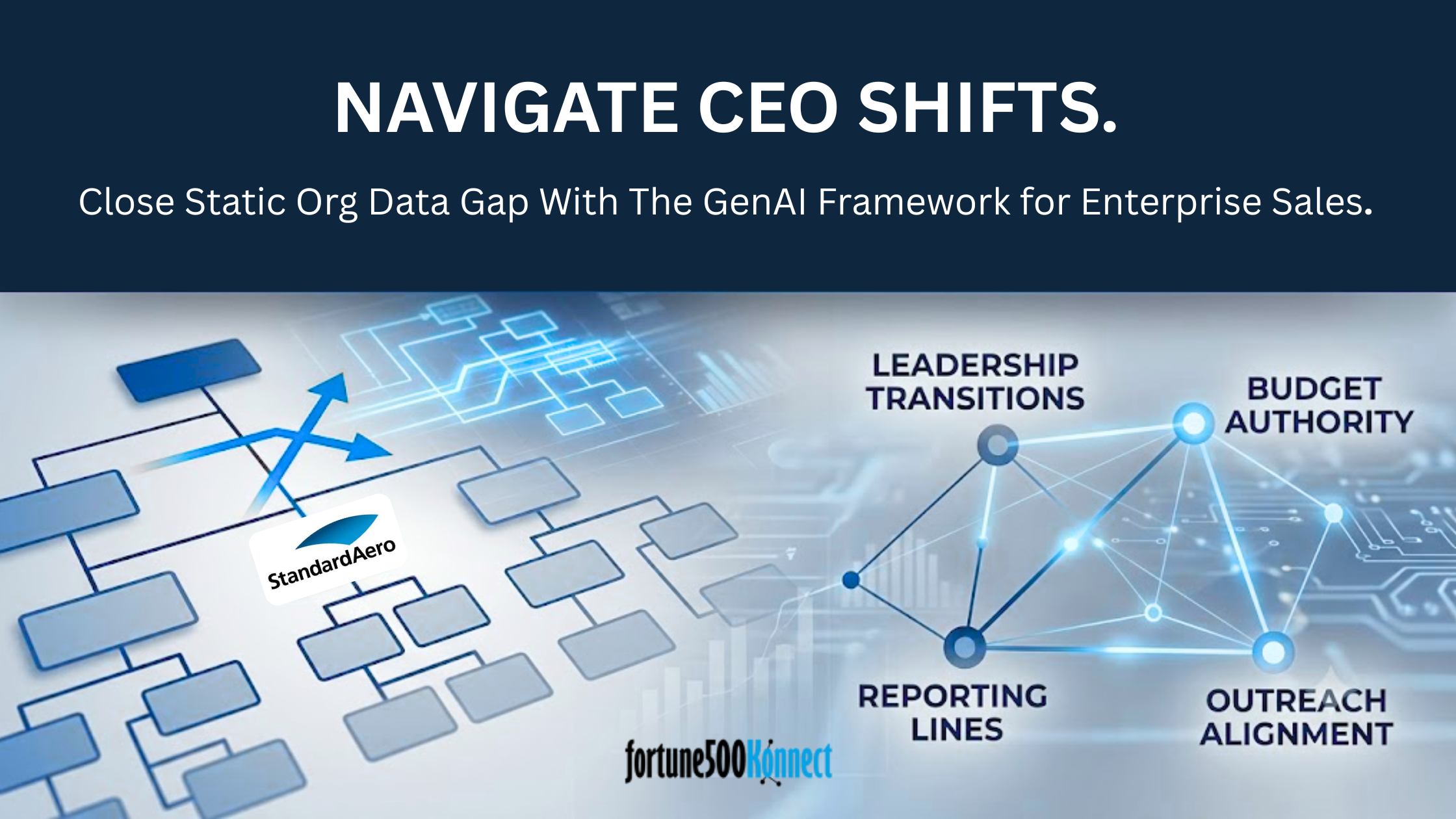
- It identifies which contacts now report into a changed chain of command, so messaging reflects who actually has budget authority today
- It surfaces McElhinney's documented priorities, his comments on robust demand across StandardAero's commercial, military, and business aviation end markets, as a substantive hook instead of a generic congratulations
- It flags contacts whose influence may be declining post-transition, so effort isn't wasted chasing a champion who no longer holds relevant authority
Identifying Fortune 500 decision makers using org chart data only works if the data reflects who decides, not who used to.
# Stage 3: Closing deals around a 90 to 180 day review window
This is the stage where most frameworks fall apart, because closing a deal during a transition is all about timing the proposal to the new CEO's evaluation rhythm rather than the seller's quarterly target.
Director Doug Brandely framed the appointment as the result of deliberate succession planning, noting McElhinney's deep understanding of the company's strategy, customers, and culture built over years on the board. That continuity is good for the business and a signal for vendors: expect informed scrutiny, instead of a blank slate.
A practical closing approach built on GenAI-driven org chart data:
- Re-score pipeline tied to the outgoing leadership structure immediately, rather than waiting for the next quarterly review to discover a champion lost authority
- Sequence proposals around the typical 90 to 180 day strategic review window new leadership tends to run, rather than pushing urgency the buyer isn't ready to match
- Separate the two effective dates correctly, McElhinney becomes CEO on October 1, 2026, and Chairman on January 1, 2027, since authority and board influence don't necessarily transfer on the same calendar
Attribution models become less reliable the moment a target account restructures, and a deal closed against the wrong assumption about who approves it stalls quietly rather than failing loudly.
# Stage 4: Following up without losing the thread
Most frameworks stop at the close. This one doesn't, because a leadership transition doesn't resolve on the day a deal closes. It keeps reshaping the account for months, and post-close follow-up built on a static org chart starts decaying again almost immediately.
A GenAI-driven org chart treats follow-up as ongoing structural monitoring rather than a calendar reminder:
- It re-checks the account's structure on a cadence faster than the typical transition timeline, instead of waiting for renewal to notice a champion moved roles
- It flags secondary movements, the new direct reports McElhinney names in his first quarter, as early signals for expansion conversations rather than unrelated noise
- It distinguishes confirmed structural changes from inferred ones, so follow-up never references authority that hasn't been confirmed yet
This is the difference between a one-time lookup and enterprise org chart intelligence as infrastructure: the first ends when the deal closes, the second never really ends at all.
Addressing a Few Frequently Asked Questions (FAQs)
Q. How frequently should GenAI-driven org charts be updated during an executive transition?
Updates should occur in near real-time. During a high-profile transition like StandardAero's, critical structural adjustments occur weekly as sub-departments realign their strategic goals before the official executive handoff.
Q. Can org chart data accurately predict budget authority shifts before they are formalized?
Yes. By monitoring secondary indicators such as departmental hiring patterns, historical vendor preferences of the incoming executive, and adjacent promotions, generative intelligence maps out emerging budget centers before formal corporate announcements.
Q. How long does post-close monitoring need to run?
Through at least the new CEO's first two quarters, the window in which most direct reports and committee assignments tend to be finalized.
Q. What's the biggest risk of skipping the navigation stage?
Outreach built on assumptions reads as uninformed exactly when a buyer expects more scrutiny, which costs more credibility than a delayed message would have.
A leadership transition at a company growing this fast is never a single event. It's four stages: navigate, personalize, close, follow up, and each only works if the actionable org chart underneath it is current enough to trust. CLICK HERE to see how BizKonnect’s GenAI-driven org chart intelligence keeps every stage of that framework running on confirmed structure.
CLICK HERE to know more with BizKonnect.