


As B2B organizations race to finalize their aggressive goals for 2026, the complexity of breaking into the vast, relationship-driven Chinese market remains a top hurdle.
Simply running broad demand generation campaigns has proven inefficient against these high-value accounts. The modern solution requires accuracy and relevance, making account-based marketing China (ABM) an essential strategy. But success hinges on visibility, a challenge increasingly addressed by cutting-edge GenAI-driven actionable organizational charts. They cut through the opacity of large, complex Chinese enterprises, pinpointing exactly who holds influence and power.
But before understanding that, let’s first address this:
Should your B2B enterprise embrace hyper-focused campaigns in the Chinese market?
The direct answer is yes, but with a critical condition: China's B2B landscape is fundamentally different. Traditional western marketing models often falter because they fail to account for the unique culture. Besides, decision-making rarely involves a single-person; it's a web of influences involving multiple departments, regional offices, and, most importantly, relationships.
This complexity is why the traditional outreach method no longer yields the necessary returns.
Account based marketing, which treats a target account as a market of one, is uniquely positioned to handle this. By focusing resources on accounts with the highest potential, companies can dedicate the time and investment required to build the trust necessary for successful sales in China. Ignoring this approach risks your entire China strategy falling behind the new China B2B marketing trends which is already being adopted by competitors.
What are the unique challenges to achieving ABM success against major Chinese enterprises?
The primary obstacle lies in mapping the internal hierarchy and influence structure, which is crucial for meeting China specific ABM requirements for B2B companies.
Sales and marketing teams struggle to answer fundamental questions:
- Who are the true decision-makers?
- Who are the key influencers?
- What are their individual priorities?
Because the structure is often opaque, involving layers of bureaucracy and group consensus, making the process of China B2B decision-making slow and frustrating. This lack of internal context means:
- Generic messaging that fails to resonate.
- Wasted time pursuing contacts with little actual influence.
- Misaligned efforts between the sales team (focused on closing) and the marketing team (focused on awareness).
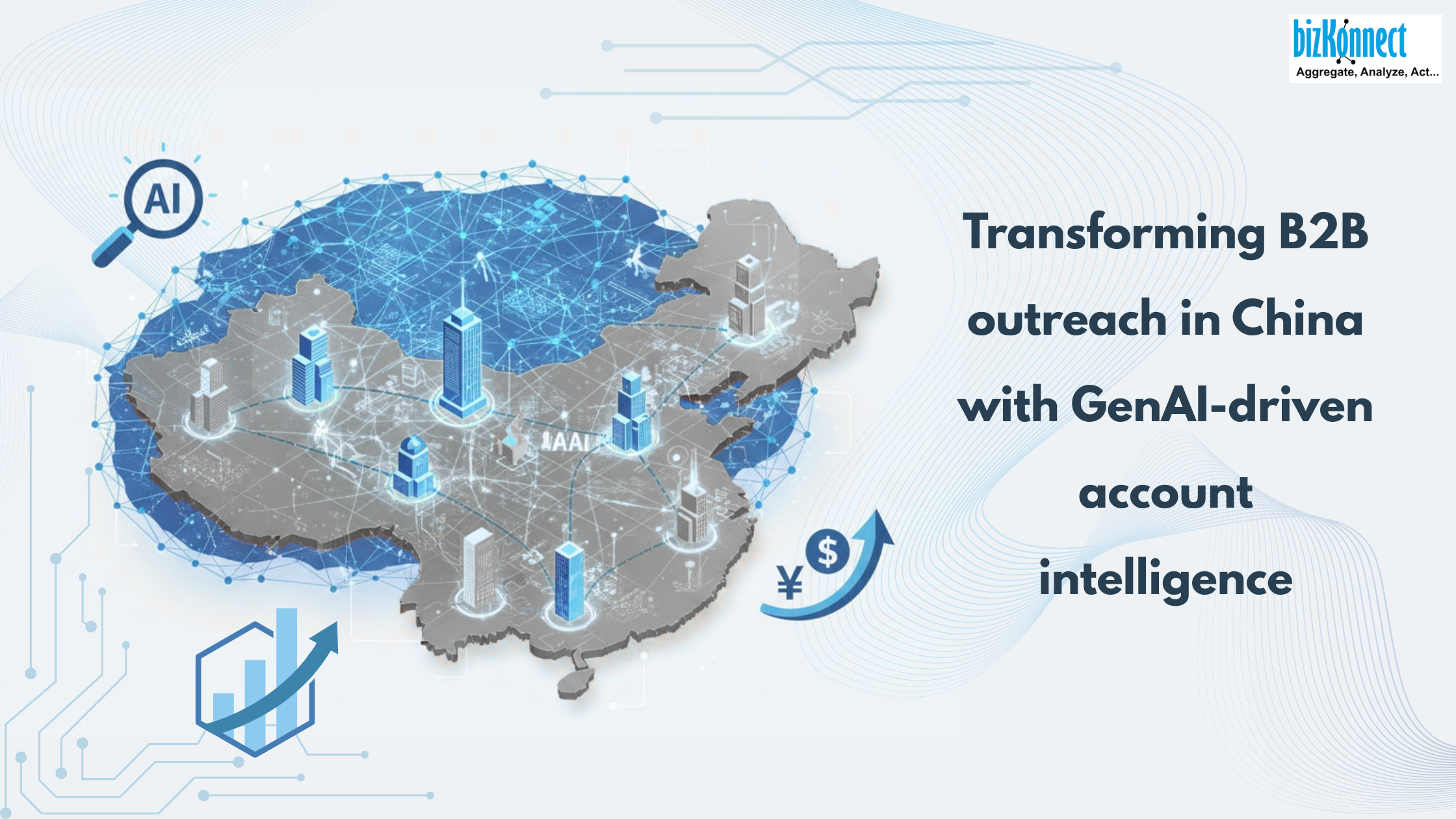
How can GenAI-driven account intelligence transform B2B outreach in China?
These next-generation organization charts go far beyond providing a simple name and title. They offer an actionable, strategic map of an account, synthesized by Artificial Intelligence. This is where the power of advanced GenAI solutions becomes indispensable for 2026 planning.
GenAI-driven org charts provide contextual intelligence by:
- Mapping the Full Influence Network: Identifying not only the core decision-makers but also critical influencers, potential internal champions (references), and even specific pain point indicators related to your solution.
- Offering an Integrated View: They serve as a strategic medium for China sales and marketing alignment, giving management, marketing, sales, and inside sales an integrated, unified perspective of the account.
- Contextualizing Insights: They leverage GenAI to provide relevant, up-to-the-minute insights such as a recent investment, a public comment by an executive on a topic, or a new project. All these are filtered specifically in the context of your solution.
This level of detail enables deep ABM personalization in China. As a result, instead of sending a generic email, sales can use the chart's insights to send a message that directly references a person's known priority or recent activity.
Can strategic account mapping truly accelerate the sales cycle within Chinese enterprises?
Absolutely. It's like having contextual charts as the "Google Maps" for navigating large Chinese enterprises. They show you the optimal routes and multiple entry points to the key contacts. So, when one connection leaves or an intended path stalls, the map instantly highlights alternative routes and contacts within the account, ensuring you are never stuck.
This approach is highly actionable. Sales teams leverage these GenAI-driven maps to:
- Craft Personalized Outreach: Using the contextual insights for highly relevant conversations.
- Generate Leads Efficiently: Inside sales teams use mapped contacts to generate high-quality leads.
- Track Progress: The maps are interactive, allowing teams to track an account's movement from initial connection to "warm" stage and eventually to sales closure and account mining thereafter.
The result is a demonstrable increase in ABM effectiveness in China heading into 2026. By combining the focused strategy of Account-Based Marketing with the accuracy of GenAI-driven intelligence, organizations can finally achieve the necessary velocity and alignment to succeed against the most coveted B2B accounts in China.
However, with these challenges identified and highly-precised GenAI solutions available, certain questions often emerge regarding execution and scaling that we are addressing below.
Frequently Asked Questions (FAQs)
1. What cultural nuances must ABM programs prioritize in China?
ABM must prioritize Guanxi (relationships) over transactional sales. This means longer nurturing cycles, localizing content with respect for hierarchy, and ensuring multiple, persistent contact points across the account's internal network.
2. How often should GenAI-driven org charts be updated for the Chinese market?
Due to the speed of change and employee movement in China, these charts should be updated continuously. The organizational intelligence needs to be constantly refreshed to maintain ABM effectiveness in China.
3. Beyond sales and marketing, which departments benefit from GenAI-driven org charts?
Management uses them to strategize and provide direction, while account management and customer success teams leverage the maps for account mining, renewals, and identifying upselling opportunities post-sale.
4. How do these charts aid in measuring the ROI of a China ABM program?
By providing a clear, trackable path through an account, the charts enable teams to measure the impact of specific marketing and sales actions on movement within the decision-making unit. Thereby proving the return on investment (ROI) for specific target accounts.
Discover what GenAI data-driven ABM really looks like for China. CLICK HERE to leverage it with BizKonnect.