


While your leadership team debates headcount approvals and onboarding timelines, companies with leaner GTM models are already running qualified conversations in markets you've been "planning to enter" for two years.
That gap is an execution problem.
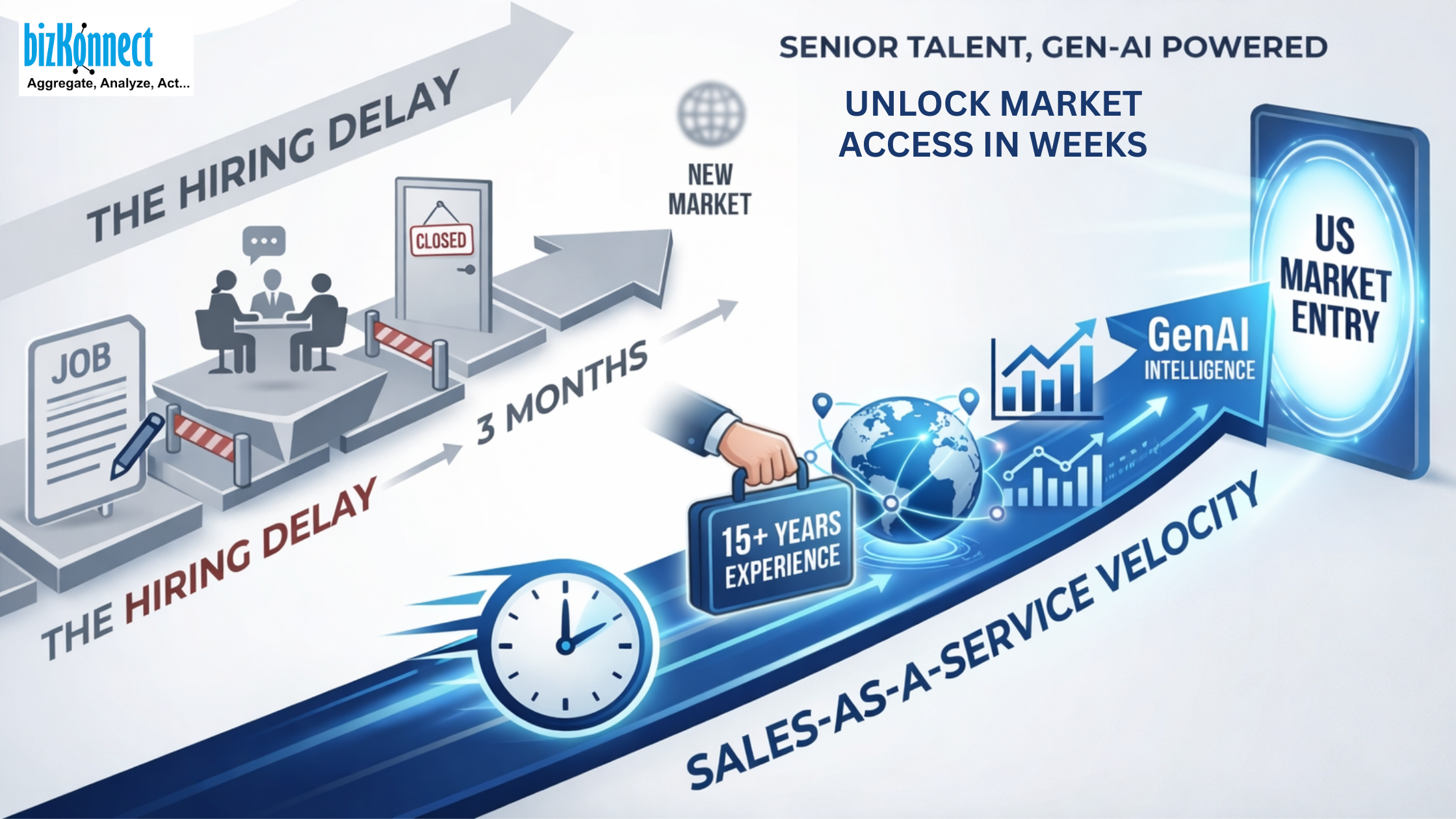
B2B Sales-as-a-Service has moved from a cost-cutting option to a genuine market entry mechanism. The model combines senior sales talent with GenAI-backed outreach intelligence. It gives companies outbound capacity that would take six to nine months to build internally with no hiring lag, ramp time, or long-term commitment.
This guide explains when the model works, where traditional approaches fail, and what execution looks like when entering the US market through a fractional sales infrastructure.
Why Are So Many Companies Getting Market Expansion Wrong Before They Even Start?
Most companies treat market entry as a hiring problem. To sell in a new market, we need a salesperson there. That logic is correct, but the execution that follows is usually expensive, slow, and poorly monitored.
Hiring a senior US-based sales executive involves substantial base compensation, benefits, tools, and management overhead with three to six months to ramp before a real pipeline exists.
The deeper problem is accountability.
A salesperson in a different timezone with limited oversight tends to self-direct in ways that may not align with company priorities. Without structured tracking, the budget gets absorbed with limited visibility into outcomes.
A recent report reinforces this urgency. Based on interviews with senior executives from over 20 multinationals across Asia and Europe, companies are accelerating US-based investments while South-East Asia and India emerge as diversification priorities. The window for entering high-value markets is not static, companies that wait often find it has narrowed before they are ready.
How Does Sales-as-a-Service for B2B Lead Generation Actually Work in Practice?
The model is more structured than most companies expect. A well-designed engagement works in four stages.
Stage one: Profile definition.
The team defines the Ideal Customer Profile precisely including industry, company size, decision-maker title, buying triggers, and geography. This determines whether the pipeline that follows is qualified or wasted.
Stage two: Align a local senior sales executive.
You get access to a professional with 15+ years of domain experience and an established network in your target sector. They represent your company in meetings, demos, and events, carrying your visiting card, LinkedIn presence, and email domain. Effectively, your country manager in the new markets.
Stage three: Intelligence and outreach.
This is where the model separates itself from a simple staffing arrangement. The backend team uses GenAI tools to identify high-fit ICPs from the sales executive's network, score prospects based on engagement signals, and generate personalized outreach at scale across email and LinkedIn.
It tracks who opens, who clicks, and who responds, then continuously refines message, timing, and volume based on that data. The result is a learning system that gets sharper with every campaign cycle with set meetings and a tracked pipeline.
Stage four: Active selling.
The sales executive conducts calls, runs demos, attends client meetings and industry events, pitches your solution, and shares structured notes with your team. Ultimately, MQLs and SQLs are generated with visibility at every stage.
Sales-as-a-Service vs Traditional Sales: Where Does the Conventional Model Break Down?
The traditional model assumes market entry is a headcount problem but it rarely is.
A full-time US hire solves the presence problem. It does not solve the network problem, the accountability problem, or the pipeline support problem. Your sales team in India or Southeast Asia has no established US relationships. Sending them to travel and sell produces inconsistent results. Relationship-based B2B selling requires local continuity, not periodic visits.
Once onboarded, there is often limited infrastructure to track a remote hire's activity. CRM entries get updated selectively, pipeline stages get inflated, and red flags appear only after a quarter of underperformance has passed.
Agility is now a strategic differentiator, but the transition is uneven because large firms restructure faster, while SMEs lack the flexibility to diversify quickly. Sales-as-a-service for startups and mid-market companies addresses this directly.
When Does Demand Generation Services Become a Competitive Advantage, Not Just a Cost Reduction?
The shift happens when the model is used offensively, not defensively.
Companies using Sales-as-a-Service purely to cut costs treat it as a temporary measure. Companies using it as a market intelligence and pipeline engine treat it as a core go-to-market asset.
Companies demonstrating agility in entering new markets are positioning themselves to capitalize on uncertainty. The winners move quickly when trade windows open. A company that deploys senior sales capacity into the new market within weeks, backed by GenAI-driven outreach and structured pipeline reporting, has a measurable speed advantage over a competitor still writing a job description.
Demand generation services embedded in the model also surface actionable market intelligence:
- Which segments respond
- Which messages land
- Which verticals are ready.
That data shapes positioning and partnership strategy well beyond the initial outreach cycle.
Now, Let’s Address Some Frequently Asked Questions (FAQs)
Q1. Is a fractional sales executive credible enough for enterprise US buyers?
Yes. Enterprise buyers respond to domain credibility and network relevance, not employment structure.
Q2. Is this model effective for complex, high-ticket B2B sales?
Yes. In fact, it is specifically designed for complex sales where a "senior" presence is required to open doors at the C-suite level, something junior BDRs or automated tools cannot achieve.
Q3. How is the performance of the remote US sales person monitored?
The model includes integrated tracking and reporting modules. You receive regular updates on clicks, opens, meeting progress, and pipeline health, managed by a dedicated backend analyst.
Expansion into the new market is no longer just a strategic decision, rather it is an execution race shaped by timing, visibility, and adaptability. If entering new markets is on your roadmap but hiring timelines are slowing you down, it may be time to reconsider the model.
CLICK HERE to explore how BizKonnect approaches this challenge with a structured, execution-first framework.
CLICK HERE to know more with BizKonnect.