


The year 2025 is drawing to a close, and for Private Equity (PE) and Venture Capital (VC) firms, the urgency to finalize pipelines and solidify strategies for a robust Q1 2026 is very clear. The market remains competitive, demanding an unprecedented volume of qualified deal flow and deeper, more accurate relationship intelligence.
Initially, the traditional answer would be hiring full-time analysts, but many firms now find that this approach slows them down. Because recruiting takes time, increases fixed cost, and does not always match the changing pace of deal sourcing. That’s why leading firms are now choosing a more agile, cost-effective solution: leveraging GenAI-trained analyst support. It helps to scale deal sourcing capacity without adding permanent overhead cost due to new hires. .
This shift is redefining how top PE/VC firms operate, transforming their relationship data from a neglected database into a strategic asset for their business.
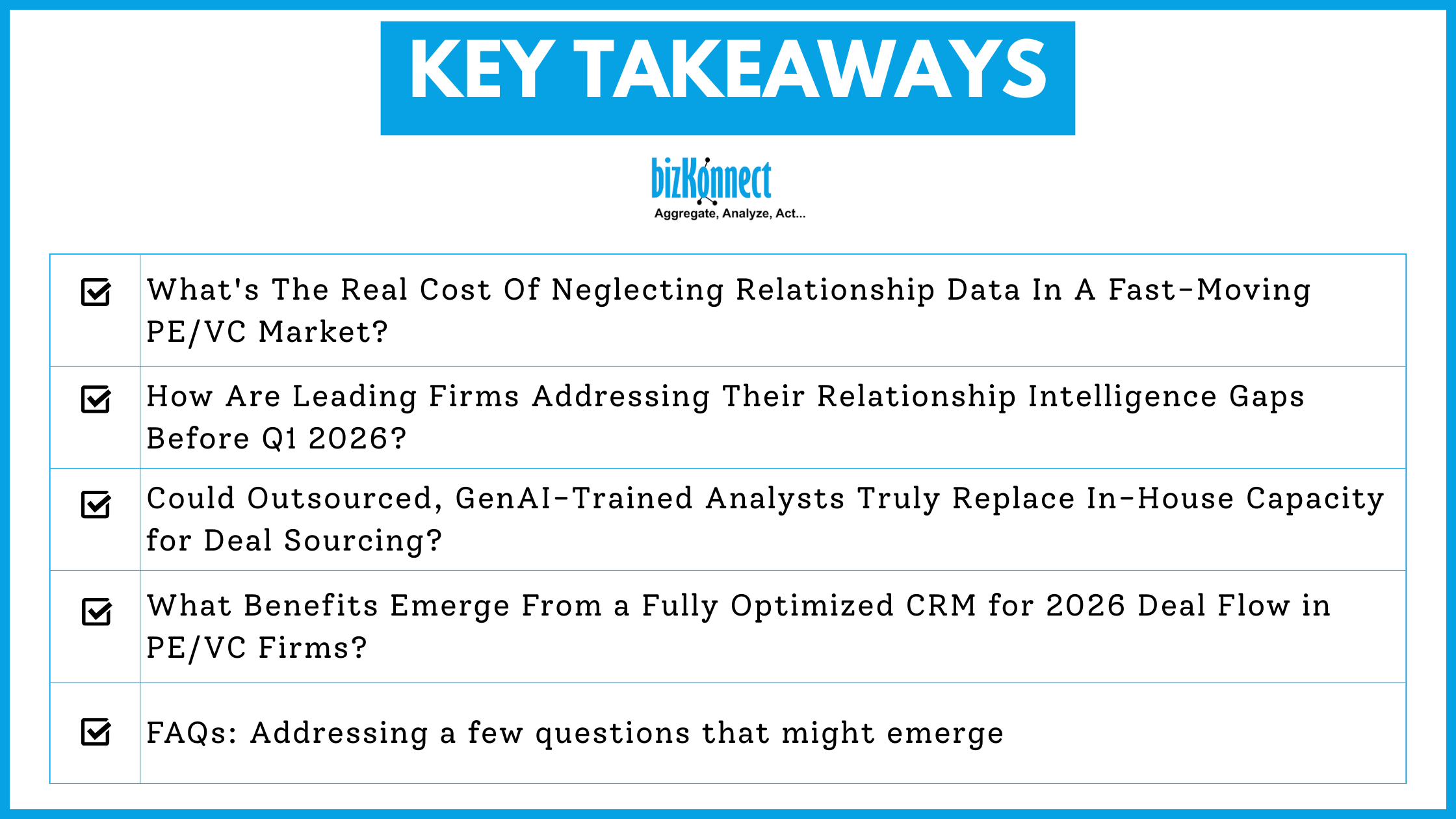
But, What's The Real Cost Of Neglecting Relationship Data In A Fast-Moving PE/VC Market?
In the high-stakes investment sector, relationship intelligence is currency. Yet, B2B data has a high decay rate, often exceeding 5% per month or over 70% annually.
Think of the sheer volume of change: titles, job functions, email addresses, and even entire companies relocating. When a PE/VC firm’s deal flow relies on tracking nuanced connections with Limited Partners (LPs), founders, and strategic investors, a decaying-outdated CRM data means missed opportunities, wasted outreach, and fundamentally flawed relationship mapping.
The consequence? Firms enter 2026 with a deal pipeline built on unreliable information, forcing senior staff to spend precious time on manual data verification instead of investment evaluation.
How Are Leading Firms Addressing Their Relationship Intelligence Gaps Before Q1 2026?
The final weeks of December and the holiday season are becoming the critical window for what we call "relationship intelligence fixes", a comprehensive CRM cleanup initiative. Leading firms are engaging flexible, on-demand expert teams, trained in GenAI, to execute targeted data remediation.
These experts focus on:
- Deep Coverage: Ensuring accurate and current contact details for key LPs and founders aligned with the 2026 investment thesis.
- Data Enrichment: Adding missing, valuable information (like SIC codes, company size, funding history) to transform a simple contact list into an actionable lead profile. This is where B2B data services and CRM data enrichment become non-negotiable.
- Accuracy & Validation: Rigorously verifying every data point like phone numbers, titles, and email addresses to eliminate the noise caused by data decay.
Could Outsourced, GenAI-Trained Analysts Truly Replace In-House Capacity for Deal Sourcing?
The model isn't about replacement; it's about intelligent augmentation and capacity extension. Full-time hiring introduces overhead and latency. Instead, firms are tapping into on-demand expertise: MBA-qualified, CRM-certified analysts who operate directly within the firm's specific investment thesis and tech stack.
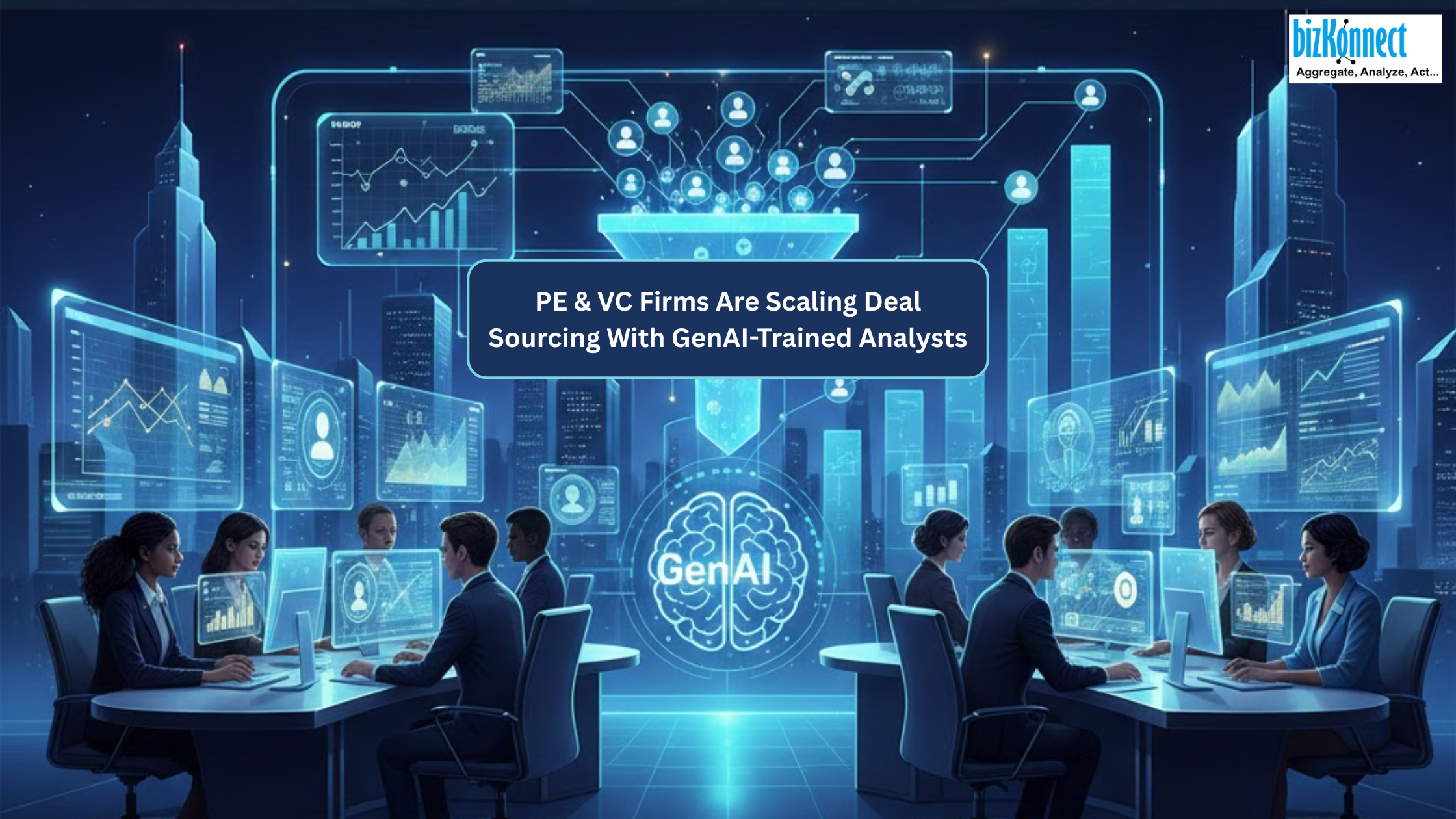
These dedicated experts specialize in key areas, enabling scaling deal sourcing without new full-time analysts:
- Thesis-Aligned Deal Sourcing: Identifying and validating founders and investors based on specific funding history and financial indicators.
- Diligence Acceleration: Conducting targeted company and market research to deliver structured insights that accelerate investment evaluation.
- Outreach Enablement: Providing curated, financially enriched founder/investor lists that power personalized, data-backed campaigns, demonstrating how a CRM helps in lead management.
- CRM Expertise: These experts have experience working different PE/VC industry CRMs like Salesforce, DealCloud, 4Degrees, Affinity, Dynamo etc.
The key differentiator is the integration of GenAI solutions into the analysts' workflow. It allows the team to process vast amounts of unstructured data faster, validate company data consolidation, and manage CRM data updates with superior efficiency and accuracy. Ultimately optimizing the CRM for lead management in B2B companies.
What Benefits Emerge From a Fully Optimized CRM for 2026 Deal Flow in PE/VC Firms?
A clean, enriched, and continuously managed CRM transforms from a static database into a dynamic, predictive asset. By the time Q1 2026 begins, the PE/VC firm is equipped with:
- A Clear Sales Funnel: A well-structured CRM visualizes the entire deal flow, allowing teams to instantly see what is a CRM sales funnel and where opportunities are progressing or stalling.
- Maximized Return on Outreach: With accurate data, personalized outreach (LinkedIn, email) hits the right decision-makers, leading to higher response rates and a lower cost per qualified lead.
- Predictable Capacity: Firms can flex their research and diligence capacity up or down based on pipeline needs, paying only for the hours worked, eliminating the fixed costs of underutilized full-time staff.
- Superior Relationship Tracking: Robust tracking of communication history and preferences ensures a more nuanced, relationship-focused engagement with LPs and founders, which is crucial for raising the next fund.
Ultimately, these strategic, end-of-year data investments allow investment teams to focus on the highest-value task: making smart investments, not fixing spreadsheets. This approach ensures they are ready to capitalize on the market opportunities of 2026.
FAQs: Addressing a few questions that might emerge
Q1. How does a GenAI-trained analyst differ from a standard freelance analyst?
A standard analyst is a human resource while a GenAI-trained analyst is a human resource augmented by technology. They use AI tools to rapidly validate data, conduct large-scale lead profiling, and manage marketing automation data refresh processes at a speed and accuracy a human alone cannot match.
Q2. How do these services specifically enhance LP/Founder coverage?
They go beyond public databases to conduct targeted lead research and lead profiling. They verify personal contact information often missed and ensure the firm's relationship intelligence spans the full breadth of the investment ecosystem.
Q3. Can this data service handle integration with existing marketing automation platforms?
Yes, a key function is providing managed services for the entire tech stack. This includes seamless integration with various data providers and platforms to ensure continuous, accurate data flow for activities like A/B testing and campaign setup.
Q4. Which is the best CRM for lead management in 2026 for PE/VC?
The "best" CRM depends entirely on the firm’s specific workflow and asset class, but its effectiveness is tied less to the platform itself and more to the quality of the data flowing through it. Even the most robust platform is useless with decayed data.
As 2025 draws to a close, PE/VC firms with vision are using the season to repair, refresh, and renew their deal pipelines. With improved CRM hygiene and data enrichment, powered by flexible, on‑demand data services, they enter 2026 equipped with trustable, actionable relationship intelligence. In a world where roles, companies, and deals shift fast, that clarity can make a real difference.
Still running CRM the old way? CLICK HERE to explore how BizKonnect can help with data services through GenAI-trained analysts.