


Every autumn, the global B2B enterprise tech ecosystem shifts its focus toward San Francisco. Key decision-makers, tech leaders, software vendors, and investors gather for Dreamforce, one of the densest annual concentrations of buying power in the world. For international companies, particularly mid-market SaaS vendors, IT services firms, and scale-ups, the event represents an unparalleled Go-To-Market (GTM) opportunity: direct access to the US enterprise ecosystem.
Yet, behind the keynote buzz lies an uncomfortable truth. For a significant portion of international businesses, major trade shows turn into expensive exploratory trips. Between cross-continental flights, premium hotel pricing, event badges, and missed internal operational hours, sending an executive team requires a substantial capital layout, often executed without a clear event GTM motion.
The core issue is the absence of a structured execution framework. Organizations frequently treat Dreamforce as a passive discovery exercise instead of a targeted account-based campaign. They arrive with open calendars, rely on chance encounters in crowded expo spaces, and fly home with unstructured contact lists that rarely transform into pipeline.
To extract real value from major industry events, B2B leadership must reframe the strategic goal. Dreamforce creates unprecedented access. The true objective is turning that access into a high-converting GTM driver, converting access into structured, high-value decision-maker conversations whether your team sets foot in San Francisco or remains focused on daily operations at home.
The Structural Reality of Event-Led Market Entry
Entering or expanding within the US market demands rapid credibility building, localized positioning, and overcoming natural buyer risk aversion toward unfamiliar brands. Events like Dreamforce act as condensed growth engines where multi-month sales cycles can be accelerated into days provided the approach is deliberate.
The Access Gap
The friction standard B2B teams experience at enterprise conferences generally falls into two distinct operational challenges:
- The In-Person Noise Threshold: Attending in person without a locked schedule of pre-qualified meetings leaves your executive team competing for attention against thousands of exhibitors. Passive booth attendance and floor wandering yield casual chats rather than high-intent pipeline.
- The Remote Opportunity Loss: When travel costs, visa timelines, or conflicting executive schedules prevent physical attendance, companies often withdraw entirely. They assume that missing the physical trip means missing out on the pipeline generated during that week.
Solving this requires shifting from passive event participation to structured Account-Based Event Execution.
Strategy Comparison Matrix
| Execution Dimension | Passive Floor Presence | Pre-Booked In-Person Strategy | Localized Proxy Model |
|---|---|---|---|
| Primary Focus | General networking & awareness | High-density qualified meetings | Cost-effective market coverage |
| Pre-Event Effort | Minimal (Travel & booth prep) | Intensive 6-week targeted outbound | Deep messaging alignment & account mapping |
| Meeting Structure | Ad-hoc booth & hallway chats | Confirmed calendar briefs | Pre-scheduled & on-floor executive meetings |
| On-Site Team | Internal Founders / Product Leads | Executive Leadership | Experienced US Sales Representative |
| Post-Event Execution | Manual email follow-ups | Account development sequences | Immediate localized lead conversion |
The Pre-Booked Pipeline Model: For Teams Attending in Person
If your leadership team is flying to San Francisco, the trip's success should be secured weeks before take-off. Walking onto an event floor expecting spontaneous, high-trust meetings with VP and C-level executives is impractical. Senior leaders operate on strict, pre-planned agendas curated long before they step into Moscone Center.
1. Account Mapping and Attendee Intelligence
Begin your campaign 6 to 8 weeks prior to the event. Map your Ideal Customer Profile (ICP) against target enterprise accounts known to participate in or send leadership to the event. Segment your target accounts systematically to optimize your GTM coverage:
- Tier 1 (Strategic Accounts): Key executive targets where custom, off-site meeting slots (e.g., dedicated briefings or quiet meeting spaces adjacent to the main floor) are pre-reserved.
- Tier 2 (Core Growth Accounts): Mid-level functional leads targeted for concise 15-minute scheduled syncs mapped cleanly around key presentation blocks.
2. Contextual Outreach Framework
Broad outbound messaging stating "Let's connect while we're both in San Francisco" is routinely ignored by busy executives. Successful outreach offers immediate, relevant value.
The Three-Part Outreach Blueprint
- Context: Acknowledge the target executive’s specific operational focus or current industry shift.
- Value Exchange: Share relevant peer benchmarks, original insights, or targeted problem-solving approaches.
- Frictionless Call-to-Action: Offer a time-bound, logistically convenient meeting slot tailored around their event schedule.
3. Execution Timeline
| Timeline | Milestone Phase | Tactical Objective |
|---|---|---|
| Week -6 | Target Account Mapping | Identify ideal buyer profiles, construct organizational charts, and map high-priority accounts. |
| Week - 4/5 | Value Outbound Sequence | Initiate context-rich messaging introducing relevant business insights tied to event themes. |
| Week -3 | Tactical Follow-Up | Deliver tailored problem-solving agendas focused on specific enterprise pain points. |
| Week -2 | Logistics Alignment | Secure confirmed calendar slots, specifying precise, low-friction meeting locations. |
| Week -1 | Agenda Lock & Confirmation | Re-confirm schedule and share briefing materials to ensure immediate meeting momentum. |
When your team arrives on-site, their entire schedule should already be populated with structured sales engagements, removing chance from the ROI equation.
The Localized Proxy Model: Capturing Event Pipeline Without Travel
Physical attendance is not always feasible or cost-effective. Scale-ups operating with lean budgets, strict international travel policies, or critical product delivery deadlines cannot always justify pulling key executives away from core business operations for a week.
However, opting out of physical travel does not require ceding high-value opportunities to competitors. A growing number of international tech vendors leverage a Localized Executive Proxy Model as a flexible, remote-first GTM motion to capture event revenue while keeping operational disruption at zero.
The Operational Flow of Proxy Representation
| Component | Responsibility | Strategic Contribution |
|---|---|---|
| Core Executive Team | Product Alignment & Knowledge Transfer | Briefs representation on technical positioning, competitive advantages, and core value props. |
| Local Senior US Sales Exec | Strategic On-Site Representation | Leverages 15+ years of US market experience to pitch offerings, hold meetings, and build immediate buyer trust. |
| Dedicated Lead Gen Engine | Back-End Campaign Management | Maps target accounts, sets pre-scheduled meetings, and coordinates on-the-ground meeting logistics. |
| Target US Decision-Makers | Executive Engagement | Participates in high-trust, localized business discussions without international friction. |
How Executive Representation Operates
This model goes far beyond basic floor presence. It is a high-level, representational sales execution framework designed to project an authentic, established local presence.
- Deep Brand and Solution Immersion: Weeks prior to the event, the fractional sales executive undergoes comprehensive alignment with your team to master your technical positioning, customer success stories, and target buyer responses.
- Pre-Set Meeting Generation: Supported by account-mapping teams, pre-booked meetings are locked into the representative's calendar with target buyers attending the event.
- Professional On-Site Delivery: Armed with your company’s collateral and representation rights, an experienced US sales veteran conducts meetings, attends key networking functions, and pitches your solution using native US market context.
- Immediate Warm Hand-Off: Meeting notes, qualified buyer insights, and immediate next steps are fed directly to your internal teams in real time, enabling quick technical follow-ups while event interest remains fresh.
Bridging the International Trust Gap
Expanding into the US enterprise market introduces subtle, structural friction points. American buyers are pragmatic, value-driven, and sensitive to deployment risks. When evaluating non-US vendors, buyers frequently evaluate quiet operational risk factors:
- Can this vendor provide real-time support despite significant time zone variances?
- Does the team understand localized compliance, data security, and procurement standards?
- Is there a credible regional leadership presence capable of maintaining long-term account accountability?
Addressing these underlying concerns early in the relationship is essential. Deploying native or deeply experienced US sales leadership either as part of your travelling delegation or through structured local representation eliminates cultural friction upfront. It confirms to prospective buyers that your business operates with mature market standards, allowing technical teams to focus purely on value delivery.
Overcoming Post-Event Momentum Decay
The ROI of an event campaign is rarely finalized during the conference itself; it is won or lost in the strategic execution that occurs immediately after.
Post-Event Lead Decay Timeline
| Timeline | Buyer Engagement Level | Risk Factors & Strategic Interventions |
|---|---|---|
| Event Week | 100% Engagement | High context, immediate problem alignment, active meeting notes captured. |
| Day 3 Post-Event | 75% Engagement | Inbox backlog sets in; event interactions begin to blend together. Action: Send personalized follow-up with meeting notes. |
| Day 7 Post-Event | 50% Engagement | Internal operational priorities re-emerge. Action: Deliver custom technical assets, case studies, or architectural specs. |
| Day 14 Post-Event | 25% Engagement | Lead turns cold; outreach reverts to standard cold cadence. Action: Escalate to dedicated multivariable account nurture. |
To ensure event momentum translates into closed pipeline:
- Categorize Interactions Immediately: Organize meeting outcomes on-site into distinct action tiersTier 1 (Immediate discovery or technical demo scheduled), Tier 2 (Interested, customized business case required), Tier 3 (Longer-term nurture profile).
- Provide Contextual Assets: Avoid template-based "Great to meet you" outreach. Reference specific discussion details and immediately provide relevant whitepapers, ROI models, or architectural frameworks discussed during the meeting.
Turning Dreamforce into a Predictable Growth Engine with BizKonnect
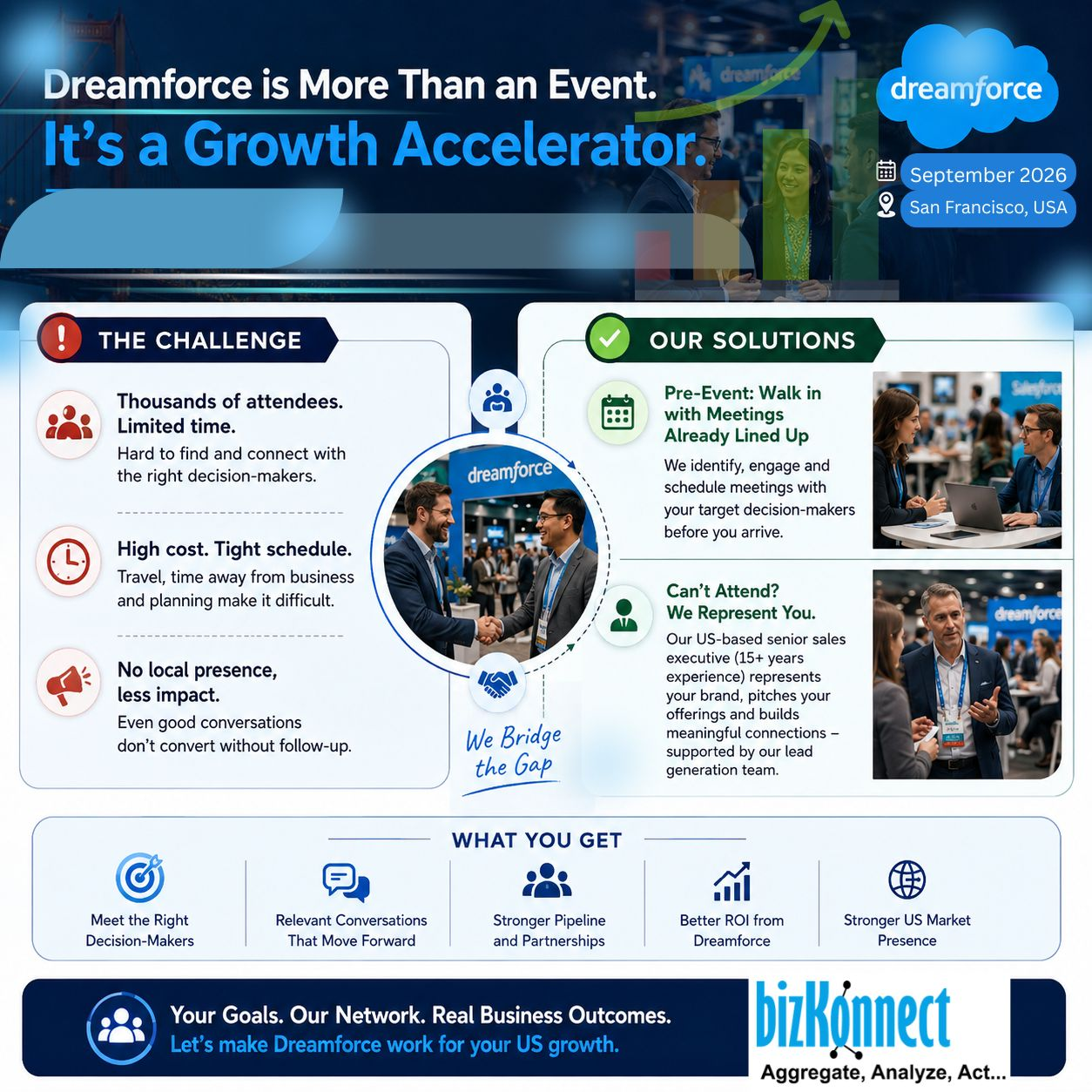
Navigating major industry events without a structured GTM strategy routinely leads to missed targets and unoptimized budgets. The goal for B2B tech leaders should never be simple event presence, it must be targeted account engagement.
BizKonnect bridges the event execution gap by offering comprehensive Event Campaign Services tailored to your specific expansion strategy:
- For Teams Attending Dreamforce: BizKonnect builds deep, account-mapped target lists and executes personalized pre-event outreach. We ensure your leadership team boards their flight to San Francisco with a fully locked calendar of confirmed meetings with key US decision-makers.
- For Teams Staying Focused at Home: BizKonnect provides experienced US-based Senior Sales Executives (with 15+ years of regional enterprise experience) backed by our lead generation engine. Our local representatives master your value proposition, conduct pre-scheduled on-site meetings, pitch directly to buyers under your brand, and hand off warm, qualified pipeline to your internal team.
Frequently Asked Questions (FAQs)
How early should we start our Dreamforce event campaign strategy?
We recommend launching your campaign 6 to 8 weeks prior to the event. This window provides sufficient lead time for account mapping, target decision-maker research, multi-touch personalized outbound sequences, and calendar locking before executive schedules fill up completely.
How does BizKonnect ensure the local US sales executive accurately pitches our technical solution?
Prior to the event, our senior US sales executive (with 15+ years of US market experience) undergoes intensive solution immersion with your internal technical and product leads. They master your unique value proposition, target customer pain points, positioning nuances, and case studies to represent your brand authentically.
What happens to the leads collected during or right after the event?
All meeting notes, strategic buyer context, and contact details captured on-site are processed in real time. BizKonnect's back-end lead generation engine organizes these contacts into prioritized post-event follow-up tiers, allowing your core team to initiate contextual technical conversations within 48 to 72 hours.
Can BizKonnect help us target companies that are not officially exhibiting at Dreamforce?
Yes. Major events draw thousands of executives who attend adjacent fringe events, off-site networking briefings, and partner summits around Moscone Center without hosting a booth. BizKonnect’s org-chart-backed intelligence identifies target decision-makers who will be in San Francisco during event week regardless of their floor presence.
Ready to Turn Dreamforce into Your Highest-Performing GTM Channel?
Don't leave your US expansion ROI to chance on the expo floor. Whether you need pre-booked executive calendars for your travelling leadership team or a seasoned US sales executive to represent your brand on-site, BizKonnect builds the exact event GTM strategy you need to win key accounts.
Schedule a Strategic Event Consultation with BizKonnect Today.
CLICK HERE to know more with BizKonnect.