


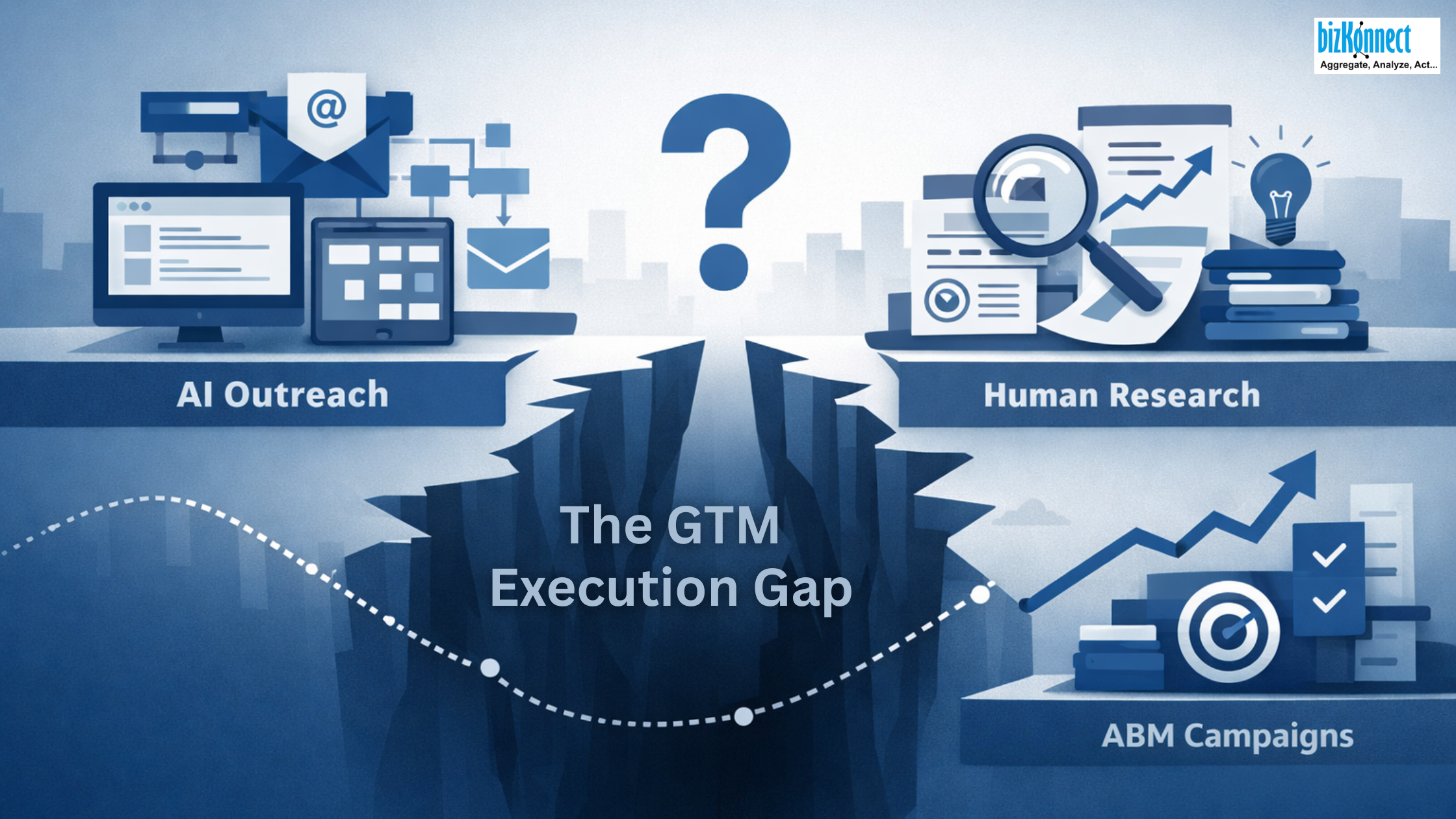
Most teams today have the full stack of tools including sequencing platforms, AI copy assistants, intent data, and enriched contact lists. And yet, they find it hard to book meetings with disappointing reply rates. The GTM framework for sales campaigns looks solid on paper but produces silence in the inbox.
So what's actually missing?
It's not the tech. It's a human-researched theme. Most AI-driven outreach goes out without a human-researched angle tied to what the account is actually dealing with right now. Without that, even a perfectly timed email with a clean subject line gets ignored.
This guide breaks down why that gap exists, what's making it harder to close in 2026, and how theme-based GTM campaigns, built on real account intelligence and scaled with GenAI, change the outcome.
Why Does AI-Assisted Outreach Still Miss Account-Level Pain Points?
The honest answer is: AI personalizes at scale, but it doesn't research at depth.
Most outbound workflows today use AI to fill variable fields, adjust tone, or maybe suggest a send time. Useful? Yes. But it only addresses the surface. What it doesn't do is answer the one question every real buyer asks before they respond: Why is this relevant to me, right now?
That answer doesn't live in a job title or a firmographic profile. It lives in an earnings call, a leadership change, a product launch that underperformed, and a shift in hiring patterns. These are signals that need human interpretation.
When outreach skips that layer, it defaults to category-level messaging.
"We help companies like yours do X." That framing worked when inboxes were less competitive. Now it blends into everything else, and filters, both algorithmic and human, have learned to spot it fast.
This is not a minor inconvenience because AI filters in 2026 can examine email text, tone, and sender history, which means generic outreach patterns are penalized before they even reach a human. The tools have made sending easier, they have not made being heard any easier.
Why Is Cold Email Deliverability in 2026 Structurally Different and Why Should GTM Teams Care?
Most GTM leaders still treat deliverability as a technical checkbox. Set up authentication, warm up the domain, keep bounce rates low. Done.
That thinking is now a liability.
Yes, the technical foundations still matter. Authentication criteria have become a requirement for bulk senders, with Google, Yahoo, and Microsoft mandating SPF, DKIM, and DMARC protocols alongside one-click unsubscribe options. Skip these and your emails go to spam by default, no matter how good the message is.
But the bigger shift is behavioral. Email service providers now analyze recipient response rates such as opens, replies, clicks, bounces, and spam complaints to determine sender reputation, and low engagement can damage domain credibility within a short time.
Here's where it gets directly relevant to GTM execution.
If your outreach lacks a theme tied to the account's actual situation, engagement stays low. Low engagement hurts sender reputation. Hurt reputation means future emails reach fewer inboxes. It's a quiet, compounding problem that shows up as declining campaign performance over months and most teams blame the copy and not the strategy.
Relevance has become the final deliverability advantage in 2026. Sending more emails does not improve performance; in most instances, it accelerates the damage. The teams still optimizing for volume are, without realizing it, working against their own pipeline.
What Actually Makes a Theme-Based Campaign for B2B Sales Work?
A theme-based campaign for B2B sales is not a content theme or a seasonal push anymore. Rather it's built around a specific, verifiable challenge that a defined set of accounts is actively navigating which is a real, time-bound business problem your outreach can speak to with enough specificity that the buyer feels seen.
This is the core difference between a theme-based campaign vs traditional outreach.
One approach works backward from what you sell. The other works forward from what the buyer is dealing with. That gap is exactly why so much AI-generated outreach lands flat even when the writing is technically sound.
Building a theme requires three inputs that most GTM planning underweights:
- A trigger: a business event or tension visible in the account's public signals
- A narrative: a clear line from that trigger to a consequence the buyer is trying to avoid
- A resolution path: a specific way your offer addresses that consequence
That's how to build a theme-based campaign for ABM that actually lands. Without all three, you just have a topic and not a theme.
And there's a deliverability dimension to this too. Researching a prospect's industry, role, and pain points before outreach signals to inbox providers that recipients find the content valuable, which directly improves deliverability performance.
How Do GenAI-Driven Insights Elevate Human Research Without Replacing It?
This is where most teams get it backwards.
They use GenAI to generate outreach from minimal inputs: give it a name and a job title, ask for a personalized email, and hope for the best. The output looks polished but iIt reads hollow because no real account intelligence was ever fed into it.
The better approach flips it. Human researchers identify the trigger, the theme, and the narrative logic. GenAI then scales that thinking, extracting signal patterns across a larger account set, synthesizing data faster than any analyst could, and structuring output so the marketer has something real to work with.
Neither can do what the other does well:
- Human research catches the nuance that structured data misses, the so what behind a signal
- GenAI handles volume and pattern recognition that human bandwidth can't sustain across a full account list
Together, they produce outreach that answers the question every buyer quietly asks: Why you, and why now?
In practice, this is what that workflow looks like:
- Analyst identifies a signal cluster: hiring shifts, tech stack changes, recent press pressure, competitor movement
- GenAI synthesizes those signals into account-level summaries
- Marketer builds messaging using that summary as the foundation
- Simple tone, genuine personalization, relevance over volume, and human-like sending patterns are applied so the output survives both algorithmic and human scrutiny
The result is outreach that feels different to receive and different is what gets replied to.
Addressing Some Frequently Asked Questions (FAQs)
Q1. How do you build a theme-based campaign for ABM without making it too narrow to scale?
Start with a trigger category instead of a single account. Find three to five accounts sharing a similar business situation and build one theme that connects them. Scale the theme across the cluster rather than rebuilding every message from scratch.
Q2. Can GenAI identify account-level pain points on its own?
Not reliably. GenAI is effective at aggregating and synthesizing signals. But identifying what a signal means for a specific business in a specific moment requires human judgment. The research layer cannot be automated away.
Q3. How often should engagement signals be reviewed in a theme-based GTM campaign?
At minimum, weekly. Tracking inbox placement, open rates, bounce rates, and spam complaint rates regularly is essential in 2026 to maintain sender reputation and campaign health.
Closing the GTM execution gap doesn't require more tools. It requires restoring the research layer that AI-only outreach has quietly bypassed. Theme-based campaigns, built on real account intelligence and scaled with GenAI, give your outreach the one thing volume never could, a reason to respond.
Want to see how a theme-based GTM campaign is built from signal to sequence? CLICK HERE to explore how BizKonnect approaches it.