


Most B2B sales and marketing teams treat retail organizational data as reference material.
Something to consult before a campaign
Confirm at the start of a quarter
Then file away.
That assumption held until retailers started restructuring at the executive level with the speed and decisiveness that resets vendor access, decision authority, and budget ownership simultaneously.
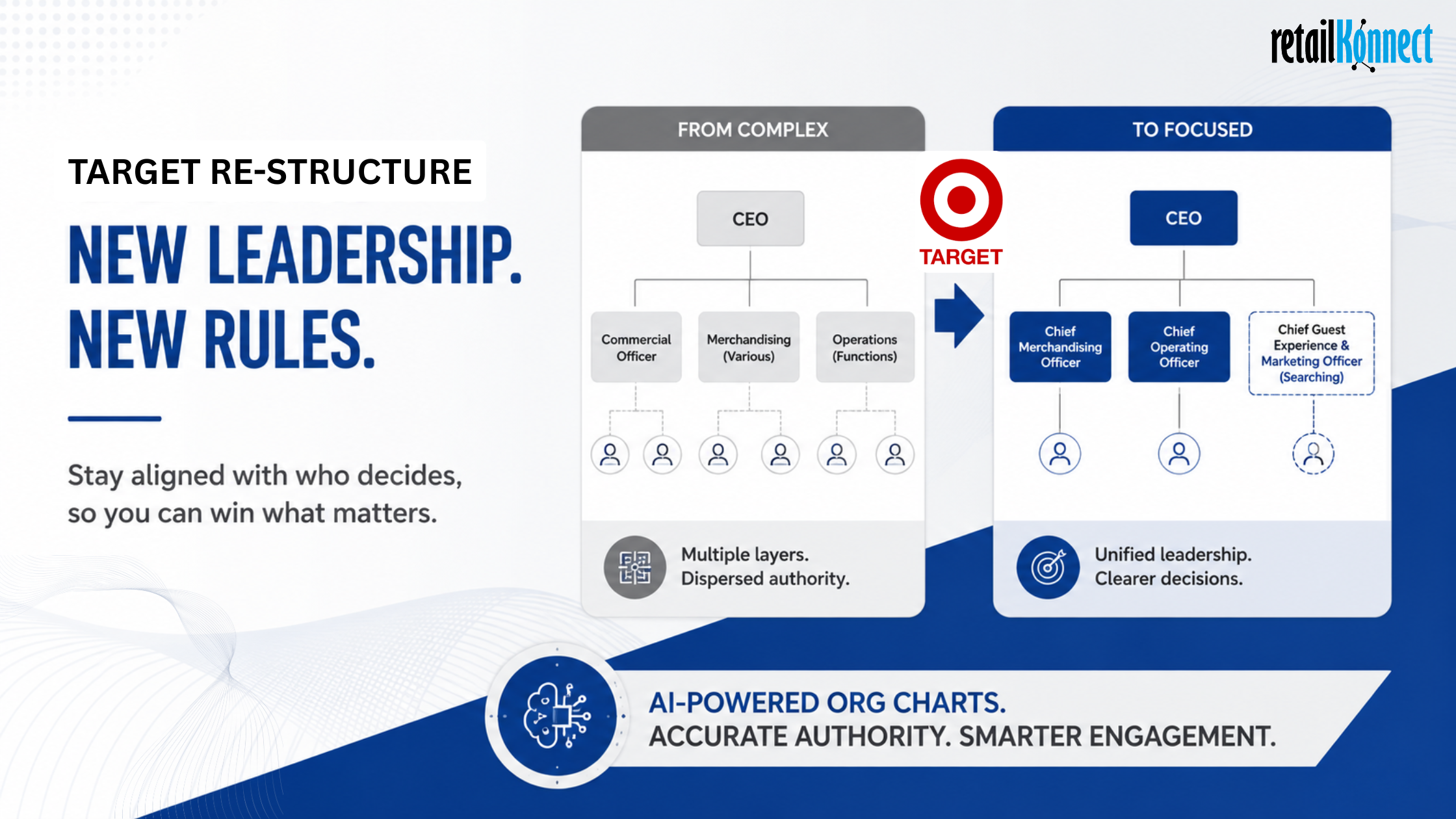
Target's February 2026 announcement did exactly that.
Under newly installed CEO Michael Fiddelke, the company didn't simply swap names.
It compressed an entire operational layer, named a singular merchandising chief, eliminated two senior roles that vendors had spent years cultivating, and opened an external search for a function that didn't previously exist in its current form.
For B2B marketers running account-based programs against Target, the existing retail account map didn't just need updating. It needed rebuilding from scratch backed by GenAI.
How Target's Retail Organizational Structure Shifted Authority and Not Just Titles?
The instinct when reading a leadership announcement is to update the CRM and move on. That instinct fails when what changes is the decision architecture underneath the titles.
Target named Cara Sylvester as chief merchandising officer, consolidating the function under a single authority. Before this, influence was distributed.
- Rick Gomez held the chief commercial officer role.
- Jill Sando was chief merchandising officer for apparel, accessories, home and Fun101.
Both departed.
Vendors who mapped their strategy around multiple stakeholders, each governing a distinct category lane, now face a consolidated authority structure. Approval paths that once offered multiple entry points now narrow.
The parallel shift is equally consequential.
Lisa Roath was named chief operating officer, previously chief merchandising officer of food, essentials and beauty, bringing expertise spanning merchandising, supply chain and stores.
This is a cross-functional integration role connecting merchandising vision to execution at scale. For B2B providers whose value touches operations or store-level performance, the decision authority for their spend category has moved.
Why Retail Account-Based Marketing Breaks When Legacy Roles Disappear?
Retail ABM programs rest on one foundational assumption that the contacts feeding the program reflect how decisions are actually made.
When that holds, ABM generates a pipeline.
When it breaks, it produces activity without outcomes.
The Target restructuring creates exactly this contact obsolescence where two senior roles are eliminated and one new function is under external search. The organizational surface area B2B marketers were mapping against changed shape faster than any enrichment tool refreshes its data.
The more insidious problem is the contacts who stayed but whose authority changed.
Sylvester's mandate as singular merchandising chief now includes product development, assortment design, and partner collaborations across style and design. A partner who connected with her through digital or loyalty functions now has access to a decision-maker with significantly broader scope. That relationship carries more leverage than it did six months ago. But only if the B2B marketer knows to use it.
This is the retail leadership hierarchy problem no static CRM solves:
Authority doesn't announce itself when it shifts. The org chart updates and the title changes but the decision scope, the budget ownership, and the relationship weight, those move quietly.
How Do GenAI-Powered Org Charts Support Account-Based Marketing When Decision Layers Flatten?
Conventional retail org charts don't, at least not at the pace restructuring now demands.
A static org chart captures a moment. Target in January 2026 looked structurally different from March 2026. The commercial officer role anchoring vendor conversations is gone. Merchandising that once required navigating category-specific leaders now routes through unified command.
What GenAI-driven org chart mapping changes is the time-to-accuracy problem.
When Target's press release went live on February 10, 2026, the delta between what was true and what lived in most B2B account maps widened immediately. AI-powered retail account mapping tools that ingest public signals and leadership announcements can close that gap in hours rather than weeks, modeling not just who moved but which budget centers now align under the same authority.
Key implications for teams working against flattened retail structures:
- Single-threaded account strategies become high-risk when authority consolidates. The contact who was one of three decision influencers may now be the only one.
- Entry-point diversity matters more when layers flatten. Fewer executives means fewer doors, so relationship quality carries greater weight.
- The external search for a chief guest experience and marketing officer creates a temporary authority vacuum. Timing vendor conversations around that uncertainty either accelerates or stalls deals.
- Roath's COO mandate spanning supply chain, stores, and operations signals where capital investment will concentrate.
What Challenges Do Retail Sales Teams Face When the Account Map Is Wrong?
The failure mode is usually gradual and expensive.
A sales team running outreach against Target's former commercial officer role generates no response, because that role no longer exists. They escalate, find no updated contact, re-route to the account executive who last touched the relationship. That executive reaches out to an existing contact who may have transitioned or shifted scope. The result is the thread goes cold, pipeline slows, and the team reads it as a buying signal problem when it's a retail organizational structure problem.
Fiddelke described the structural intent clearly: "simplify our structure so we can advance our strategy with greater speed, clarity and accountability." That simplification from the inside is complexity from the outside. Fewer decision nodes and faster internal alignment at Target means vendors who haven't remapped their account strategy are working against a structure that no longer exists.
The retail account mapping imperative is all about recognizing that when a retailer flattens its operational layers, the rules of engagement for every B2B vendor in its ecosystem change simultaneously.
Frequently Asked Questions (FAQs)
Q. How frequently should B2B marketers update retail org charts for accounts like Target?
Continuously, using automated signal monitoring. A February announcement can make a January account map obsolete within days, particularly during CEO transitions.
Q. How do retail org charts support account-based marketing when decision authority consolidates?
They identify which formerly distributed budget decisions now route through a single executive, directly informing outreach sequencing and where to direct executive sponsorship.
Q. What's the difference between a contact update and a structural remap in retail account mapping?
A contact update changes a name. A structural remap changes the understanding of how decisions are made and where authority now sits. Target's 2026 restructuring requires the latter.
Q. How should B2B teams handle the authority vacuum from open executive searches at major retailers?
Maintain existing relationships in the vacant function while redirecting executive engagement to confirmed authority. Reintroduce formally once the new leader is named.
Target's move under Fiddelke is a preview of how major retailers will continue consolidating authority as competitive pressure intensifies. So, now the question for B2B marketers is whether the tools being used today can close the accuracy gap fast enough to matter.
If you want to map Target's new decision structure and identify the right engagement points across its flattened org, CLICK HERE to explore how BizKonnect's GenAI-driven account intelligence helps sales and marketing teams rebuild retail account maps after major restructuring events.
CLICK HERE to know more with BizKonnect.