


The holiday has begun and as 2025 begins its final call, the conventional wisdom in sales starts whispering: "Slow down. Everyone is too busy with budgets, vacation, and end-of-year deadlines. Your outreach is a waste of time until Q1 2026."
This is a dangerous myth.
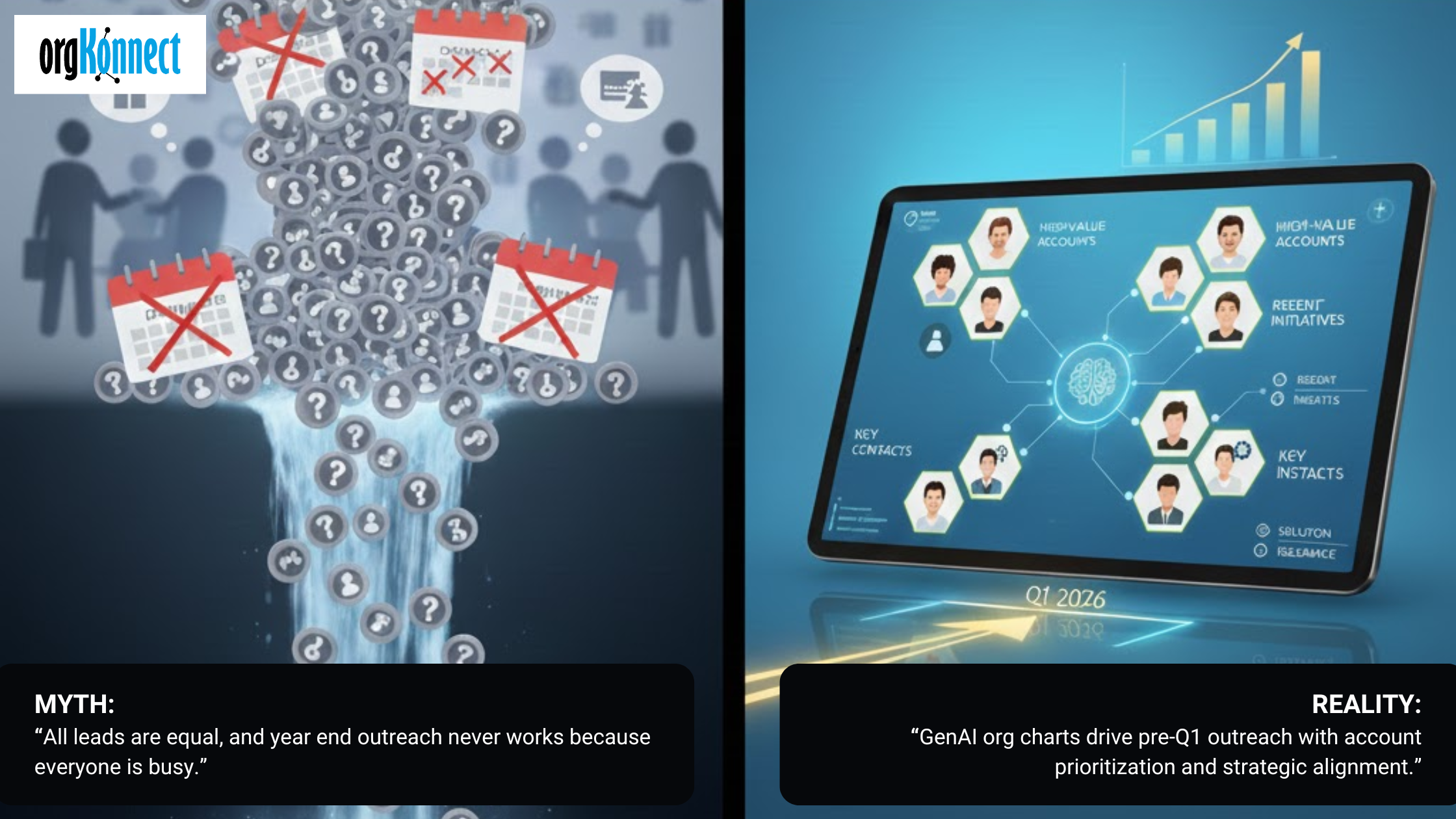
It’s based on a quantity-over-quality mindset, the idea that all leads are equal and success belongs to numbers. In reality, the most critical planning for 2026 initiatives is happening right now, behind those closed doors. The companies that will be your biggest wins next year are setting their priorities today.
And, the key to unlocking these opportunities is smarter, deeply focused effort powered by a “dynamic GenAI-driven actionable org chart of target accounts”. This is an interactive strategic map infused with artificial intelligence to reveal high-value accounts, key contacts, their context, and their pain points in relation to your solution.
But, why does the traditional 'quantity' model really stall in Q4?
The old model relies on broad, generic outreach. When everyone is genuinely busy with defining next year’s strategic roadmaps and securing budgets. At this time, a generic email or call is the first thing they delete.
If you treat every prospect like an equal number in a spreadsheet, you force your sales team into a cycle of low-relevance conversations that drain energy and lead to slow pipeline velocity. You waste precious time chasing accounts that aren't ready, while your competitors are subtly aligning with the true decision-makers at your most valuable targets.
How can we shift from simply chasing leads to driving focused sales efforts?
The shift happens when you move from a generic database approach to one defined by hyper-relevance and account prioritization.
Here, a GenAI-driven actionable org chart serves as your GPS in complex enterprise sales. It helps you zoom in on accounts that have recently announced initiatives, made relevant C-level hires, or publicly stated a strategic direction that directly aligns with your offering.
- Identifies High-Value Accounts: Pinpoints companies where your solution has the highest potential impact based on contextual insights.
- Maps the Decision Ecosystem: Goes beyond job titles to show the true decision-makers, influencers, and technical approvers.
- Reveals Connection Paths: Highlights existing connections within your company (management, sales, marketing) that can be leveraged for warm introductions.
This level of detail ensures your team is investing time only in the opportunities that matter most for a strong start to 2026.
Where does the "Dynamic Org Chart" get the intelligence for strategic alignment?
This intelligence comes from the power of GenAI processing vast amounts of contextual data, transforming a static company hierarchy into an interactive org chart for large organizations.
For example: It doesn't just show you that 'Jane Doe is the CIO'; it tells you that:
"Jane Doe recently spoke at a conference about her department's urgent need to adopt sustainable cloud infrastructure (2 weeks ago), which aligns perfectly with your company's GreenOps solution."
This contextual insight about the individual, the business unit, and the company’s recent activities provides a relevant hook for timely outreach. Ultimately, you’re calling to align your proposal with their now-validated 2026 priorities. This increases solution relevance and cuts through the end-of-year noise.
How do these insights lead to faster pipeline velocity?
When you approach a prospect with a context-aware understanding of their business using an actionable org chart, you bypass the low-level gatekeepers and engage immediately in a high-value conversation.
Instead of starting with "Do you have this pain point?", you start with "I noticed your recent investment in Project X; our solution is designed to specifically accelerate that initiative." This focused approach streamlines the discovery phase, accelerates consensus-building among multiple stakeholders, and moves the deal from initial contact to a qualified opportunity much faster. Thus, it ensures a high-velocity pipeline going into Q1 2026.
2026 is built now: How GenAI-driven actionable org charts strengthen it?
The time to influence 2026 budgets and strategic direction is now, as we close out 2025. Abandon the myth of the busy buyer and embrace the reality of the focused, planning buyer.
A truly dynamic org chart for enterprises is more than just a visualization of the organizational structure. It’s a strategic asset that gives you:
- Multiple Entry Points: It identifies several key decision-makers and influencers, so if one contact isn't interested, you have other paths mapped out for a successful entry.
- Leveraged Connections: It maps your sales, marketing, and management team's connections to the account, turning cold calls into warm introductions.
- Contextual Messaging: It provides the exact, relevant insight needed to send a personalized message that the prospect cannot ignore.
Instead of waiting until January 2026 to start cold, use this strategic period to align your solutions with the initiatives that your target accounts are actively funding and planning right now. Quality outreach driven by deep insights from GenAI-driven actionable org charts, is the key to closing 2025 strong and guaranteeing a record-breaking 2026.
Let’s address some Frequently Asked Questions (FAQs)
Q1. How does a GenAI-driven org chart differ from a standard company hierarchy?
A standard organizational chart, or company org chart, is static, showing only job titles and reporting lines. A GenAI-driven one is dynamic and contextual as it overlays current, solution-relevant insights into the organizational structure, making the contact data actionable.
Q2. What specific "pain point indicators" does the org chart highlight?
Pain point indicators are contextual signals that reveal where a company is struggling or prioritizing change. Examples include: a recent layoff in a specific department (indicating efficiency issues), a new hire in a strategic technology area (indicating a new project), or a public quote about the need for digital transformation. These are mapped directly onto the relevant individual in the company org chart.
Q3. Why is focusing on "multiple entry points" critical in enterprise sales?
In large enterprises, no single person makes a major decision. Focusing on multiple entry points and mapping the connections within the company hierarchy ensures you have several parallel paths to reach the ultimate decision-maker. This prevents your entire deal from stalling if one contact leaves the company or stops responding.
Q4. Is this type of intelligence available for global enterprises?
Yes, leading platforms maintain a repository of dynamic org charts for enterprises and global accounts, enabling sales and marketing teams to execute strategic, geographically diverse campaigns based on the most current data.
Want to know who matters in your next pitch? CLICK HERE to explore the org intelligence of your target account with BizKonnect.