


Your sales team just marked Microsoft as a high-intent account because the intent score looks impressive. Website visits are up, content downloads are increasing, someone from their Redmond campus spent significant time on your pricing page yesterday, and your CRM is flashing green lights everywhere. Without an ABM org chart, you're missing opportunities.
Because here's what that score doesn't tell you:
- Is it the VP of Cloud Infrastructure driving this evaluation, or an intern doing research for a college project?
- Is the CTO championing your solution internally, or is the procurement team just struggling for a vendor comparison spreadsheet?
In the current landscape, intent data without organizational context is like having a Google map without coordinates. Here, ABM org charts powered by GenAI transform how B2B sales teams approach high-value accounts like Apple, Microsoft, and Cisco, moving from surface-level signals to strategic account penetration.
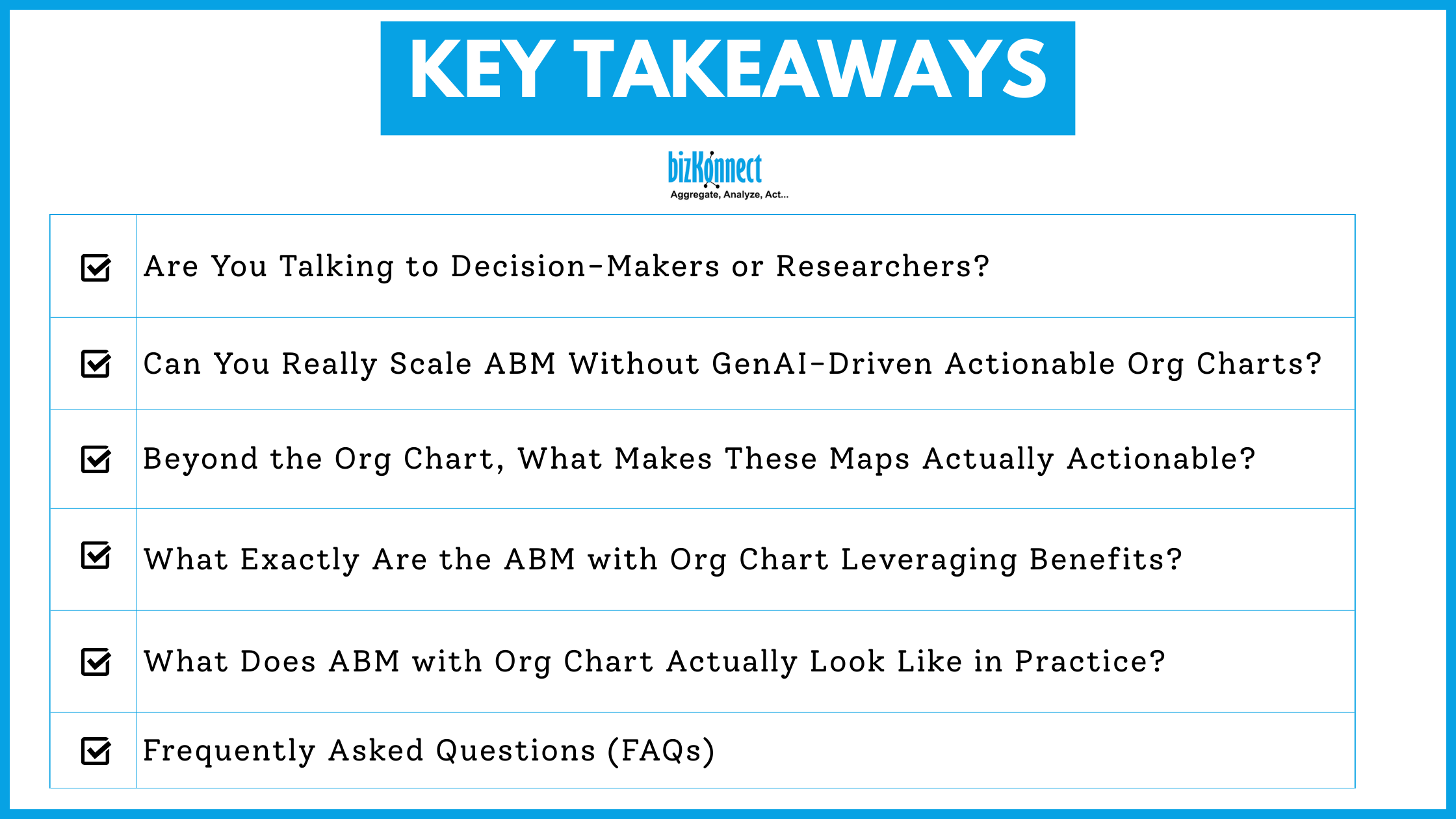
But, First Understand: Are You Talking to Decision-Makers or Researchers?
Traditional intent scoring tracks behavioral signals like downloads, page visits, and email opens. It tells you that someone is interested but it doesn't tell you who that someone is, what authority they hold, or whether they can actually make the decision.
Suppose your intent platform shows multiple touchpoints from Cisco’s San Jose headquarters last month. But without an ABM org chart strategy, you're unable to navigate their internal dynamics. You might be engaging with a solutions architect who loves your product but reports to a VP who's already committed to a competitor.
ABM with org chart for B2B sales changes this equation entirely.
Instead of chasing anonymous intent signals, you're mapping the actual decision-making hierarchy. You know who owns the budget, which executives are championing digital transformation initiatives, who influences purchasing decisions, and how recent organizational changes impact your deal timeline.
Can You Really Scale ABM Without GenAI-Driven Actionable Org Charts?
Not really! Manual account mapping works when you're targeting just a few accounts. But what happens when you need to execute account-based marketing org charts across a bulk of enterprises?
This is where GenAI-driven org charts become non-negotiable. Advanced Natural Language Processing (NLP) capabilities now aggregate and map business entities across millions of global companies, identifying decision-makers, influencers, and their reporting structures.
For example: Apple’s organizational structure spans multiple business units, geographies, and product lines. A GenAI-powered ABM org chart reveals:
- Recent hires in departments relevant to your solution
- Executives who've spoken publicly about pain points you solve
- Internal connections between different business units
- Budget allocation signals based on recent investments
This level of intelligence transforms ABM account mapping from guesswork to accurate and efficient targeting.

Beyond the Org Chart, What Makes These Maps Actually Actionable?
Static org charts are just fancy contact lists. The real power comes from contextual intelligence layered on top of organizational structures. Modern account-based marketing strategy solutions provide:
- Pain Point Indicators: Updated signals about challenges specific executives are facing. When your targeted account mentions infrastructure optimization in earnings calls, that's mapped directly to relevant stakeholders.
- Reference Connections: Your sales team's existing relationships visualized across the org chart. You discover your account executive went to college with a director several levels down from your target VP.
- Engagement Tracking: Interactive maps that show prospect movement from initial contact to warm leads to active negotiations. You're tracking deal progression through the organizational intricacies.
- Multiple Entry Points: When targeting companies like Apple, Microsoft & Cisco, you need pathways to decision-makers through different departments and business units. If your champion in network security leaves, you have pre-mapped alternative routes.
So, What Exactly Are the ABM with Org Chart Leveraging Benefits?
ABM with org chart benefits versus traditional ABM isn't subtle, it's transformative:
- Accuracy over volume
- Context-driven personalization
- Strategic resource allocation
- Accelerated deal velocity
While Getting Started, What Does ABM with Org Chart Actually Look Like in Practice?
Understanding what ABM is with org chart is straightforward: it's an account-based marketing strategy powered by detailed organizational intelligence rather than generic firmographic data.
In practice, this means sales and marketing teams collaborate using shared account maps showing the complete decision-making ecosystem. Campaign themes are built around specific pain points relevant to targeted business units. Personalized outreach leverages insights about individual prospects like recent news mentions, event participation, and internal project announcements. Business email addresses and LinkedIn profiles are directly accessible for immediate action.
The insight quality separates mediocre from exceptional execution. Where generic databases give you names and titles in 2026, contextual org charts give you insights for meaningful conversations when targeting giants like Apple, Microsoft, and Cisco.
Now, Addressing Some Critical Implementation Questions
Q1. Can intent data alone identify buying committees at enterprise accounts?
No. Intent signals show aggregate activity but don't reveal who within Apple, Microsoft, or Cisco is driving evaluation processes. You need org charts mapping authority and influence across business units to identify actual buying committees.
Q2. What makes an org chart "actionable" versus just informational?
Actionable org charts integrate contact mechanisms, visualize your team's existing connections, surface recent relevant insights about individuals, and track engagement progression. They're collaboration solutions, not static reference documents.
Q3. Does ABM org chart strategy work for mid-market accounts or just enterprises?
While the complexity of organizations like Apple, Microsoft, and Cisco justifies sophisticated mapping, mid-market companies still have multi-stakeholder decision processes. The same principles apply: you need to identify and navigate to actual decision-makers, regardless of company size.
In short, intent scores measure interest while GenAI-driven ABM org charts reveal who holds the power to act on that interest. In the competitive B2B landscape of 2026, the difference determines whether you close deals or just collect data.
Want to know who matters in your next pitch within companies like Apple, Microsoft, or Cisco? CLICK HERE to get real-time org intelligence of your target account with BizKonnect.