


Enterprise software vendors routinely construct their outbound strategies around standard buyer personas. It directs their pipeline generation toward technical department heads and engineering leaders, yet:
- Accounts remain stagnant
- Procurement cycles lengthen
- Complex value propositions bounce off the mid-level technical hierarchy
This systemic issue is an alignment lag behind a structural consolidation of power at the top of the industrial enterprise.
As global trade policies fluctuate, capital deployment requirements intensify, and currency and tariff headwinds squeeze margins, Toyota Motor Corporation has shifted its decision-making logic from technological experimentation to strict margin protection.
When the world’s largest automaker structurally alters its executive layout, it provides a definitive blueprint of how buying criteria are evolving across the enterprise landscape. B2B go-to-market teams continuing to use historical relationship maps are effectively pitching to an operational structure that no longer possesses autonomous capital allocation authority.
Why Does Enterprise Pipeline Stagnate Under Engineering-Led Mapping?
For years, the conventional B2B playbook dictated that commercial teams target product innovators, technical engineers, and digital transformation leads. The rationale seemed airtight:
If an automotive account-based marketing campaign could capture the interest of the executive running a high-profile technology or mobility division, budget authorization would naturally follow.
The automotive leadership changes at Toyota illustrate the structural vulnerability of this approach.
In a major executive restructuring announced in February 2026, Toyota transitioned Koji Sato, an engineering-rooted leader who championed advanced vehicle programs, into the newly created external role of Chief Industry Officer and Vice Chairman. In his stead, Kenta Kon, the long-time Chief Financial Officer and architect of the company’s internal cost-containment frameworks, assumed the role of President and Chief Executive Officer.
This structural transition highlights a massive operational reality for enterprise sellers.
- When a corporate giant experiences rising operational costs and escalating tariff pressures, it stops buying on technical potential. The core operational mandate becomes lowering the break-even volume and fortifying internal earning power across the entire value chain.
- When the executive office is occupied by a finance specialist whose career was built on dismantling functional segmentation and enforcing capital discipline, any B2B vendor pitching features to an engineering department will find their proposal permanently stalled in a procurement review.
The purchasing power has moved upstream, away from the functional silos and into the centralized core of corporate financial governance.
How Does the Toyota Organizational Structure Redefine the True Buying Center?
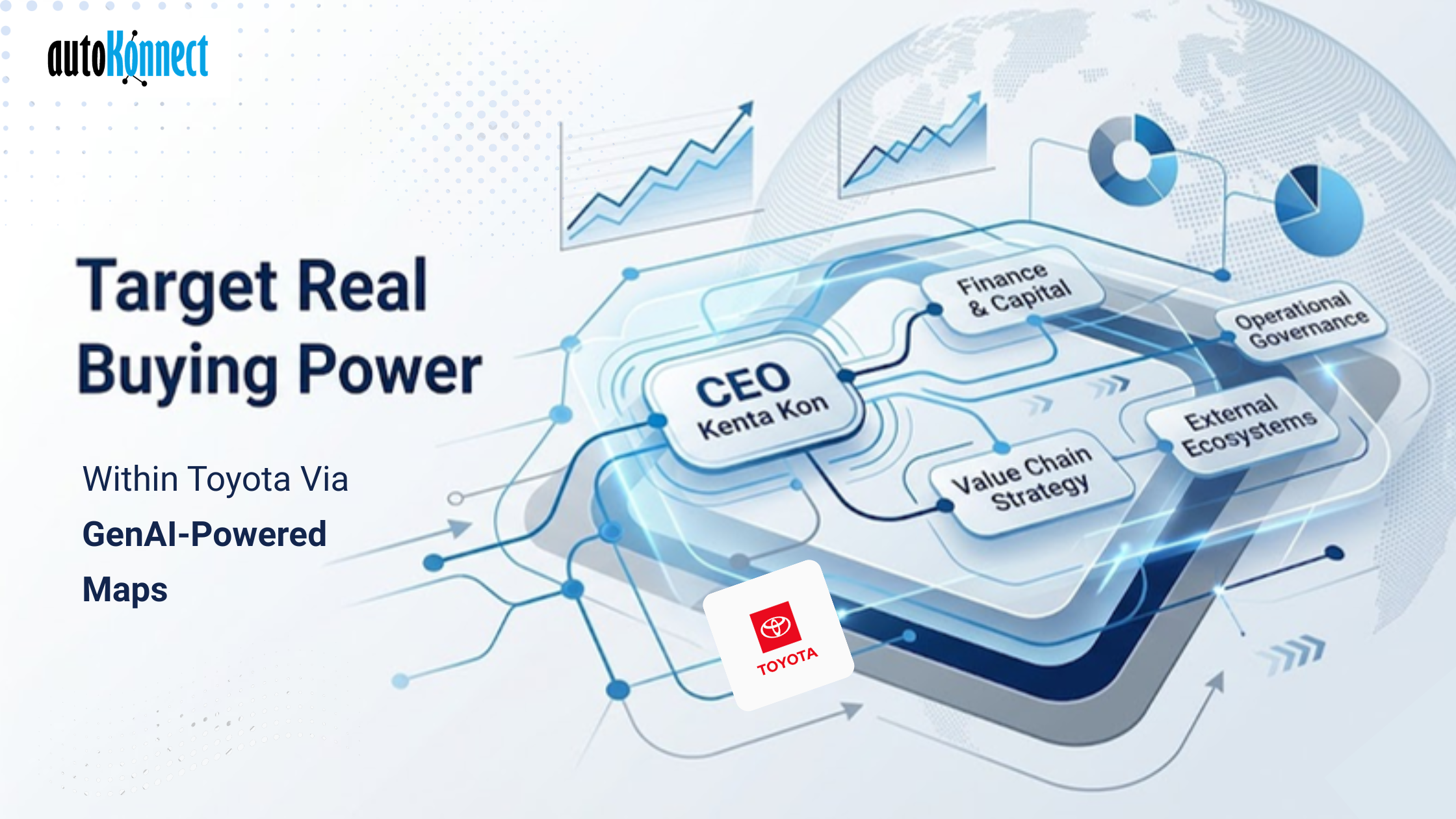
Understanding where power sits requires analyzing the precise boundary lines drawn inside a modern enterprise hierarchy. The division of labor within the Toyota corporate structure clarifies how modern enterprise buyers are segmenting their leadership priorities:
- External Ecosystem Orchestration: The Chief Industry Officer position focuses outward, handling cross-industry collaboration, regulatory policies, trade associations, and broad industry ecosystems.
- Internal Value Chain Governance: The President and CEO role maintains absolute authority over internal company management, operational efficiency, and the cross-functional value chain.
- Central Financial Stewardship: The CFO chair, now held by Yoichi Miyazaki, directly supports the optimization of the company's earning structure.
This specific Toyota corporate hierarchy and reporting structure demonstrates that enterprise deals can no longer be sold through a single, vertically isolated department.
A tech platform pitching a software-defined vehicle solution cannot simply win over a software unit like Woven by Toyota. The modern value proposition must show a direct, friction-free link to broader corporate balance sheet targets.
Because buying centers are fragmented yet financially consolidated, standard static organizational charts are completely insufficient for automotive account-based marketing. A typical database lists titles, but it misses the invisible operational dependencies, the shifting mandates of specific committees, and the actual reporting velocity. Enterprise procurement teams are tasked with eliminating duplicate vendor spend and optimizing value chains holistically.
If an outbound campaign treats an industrial buyer as a loose collection of independent budgets, it will fail to gain any traction with the executive committee.
Why Do Traditional Target Frameworks Fail to Identify Shifting Buying Authority?
The execution gap in large-scale outbound sales stems from an over-reliance on legacy enterprise data models.
Sales teams rely on data tables that refresh on fixed quarterly schedules, leaving them blind to sudden operational realignments. When an enterprise changes its leadership layout to tackle margin compression, it instantly invalidates the historical account scoring models used by marketing teams.
Furthermore, standard data lists fail to surface cross-functional realities.
Kenta Kon’s path to the top executive role was built on his cross-functional management experience across both corporate accounting units and high-growth technology projects. Traditional profile targeting lacks the contextual intelligence to recognize when a financial executive holds deep operational oversight over advanced technology initiatives.
This is where GenAI-driven Toyota org charts fundamentally rewrite the B2B prospecting playbooks.
Instead of delivering a flat, disconnected directory of names and titles, generative intelligence ingests:
- Complex corporate filings
- Earnings call transcripts
- Global press updates
- Operational disclosures
It maps the implicit relationships, active corporate mandates, and cross-departmental committees that dictate actual capital deployment.
For an enterprise vendor, utilizing GenAI-powered org charts turns a blind outbound motion into a highly targeted strategic alignment. It allows a business development team to look at the Toyota org chart and immediately see:
- Which business units are operating under an urgent directive to reduce break-even thresholds?
- Which departments report to Toyota’s CEO under the new 2026 alignment?
- How does a technical solution directly impact the corporate cash flow?
What Operational Adjustments Must Account Teams Execute to Protect Pipeline Velocity?
To navigate an environment where financial oversight supersedes technical enthusiasm, account management and marketing teams must adjust their engagement models across three distinct areas.
# 1 - Value metrics must be completely reframed.
In an executive climate defined by aggressive margin protection, metrics like development speed or system feature density carry far less weight than they used to. Every commercial proposal must explicitly communicate its impact on the target account's break-even volume and overall value chain optimization.
If a software solution promises to automate complex engineering tasks, the narrative must show how that optimization directly lowers capital expenditure requirements for the executive committee.
# 2 - Account teams must map and engage the entire cross-functional value chain.
When an enterprise client moves away from functional segmentation, a vendor's sales process must reflect that change. Marketing and sales components must be deployed simultaneously to reach the operational managers who feel the day-to-day pain, the financial analysts who evaluate vendor ROI, and the executive leadership team managing the overarching corporate strategy.
| Legacy Prospecting Focus | Modern Financial-Led Focus |
| Departmental feature adoption | Total value chain cost-reduction |
| Functional budget alignment | Cross-functional capital approval |
| Quarterly tech evaluation cycles | Continuous operational ROI tracking |
# 3 - GTM teams must implement continuous, real-time trigger monitoring.
Waiting for a standard database update to reveal major corporate leadership changes means missing the critical three-to-six-month window when a new executive structure is actively setting its fresh strategic priorities. Account teams need automated data workflows that instantly flag executive reshuffles, unexpected committee formations, and shifting corporate mandates.
This ensures that outbound positioning can be adjusted before competitors even realize the target account's internal power dynamics have changed.
With these operational shifts in mind, several practical questions tend to surface during evaluation and execution.
Frequently Asked Questions (FAQs)
Q1. What is Toyota’s current organizational structure?
Toyota operates through a multi-layered global structure combining executive leadership, mobility initiatives, software divisions, manufacturing operations, and regional business units. Recent leadership changes indicate stronger coordination between finance, software strategy, and operational governance.
Q2. Why are GenAI-powered org charts useful for B2B sales teams?
GenAI-powered org charts help revenue teams identify shifting influence patterns, executive overlaps, reporting changes, and operational decision pathways that traditional static org charts often miss.
Q3. How does Toyota’s leadership change affect automotive account-based marketing?
The shift signals that automotive buying decisions increasingly involve finance, software governance, mobility strategy, and alliance coordination simultaneously. ABM teams must map influence networks rather than relying only on departmental targeting.
Succeeding in highly competitive automotive accounts requires more than basic contact lists and generic outbound emails. True sales alignment demands deep contextual clarity into how corporate entities are managed, how their leadership teams are structured, and where capital approval authority actually sits. Discover how to transform your enterprise prospecting accuracy and build deeper executive relationships across complex industrial accounts.
CLICK HERE to learn how BizKonnect can supercharge your enterprise go-to-market execution.
CLICK HERE to know more with BizKonnect.