


For eighteen years, Adobe's technology leadership hierarchy operated with a clarity most enterprise software companies envied.
A single strategic architect shaped every major pivot from boxed software to Creative Cloud, from point solutions to an integrated experience platform. Sales teams mapping Adobe accounts knew exactly where strategic decisions lived. The org chart was, in effect, stable infrastructure.
That infrastructure is now in motion.
On March 12, 2026, Adobe announced that Shantanu Narayen, who has served as CEO for eighteen years, has decided to transition from his position once a successor is named.
The board has initiated a formal search process considering both internal and external candidates, with Frank Calderoni, Lead Independent Director, appointed to chair the special committee overseeing succession planning. Narayen will remain as Chair of the Board.
What changes in the market when that level of leadership certainty disappears?
More than most B2B sales teams are currently prepared for. Creative enterprise software is no longer just about tools, rather it is about:
- Who controls the AI strategy behind those tools?
- How deeply that strategy is embedded across an organization?
- Whether the next leader continues, corrects, or reinvents what Narayen built?
For sellers navigating GenAI-driven Adobe org charts right now, that uncertainty is the ideal environment.
Why Does a Planned CEO Succession Disrupt Buying Authority More Than a Crisis Would?
Adobe is not a company undergoing distress. This is not a crisis succession and that distinction is precisely what makes the situation harder to navigate for enterprise sellers.
In a distressed leadership change, buying cycles freeze where everyone waits and this signal is unmistakable. A planned, orderly succession creates a more disorienting dynamic because budgets remain active and roadmaps stay theoretically intact.
But beneath the surface, authority is actively migrating:
- Strategic prioritization is in flux: Adobe's deep investment in Firefly was built under Narayen's direction. An incoming CEO will interrogate that bet, accelerate it, or redirect it and vendors positioned around that roadmap will feel the adjustment.
- Vendor relationships are quietly re-evaluated: Department heads who aligned around one leadership philosophy begin repositioning for the next.
- Decision-making disperses: CMOs, CPOs, and business unit leads absorb decisions that previously escalated upward. The contact who mattered yesterday may not matter today.
Sales teams working from Adobe org charts built six months ago are not working from outdated data. They are working from a fundamentally different organizational reality.
How Do GenAI-Powered Org Charts Help B2B Sales Teams Navigate Enterprise Transitions?
Org charts in their conventional form show reporting lines. What AI-powered tech company org charts reveal is more consequential: how authority actually flows when formal hierarchy is disrupted.
During a CEO transition at an organization of Adobe's complexity, several predictable patterns emerge:
- Shadow authority rises: Senior leaders who previously deferred to CEO-level alignment begin acting on their own assessments. GenAI-driven org charts that map informal influence clusters identify emerging decision nodes before they surface publicly.
- Procurement gatekeeping tightens: New leadership invariably conducts spend audits, making vendors without multi-level relationships vulnerable. Org intelligence that surfaces second and third-tier champions becomes a retention tool.
- Internal advocacy networks shift. The executive who championed a vendor under the prior CEO may lose standing under the next. AI-powered technology leadership insights give sales teams early warning before that erosion becomes a lost renewal.
The conventional CRM contact list captures who you know. GenAI org charts tell you whether those people still matter and who has quietly started to.
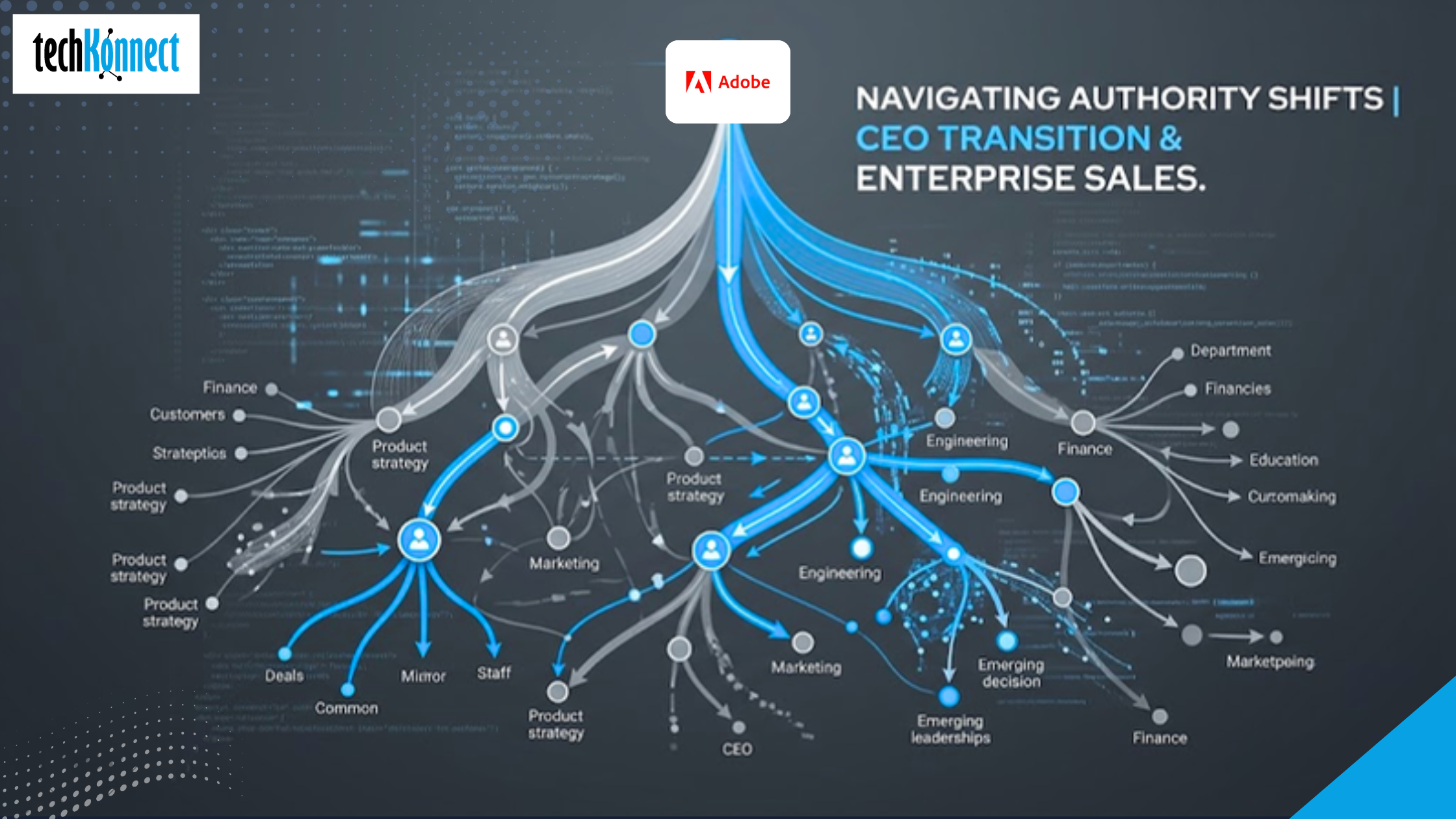
Why Is Adobe's CEO Transition Creating Two Simultaneous Buying Committee Disruptions?
Narayen's tenure repositioned Adobe from a creative tools company to an enterprise AI platform.
Firefly's integration across Creative Cloud, Adobe Express, and the Experience Platform fundamentally changed the buyer profile and in doing so, redefined what creative enterprise software means at the procurement level. IT now cares and legal reviews AI output policies. What was once a CMO-level renewal became a cross-functional evaluation spanning security, compliance, and data governance.
That redefinition was still unfolding under Narayen's direction when the succession was announced.
An incoming CEO inherits a product portfolio mid-transformation:
Firefly is commercially live but strategically unfinished
The Experience Platform competes across categories requiring different enterprise sales motions
The AI monetization model is still being pressure-tested against enterprise budgets.
The next leader's appetite for that complexity will determine Adobe's trajectory in creative enterprise software for the next decade. Sellers who understand Adobe org charts well enough to track where those decisions will land have a measurable advantage over those who don't.
That expansion of the buying committee was already straining traditional account maps.
Now, with an incoming CEO almost certain to conduct a strategic review of the AI portfolio, a second layer of complexity is forming at the top of the organization.
For B2B sellers with Adobe as a customer, partner, or competitive reference point, evaluation criteria are moving on two axes simultaneously: product evolution at the department level and leadership succession at the C-suite level.
Static account intelligence cannot resolve a two-axis problem. Only continuously updated, AI-generated org maps that reflect real-time organizational changes give sales teams the visibility to act with precision rather than assumption.
Why Is the Succession Window the Highest-Value Moment in the Adobe Account Cycle?
The search process will generate organizational uncertainty until a successor is named and establishes strategic direction. For B2B marketers and enterprise sellers, this window is when accounts are most malleable.
Organizations in leadership transition are simultaneously more open to new vendor relationships and more likely to let existing ones lapse through neglect. Decision-making timelines can accelerate when champions want to close before losing authority or stall when new leadership arrives with a mandate to review commitments.
Both dynamics run in parallel, at the same time.
Traditional account research such as LinkedIn profiles, CRM records, and press releases has a structural lag problem. A press release announces a successor after the search concludes, not while authority is actively migrating.
GenAI-driven Adobe org charts address this through continuous signal aggregation: job posting patterns, executive activity, news mentions that correlate leadership changes with spending decisions. The result is a living account map rather than a quarterly snapshot.
Navigating this window without current technology leadership insights is navigation by assumption. And assumption, in enterprise sales, is where pipelines go to stall.
Addressing a Few Frequently Asked Questions (FAQs)
Q. Should outreach to Adobe accounts pause during the succession process?
No. The succession window is often the highest-engagement period in an account cycle. Internal buyers are assessing vendor relationships, new champions are emerging, and spending authority is redistributing. Pausing cedes that window to competitors.
Q. Which Adobe roles are most likely to gain authority during the transition?
Senior vice presidents and business unit presidents typically absorb decision-making during CEO succession. Within Adobe's structure, leaders overseeing Digital Experience and Creative Cloud are the most consequential nodes to track.
Q. How do AI-powered org charts differ from standard company directories during a CEO transition?
Standard directories reflect static hierarchy. AI-powered org charts update continuously based on job change signals and reorganization patterns, surfacing authority shifts before they are formally announced.
Q. How do org charts help B2B sales teams close deals faster during Adobe’s leadership transitions?
By identifying which contacts retain decision-making authority and which have lost internal standing, org intelligence lets teams prioritize the right relationships at the right moment.
Understanding where authority is moving inside Adobe's organization right now is not a research project, instead it is a sales motion. To see how GenAI-driven org charts can help your team map Adobe's evolving technology leadership hierarchy and accelerate deal cycles during this transition, CLICK HERE to explore what BizKonnect's account intelligence can surface for your pipeline.
CLICK HERE to know more with BizKonnect.