


What is Actionable Sales Intelligence?
Sales intelligence is the systematic collection, analysis, and application of data about prospects, customers, competitors, and market conditions to help sales teams sell more effectively. It draws from firmographic records, technographic profiles, behavioral signals, intent data, and trigger events and turns those inputs into the next move a sales rep should make.
In simple terms,
Actionable sales intelligence is the subset of that intelligence that is specific enough, timely enough, and contextually relevant enough to directly inform a decision like who to call, what to say, and when to reach out. It is the difference between a data point sitting in a dashboard and an insight that drives a rep to pick up the phone.
The distinction matters enormously.
Sales teams today do not suffer from a shortage of data. They suffer from a surfeit of it because data that sits in disconnected systems, decays before it can be used, or arrives without context. Actionable intelligence solves a different problem than raw data coverage. It answers not just what is happening but what we should do about it.
What is an “Actionable” Gap and Why Does it Exist?
There is a common pattern in sales organizations: a platform gets purchased, dashboards fill up, and reps still prospect the same way they always have. The data is there, but the behavior change is not. This is the actionability gap, and it is the central challenge of modern sales intelligence.
"Most revenue teams do not have a pipeline problem. They have a data-confidence problem. Reps dial numbers that have been wrong for six months and email contacts who left two years ago."
Intelligence fails to become actionable for a few predictable reasons:
- Data arrives too late like a funding event is spotted three weeks after it was announced, well after a competitor already made contact.
- Context is missing, a rep sees that a prospect downloaded a whitepaper but has no idea why that matters for their specific territory.
- The insight lives in the wrong tool, buried in a BI report no one checks during a prospecting session.
- The signal is technically present but requires so much interpretation that time-pressed reps ignore it entirely.
Closing the actionability gap requires intelligence that is accurate, current, contextually relevant, delivered in the rep's actual workflow, and specific enough to generate a clear next step. Meeting all five conditions simultaneously is harder than it sounds and the gap between systems that meet one or two of them and those that meet all five is where sales outcomes diverge.
Intelligence becomes actionable when it reaches a rep inside the tool they're already working in, at the moment it's relevant, with enough context to drive a specific decision in a precisely timed, precisely targeted conversation.
Why Actionable Sales Intelligence Matters Now?
The case for intelligence-driven selling is no longer theoretical because the impact is measurable across win rates, deal size, sales cycle length, and rep productivity. And the gap between organizations that leverage it and those that don't continues to widen.
- 46% win rate for teams using sales intelligence vs. 32% for those that don't
- 40% increase in average deal size reported by intelligence-enabled teams
- 2.5 hours per day saved per rep on prospecting research when intelligence is centralized
The urgency has intensified because buyer behavior has changed.
Modern B2B buyers complete a significant portion of their research before engaging with a sales rep. By the time someone responds to cold outreach, they may already have a shortlist.
Actionable intelligence lets sales teams enter the conversation earlier, identifying the research phase through intent signals and engaging accounts before the shortlist is formed. Meanwhile, the volume of available data has grown faster than any team's ability to process it manually. AI and automation have shifted the advantage decisively toward teams that have systematized intelligence collection, analysis, and delivery.
Organizations still relying on manual research face a compounding disadvantage that only grows as their competitors' systems improve.
What are The Data Layers That Power Actionable Sales Intelligence?
Actionable sales intelligence is the product of several distinct data layers working together. Each layer answers a different question. Used in isolation, they are informative. Combined, they become genuinely predictive.
- FIRMOGRAPHIC DATA: Who They Are
Firmographic data covers the structural attributes of a company: industry, size, revenue, geography, ownership structure, and business model. It is the foundation of ideal customer profile (ICP) definition and the starting point for any prospecting motion.
A rep who knows an account is a 400-person, private-equity-backed logistics company with a headquarters in the Midwest has a meaningfully different opening conversation than one working from a company name alone.
2. TECHNOGRAPHIC DATA: What They Use
Technographic data maps the technology stack a company runs: their CRM, marketing automation platform, cloud infrastructure, security tools, and everything in between. For sales teams, technographic data is both a qualification signal and a conversation anchor. It helps identify displacement opportunities such as accounts running a legacy solution your product replaces and surfaces the specific integrations and compatibility questions that will arise before they need to be asked.
3. CONTACT INTELLIGENCE: Who Decides
Contact intelligence goes beyond a name and email address. It covers a person's role, seniority, reporting structure, career history, areas of responsibility, and their position within the buying committee.
Org chart visibility is particularly valuable for knowing not just the primary contact but the adjacent stakeholders who influence a deal allows reps to multi-thread effectively rather than relying on a single champion.
4. INTENT DATA: What They're Thinking About
Intent data captures behavioral signals indicating that a company or individual is actively researching a problem, category, or solution.
First-party intent comes from your own digital properties like website visits, content downloads, demo requests, and email engagement. Third-party intent comes from external sources: spikes in topic-specific research across B2B media, activity on software review platforms, or competitor website visits.
Together, they reveal buying interest that hasn't yet been expressed directly to a sales team.
5. COMPETITIVE INTELLIGENCE: Who Else They're Considering
Competitive intelligence tracks the pricing, positioning, product changes, and customer sentiment of competing vendors. For sales teams, it serves two purposes:
- Arming reps with the context they need to handle objections before they arise
- Identifying displacement opportunities where accounts currently using a competitor may be receptive to switching.
Here’s the quick reference of data layer:
| Data Layer | Question It Answers | Primary Actionable Output |
|---|---|---|
| Firmographic | Does this account fit our ICP? | Account qualification and TAM sizing |
| Technographic | What are they running and what could we replace? | Displacement targeting and integration-led messaging |
| Contact Intelligence | Who should we be talking to? | Multi-threading and champion mapping |
| Intent Data | Is this account actively buying? | Outreach timing and prioritization scoring |
| Trigger Events | Did something change that creates an opening? | Timely, context-specific outreach |
| Competitive Intelligence | Who are we competing against? | Battle card activation and displacement campaigns |
What are the Signals That Make Sales Intelligence “Actionable”?
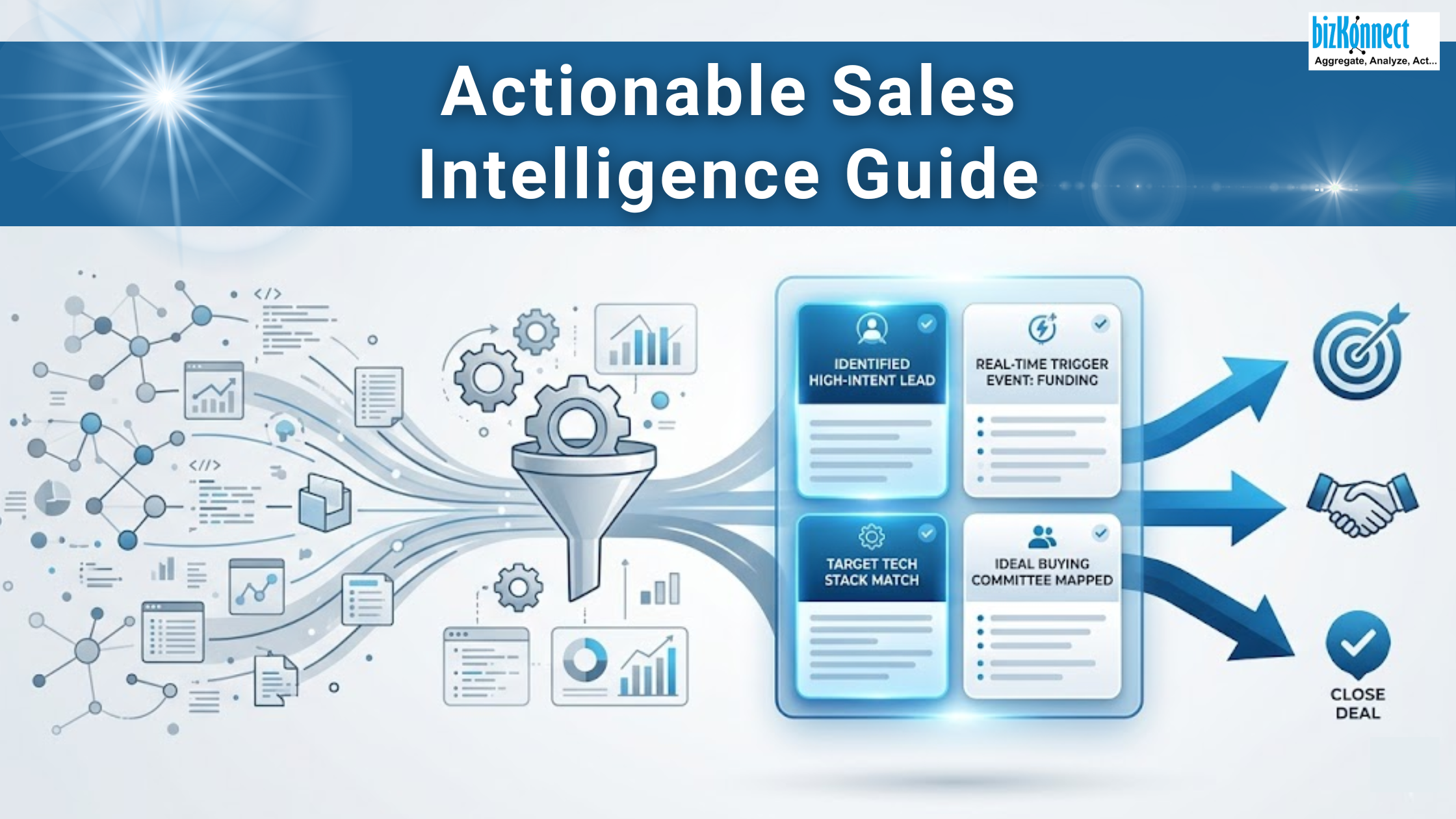
If data layers are the raw material, signals are what convert information into a reason to act.
A signal is a change in a company's state that meaningfully increases or decreases the probability of a successful sale. Monitoring for the right signals and being able to act on them quickly is one of the most significant competitive advantages an intelligence-enabled team possesses.
- Funding Rounds: A capital raise signals budget availability and organizational momentum. Teams that reach out within days of an announcement consistently outperform those that wait.
- Leadership Changes: New executives, especially VP or C-suite hires, frequently evaluate vendors in their first 90 days. A new CRO or CFO is one of the highest-quality signals a sales team can act on.
- Hiring Patterns: A surge in engineering roles signals product investment. New go-to-market hires signal revenue expansion. Hiring patterns reveal strategic priorities before those priorities become public announcements.
- Intent Spikes: When a target account shows a measurable surge in research around a topic you solve, that is a high-confidence indicator of active purchase consideration, often weeks before any direct engagement.
- M&A Activity: Mergers and acquisitions create technology overlap, displaced vendors, and new budget cycles, all of which open doors for timely outreach with highly relevant context.
- Review Site Activity: A spike in competitor reviews, especially negative ones, signals evaluation activity. Accounts actively rating your competitors are by definition in a buying mindset.
The value of a signal decays with time. A funding announcement that was cold-called on day one yields a very different conversation than the same outreach placed three weeks later. Speed matters, which means signals need to be monitored continuously and surface directly inside the tools where reps work.
What are the 4-Pillars of Intelligence-Driven Selling?
01 - Prospect With Precision: Use ICP fit plus real-time intent signals to build prospecting lists that prioritize accounts showing active buying behavior.
02 - Time Outreach to Signals: Replace calendar-driven cadences with signal-driven ones. The right time to reach out is when something changed at the account.
03 - Personalize With Context: Use technographic, firmographic, and trigger data to open conversations with specific, relevant context. Reference the funding round. Acknowledge the new CRO. Mention the integration you know they need.
04 - Multi-Thread Every Deal: Contact intelligence and org charts reveal the full buying committee. Intelligence-enabled teams don't rely on a single champion, they map and engage multiple stakeholders from the start.
How to Implement Sales Intelligence That Actually Gets Used?
A sales intelligence platform that reps don't trust is just an expensive subscription. Adoption is the hardest part of implementation and it depends on getting a few foundational decisions right from the start.
1. START WITH DATA QUALITY
Reps lose trust in a platform after the first few bad phone numbers or contacts who left their company six months ago. Prioritize vendors with high verification standards and continuous refresh cadences before worrying about feature breadth.
2. INTEGRATE BEFORE YOU LAUNCH
The platform needs to work inside the CRM and sales engagement tools the team already uses before rollout, not as a promised future integration. If reps need to context-switch to get value, most won't.
3. DEFINE SPECIFIC USE CASES
The best implementations start with two or three concrete workflows: SDR trigger-event alerting, AE expansion signal monitoring, inbound lead enrichment. Broad launches with no defined use cases produce broad shrugs.
4. TRAIN ON INTERPRETATION
Teaching reps which button to click is table stakes. The high-value training teaches them how to read a signal, how to build a sequence around a trigger event, and how to use org chart data to build a multi-thread strategy.
5. AUDIT DATA COMPLIANCE FROM DAY ONE
Intelligence platforms operating in enterprise sales environments need to satisfy GDPR, CCPA, and other applicable privacy regulations. Establish data governance policies before any intelligence is used in outreach, not after a compliance question surfaces.
6. MEASURE WHAT CHANGES
Define the metrics that should move: connect rates, sequence response rates, pipeline coverage in target accounts, average days to first meeting. Review them quarterly and iterate on which signals and workflows are producing results.
What are the Common Mistakes and How to Avoid Them?
Most sales intelligence implementations underdeliver because of predictable, avoidable mistakes in how they're deployed. Here are some of them:
1. Treating Intelligence as a Prospecting List Tool
The most underutilized dimension of sales intelligence is in-deal. Teams that use intelligence only at the top of the funnel to build prospecting lists miss its most powerful applications:
- Identifying new stakeholders mid-deal
- Monitoring competitor activity in open opportunities
- Using conversation intelligence to understand why deals stall
Intelligence should follow the opportunity, not just precede it.
2. Ignoring Data Decay
B2B contact data decays at a rate of roughly 20–30% per year as people change jobs, get promoted, or leave organizations entirely. A platform with excellent data at the time of purchase can become a liability within 18 months if the vendor's refresh methodology isn't continuous. Always ask specifically how often records are verified and updated, not just how large the database is.
3. Confusing Volume With Quality
More signals are not better signals. Reps who receive dozens of alerts per day will start ignoring all of them.
The goal is a small number of high-confidence, clearly prioritized signals that genuinely warrant action. Good intelligence systems are ruthlessly opinionated about what surfaces. Bad ones surface everything and call it comprehensive.
4. Failing to Close the Feedback Loop
Intelligence systems improve when outcomes like won deals, lost deals, meetings booked, and emails responded to are fed back into the model. Teams that don't track which signals and workflows produce results can't improve their intelligence strategy over time. Win/loss data, documented consistently, is one of the most valuable inputs a sales intelligence system can receive.
Frequently Asked Questions (FAQs)
Q: How is actionable sales intelligence different from a CRM?
A CRM stores and manages the history of your existing customer and prospect relationships. Sales intelligence enriches that history with external data such as signals, contact updates, technographic profiles, and intent data. The two are complementary. Intelligence feeds the CRM; the CRM gives intelligence context about the relationship history.
Q: What makes sales intelligence "actionable" vs. just informative?
Intelligence is informative when it tells you something you didn't know. It is actionable when it tells you something specific enough to drive a clear next step such as reaching out to this person, at this company, today, because of this specific event, with this angle. The difference is precision and timeliness.
Q: How do I evaluate whether an intelligence platform's data is actually accurate?
Ask the vendor for a sample of verified data for your specific target market before buying. Run that sample through your own outreach to check bounce rates, phone number accuracy, and contact tenure. Independently verify a handful of records against LinkedIn. Ask the vendor specifically how frequently records are refreshed and how verification is conducted. Then ask for reference customers in accounts similar to yours and ask them directly about data quality in practice, not just in demos.
As standard outbound outreach channels grow increasingly saturated, generic high-volume sales tactics continue to yield diminishing returns. Sustainable pipeline acceleration belongs exclusively to organizations that can accurately identify subtle market shifts and act on them with precise timing.
By shifting from passive data collection to an integrated ecosystem of Actionable Sales Intelligence, enterprise revenue organizations stop chasing cold markets. Instead, they position themselves as timely, contextual solutions arriving exactly when the buyer's internal needs demand them.
CLICK HERE to explore how BizKonnect helps B2B teams reach the right decision-makers with verified contacts, contextual org charts, and insight-driven campaigns.
CLICK HERE to know more with BizKonnect.