


Quarterly reporting used to give finance leaders enough room to explain performance, revise forecasts, and reset investor expectations. That operating rhythm is breaking down. Boards now expect CFOs to explain what happens if revenue contracts next month, if supply costs spike next quarter, or if a new acquisition changes cash flow assumptions overnight.
That shift is quietly changing how Investor Relations (IR) technology is evaluated and bought.
Many B2B marketers still position IR platforms around reporting efficiency, compliance workflows, or earnings presentation management. But, buyers are moving somewhere else. They are looking for systems that support continuous financial visibility, faster scenario analysis, and decision confidence under uncertainty.
The gap here is market understanding, making actionable sales intelligence critical because finance buying signals now emerge long before procurement begins. Teams that understand those signals early are building stronger positioning, tighter messaging, and better pipeline quality.
What Has Actually Changed in the CFO's Mandate?
In Deloitte's Q4 2025 CFO Signals survey of 200 finance chiefs at North American companies with at least $1 billion in annual revenues, a survey-high 50% named digital transformation of finance among their top three priorities for 2026, with 87% predicting that AI will be extremely or very important to their finance department's operations in the coming year.
That is not a technology preference, rather than a mandate shift.
What is driving it is the nature of uncertainty itself. Markets, interest rates, regulatory conditions, and investor expectations are no longer behaving in quarterly rhythms. Boards have noticed and they are no longer content with a polished slide deck that reflects where things stood 90 days ago. They want to know what happens to the cash position if a rate decision lands next Tuesday. They want scenario outputs before a deal closes.
This is the environment IR tech vendors are now selling into.
The CFO is not just looking for a better reporting tool. They are looking for infrastructure that makes their finance function faster, more adaptive, and capable of holding a board-level conversation on short notice.
The marketers who understand this distinction will reach a different kind of buyer at a different stage in their decision-making.
Why Are IR Tech Marketers Missing the Real Buying Trigger?
Most IR tech marketing still leads with efficiency. Automate your reporting, consolidate your data, and save your team hours every week. These are real benefits, but they are not the reason a CFO opens a budget.
The actual trigger is credibility under pressure. Boards are asking harder questions faster.
CFOs who cannot model scenarios in real time, who cannot pivot an investor narrative mid-quarter, and who cannot show clean forward-looking data at a moment's notice, are losing standing in the boardroom.
B2B marketers who sell into this space are leaving that trigger entirely unaddressed. They are marketing to the finance operations team when the actual urgency lives at the CFO level, and the actual fear is not inefficiency, it is exposure.
A survey-high 54% of CFOs said integrating AI agents is among their top three finance transformation priorities today. The full picture of where investment is going looks like this:
- Integrating AI agents into finance operations (54%)
- Automating and accelerating financial processes (50%)
- Investing in technology infrastructure (48%)
They are coordinated values in a new way of operating. IR tech marketers need to align their messaging to this coordinated intent, not to individual feature value.
How Does Actionable Sales Intelligence Change the GTM Approach for IR Tech?
This is where the gap between awareness and pipeline becomes a solvable problem.
The challenge for IR tech marketers is finding CFOs who are actively rebuilding their finance infrastructure right now, at a company whose board is already pushing for real-time scenario visibility. That is a narrow profile, and spray-and-pray outreach does not reach it efficiently.
Actionable sales intelligence changes the targeting logic entirely.
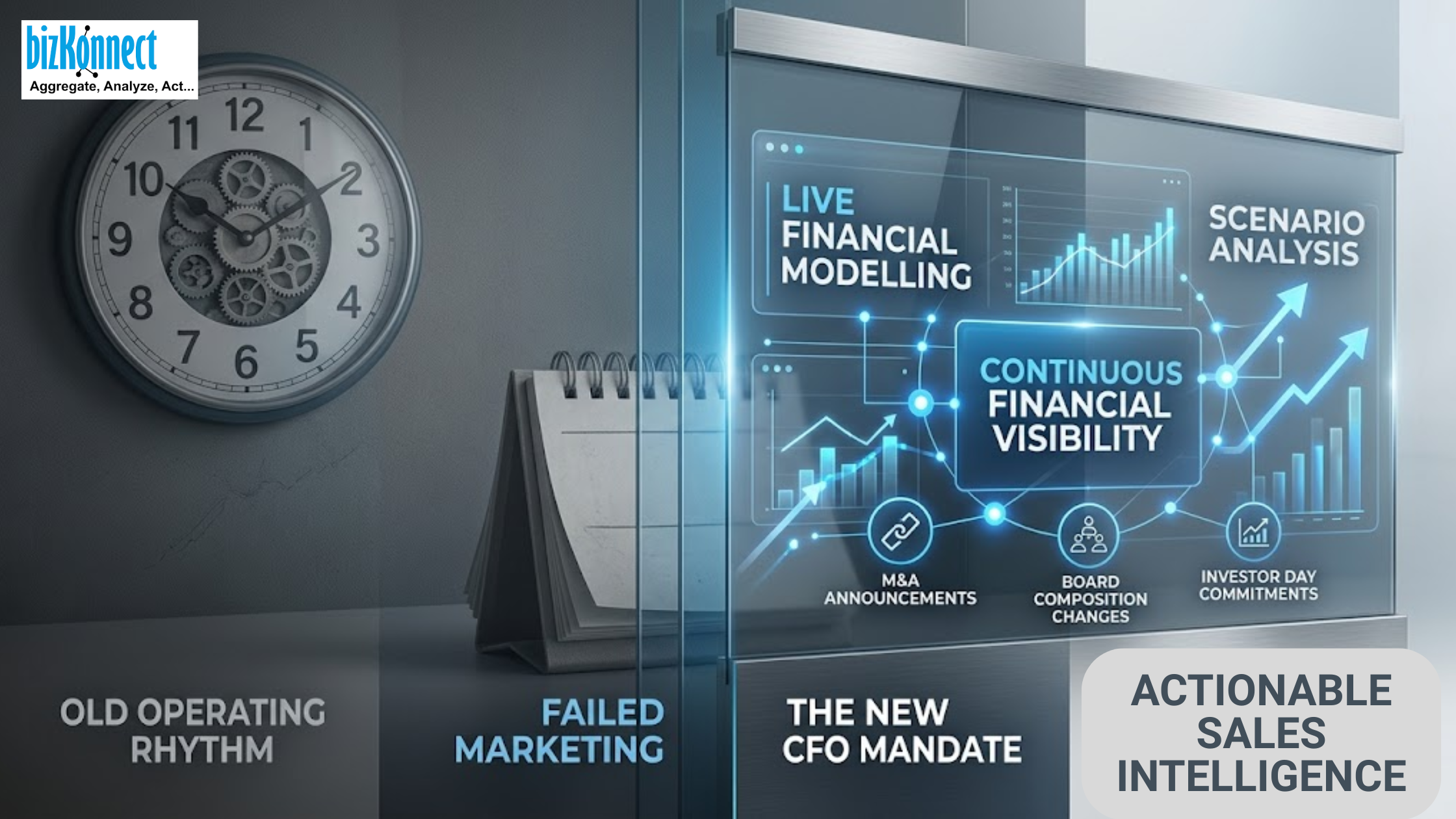
Instead of reaching out to every finance leader in a named industry vertical, teams can identify accounts showing intent signals that map directly to the buying trigger:
- CFO-level technology investment announcements
- Board composition changes that signal governance pressure
- Recent investor day commitments that create downstream reporting demands
- M&A activity that expands investor relations complexity overnight
The specificity matters because the sales cycle for IR tech is rarely short.
The CFO is not the only voice. IR teams, FP&A, investor relations officers, and sometimes legal all weigh in. Sales intelligence that maps the buying committee across those functions, with contact-level data and engagement context, gives marketing and sales teams a real head start.
What Does the Right Message Look Like for a CFO Who Has Already Decided the Old Way Does Not Work?
The CFO who is actively rebuilding their finance function are looking for a decision they can defend upward. That’s why the message that reaches them is about outcomes the board will recognize.
This means IR tech marketing has to operate at two levels simultaneously.
At the category level, the messaging needs to reflect the stakes of the moment: real-time scenario modelling is not a nice-to-have when the board expects live answers. At the product level, the proof has to be specific. Case studies with named outcomes, implementation timelines that are honest, and integration realities that acknowledge the complexity of legacy finance stacks.
The marketers who close this gap are the ones who build content that a CFO could actually take into a board conversation.
Frequently Asked Questions (FAQs)
With these challenges and solutions in mind, a few important questions naturally arise for teams navigating similar situations. Let’s address some of them:
Q. What is the most common mistake IR tech marketers make when targeting CFOs?
Leading with operational efficiency rather than board-level credibility. The CFO's real pain today is the pressure to respond faster and more precisely to investor and board scrutiny, not saving hours on report generation.
Q. How does real-time scenario modelling change what IR tech buyers actually need?
It shifts the requirement from static reporting tools to dynamic, integrable infrastructure. Buyers need platforms that can ingest live data, model multiple variables simultaneously, and output narratives that hold up under board questioning.
Q. What intent signals should sales teams prioritize when targeting IR tech prospects?
M&A announcements, investor day scheduling, CFO transitions, board governance changes, and public commitments to finance digital transformation all indicate an active evaluation window.
If your team is trying to reach the right finance and IR decision-makers at the right moment in their buying cycle, actionable sales intelligence is what closes the gap between awareness and pipeline.
CLICK HERE to explore how BizKonnect helps IR tech marketers identify and engage high-intent accounts before the window closes.