


Selling a hospital information system (HIS) is not like closing a SaaS deal with a single founder or one IT director. The moment a health system decides to evaluate a new Electronic Health Record (EHR), Revenue Cycle Management (RCM) platform, or Patient Engagement tool, a web of stakeholders activates.
Each with their own priorities, veto power, and timelines.
Vendors who treat this as a single-contact pursuit lose deals they should have won. That is exactly where an actionable sales intelligence-driven healthcare IT decision-makers email list changes the equation. Besides giving updated contacts, it also equips vendors with role-specific context, company-level triggers, and verified data that tells them “who to reach”, “when to reach them”, and “what to say”.
The hospital IT buying process, is it really that complicated?
Yes, and the complexity is deliberate. Hospitals are highly regulated environments where a wrong technology decision can affect patient outcomes, compliance standing, and operational continuity all at once. A decision to replace or upgrade a hospital information system typically takes 12 to 24 months. During that window, multiple departments weigh in, budgets get reviewed at board level, and the final contract often requires sign-off from people who never attended a single product demo.
What makes this especially challenging for vendors is that the person who responds to your cold email is rarely the person who approves the purchase.
So who are the actual decision-makers in a hospital IT purchase?
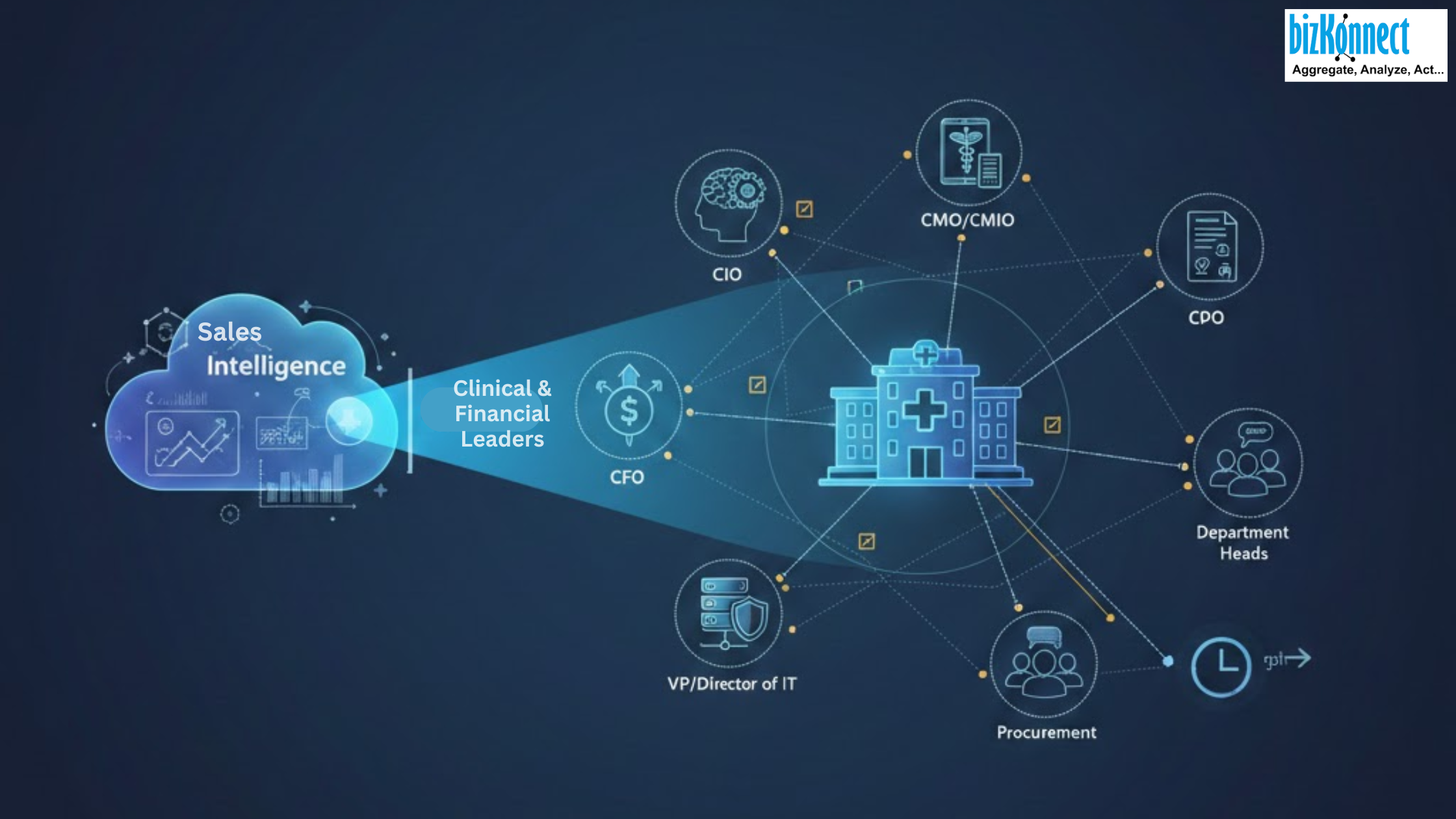
Understanding the hospital IT decision-maker hierarchy is the foundation of any effective sales strategy in this space. It is not a straight line, it is a layered structure where clinical authority, financial control, and technical evaluation all intersect, often with competing priorities.
Here are the key roles that consistently show up in hospital information system purchases:
- Chief Information Officer (CIO): Owns the overall technology roadmap. Their priority is integration, scalability, and long-term vendor reliability.
- Chief Medical Officer (CMO) or Chief Medical Informatics Officer (CMIO): Evaluates whether the system supports clinical workflows. They carry significant weight when EHR or clinical decision support tools are involved.
- Chief Financial Officer (CFO): Controls budget approval. Any deal above a certain threshold needs CFO visibility.
- VP or Director of IT: Handles the technical evaluation: infrastructure compatibility, data security, implementation timelines.
- Department Heads (Nursing, Radiology, Emergency): End users who often have informal veto power. If the nursing staff pushes back on a new Patient Engagement platform, the deal stalls.
- Procurement and Vendor Management Teams: Control the Request for Proposal (RFP) process and contract negotiation.
Missing even one of these contacts in your outreach means your message hits a roadblock before it reaches the people who can say “yes”.
How does a healthcare IT decision-makers email list actually help vendors close faster?
hospital information systems email list that is built purely on job titles and company names is a starting point, not a sales strategy. The real value comes when the data includes and actionable sales intelligence is what transforms that data into a pipeline. The distinction is practical.
A generic contact record tells you:
A hospital's CIO name and email is a starting point.
An intelligent record tells you:
The same hospital recently appointed a new CIO, runs a legacy EHR approaching end-of-life, employs 800 people across three facilities, and has publicly announced a digital health transformation initiative.
So, actionable sales intelligence-driven lists in healthcare IT typically includes:
- Verified direct emails: not info@ addresses or catch-all inboxes that kill deliverability
- LinkedIn profiles: for multichannel outreach (email + LinkedIn in sequence meaningfully improves reply rates)
- Technology environment data: what systems the hospital currently runs, so vendors know whether they are selling a replacement or an integration
- Company-level intelligence: employee size, revenue range, facility type, and ownership structure
- Trigger signals: leadership changes, system mergers, CMS (Centers for Medicare & Medicaid Services) penalties, service line expansions, or end-of-contract windows
When a vendor knows that a target hospital is six months from their EHR contract renewal and recently hired a new CIO, that is a conversation with natural timing on your side.
Does the buying committee change based on what you are selling?
Significantly. This is one of the most overlooked variables in healthcare IT sales strategy. The hospital IT email list that works for selling a Telehealth solution is not the same one you need when selling Revenue Cycle software.
For EHR/EMR (Electronic Health Record/Electronic Medical Record) systems, the CMIO and CIO share the decision. For Practice Management tools, the COO (Chief Operating Officer) and billing directors become central. For RCM software, the CFO and Revenue Cycle Directors lead. For Telehealth platforms, clinical leadership and the VP of Patient Experience carry weight.
Vendors who build role-specific outreach, matching their message to each stakeholder's core concern, consistently see better engagement than those sending a single pitch across every title on their list.
Actionable sales intelligence makes this segmentation possible at scale, not just in theory.
When is a hospital actually ready to buy and how do you know?
Timing is where most healthcare IT vendors lose ground. The best hospital information system decision-makers are not always in active buying mode. But certain business triggers signal when a hospital is likely to evaluate new technology:
- A health system recently completed a merger or acquisition
- A hospital just received CMS (Centers for Medicare & Medicaid Services) penalties tied to data quality or billing errors
- A new CIO or CMIO has been appointed (new leadership often means new vendor evaluations)
- A hospital is expanding into a new service line, such as behavioral health or telehealth
- Their existing system is approaching end-of-life or vendor support is being discontinued
Without actionable sales intelligence, vendors have no reliable way to identify these moments. They either reach out too early which is before a budget is open or too late which is when a shortlist is already finalized. Trigger-based data closes that timing gap, turning outreach from interruption into a well-timed response to a problem already on someone's desk.
Now let’s address some frequently asked questions:
Q1. What separates a basic healthcare IT contact list from an actionable sales intelligence-driven one?
A basic list gives you a name, title, and email. An actionable intelligence-driven list adds technology environment data, trigger signals, company-level firmographics, and LinkedIn profiles for multichannel outreach.
Q2. How quickly do hospital IT decision-maker contacts become outdated?
Healthcare leadership turns over at a significant rate, particularly CIOs and CMIOs, who frequently move between systems. Outreach to outdated contacts harms sender reputation, reduces deliverability, and wastes sales capacity. So, levering a verified, regularly refreshed data is a pipeline protection measure.
Q3. How does a vendor identify which hospitals are in an active technology evaluation right now?
Business trigger signals are the most reliable indicator: leadership appointments, system mergers, CMS penalty disclosures, new service line announcements, or publicly stated digital health transformation initiatives. Actionable sales intelligence platforms surface these signals so vendors can time outreach to moments when hospitals are already in motion.
In short, hospital information systems are complex purchases shaped by shared authority and operational risk. Vendors that align outreach with the true hospital IT decision-maker hierarchy, supported by an actionable sales intelligence-driven healthcare IT decision-makers email list, move beyond generic outreach. They enter conversations at the right level, at the right time, with the right context.
Want to see a sample list of decision makers for your Healthtech outreach? Click here to request a sample list
CLICK HERE to know more with BizKonnect.