


On June 19, 2026, a single Toyota press release quietly broke a lot of outbound plans. Sales teams that had spent the spring mapping Toyota's North American manufacturing and supply chain leadership were, by the next morning, pitching titles that no longer controlled the budgets, divisions, or approval chains they were built around.
Two retirements, eleven promotions or reassignments, and two supply chain leaders absorbing entirely new mandates. None of it was a rumor. All of it was effective within weeks.
This is the quiet failure mode of account planning in large industrial accounts: the automotive executive org chart is treated as a static reference document, when it is actually a live system backed by GenAI that resets itself every time a manufacturer rebalances production, quality, and technology under new ownership.
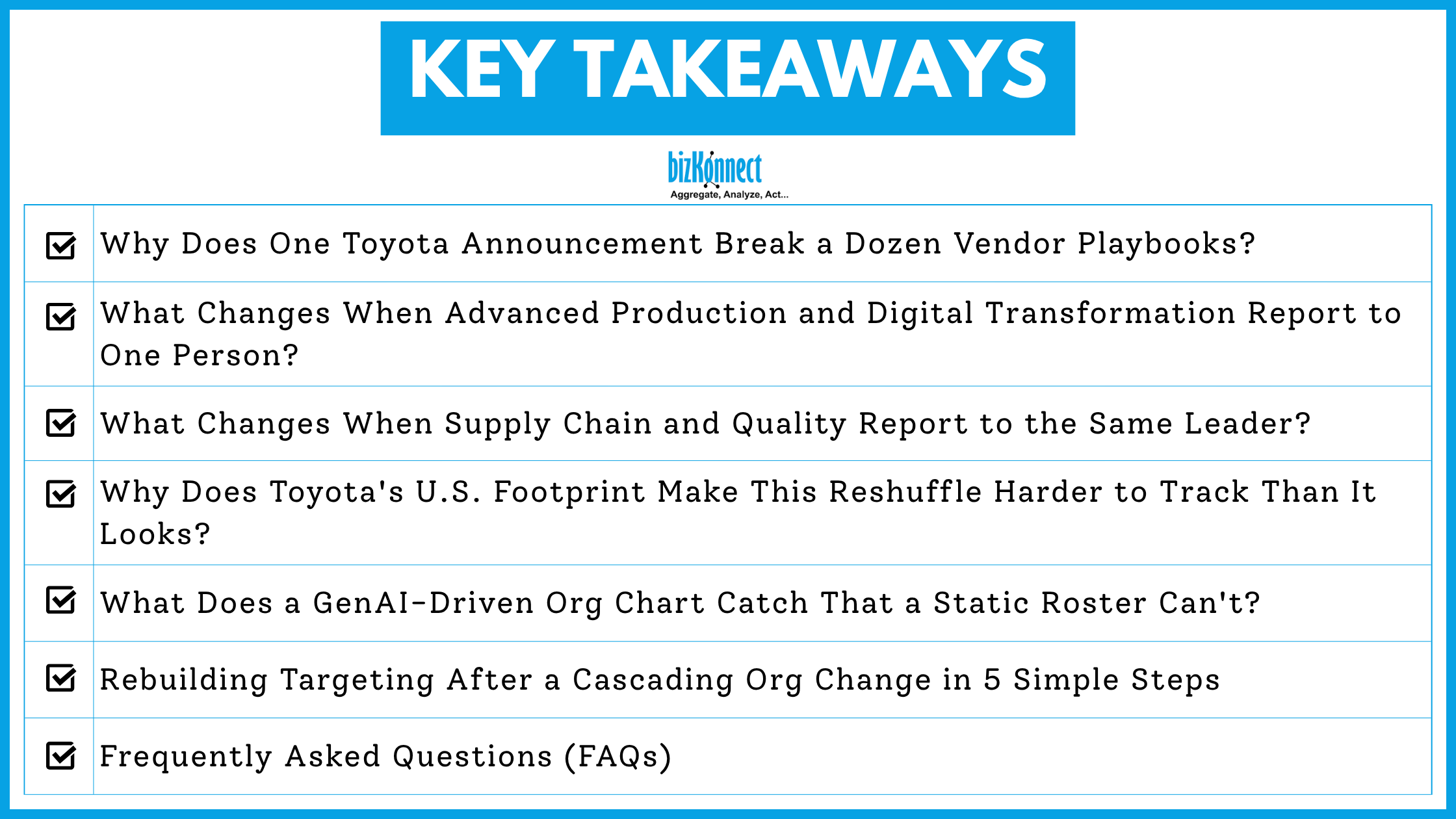
Why Does One Toyota Announcement Break a Dozen Vendor Playbooks?
The scale of the June 19 changes is what made them consequential, not any single move in isolation. Toyota confirmed the retirement of Ellen Farrell, group vice president and executive advisor at Toyota Financial Services after more than 25 years, alongside Kerry Creech, who led Toyota Motor Manufacturing Kentucky (TMMK) and retired after 36 years with the company. Both exits triggered downstream reassignments across manufacturing regions, not just backfills.
That is the part conventional org-chart tracking misses. A retirement at the top of a plant hierarchy does not create one opening. It creates a chain:
- TMMK's presidency moved to David Fernandes, previously leading Manufacturing Region 6 and Mazda Toyota Manufacturing (MTMUS)
- Fernandes's prior region went to Erik Skaggs, formerly president of Toyota Motor Manufacturing Mississippi
- Skaggs's old post went to Aaron Foster, promoted from general manager
- A parallel chain moved through Toyota Motor Manufacturing Guanajuato and Toyota Autobody Company
Vendors who mapped only the plant president lose the whole chain beneath it. The account intelligence problem is not "who retired." It is "how many reporting lines moved as a result."
What Changes When Advanced Production and Digital Transformation Report to One Person?
The more strategically loaded move sits outside manufacturing regions entirely.
Stephen Brennan, previously senior vice president over Region 1 Manufacturing Operations and Manufacturing Business Operations, was assigned to Toyota Motor Corporation as chief production leader of the Advanced Technology Area. That single title now carries responsibility for five previously distinct functions: Advanced Production Engineering, Production Engineering, Mobility Tooling, Logistics and Information Production Engineering, and Production Digital Transformation.
This is a consolidation, not a lateral move, and consolidations change buying behavior faster than promotions do. When five divisions report through one production leader, purchasing and pilot-program decisions that used to require five separate stakeholder conversations start compressing into one. Vendors selling into advanced manufacturing, tooling, or digital transformation who kept those divisions in separate CRM records are now tracking one relationship, not five, and the leader who owns it reports directly to Takefumi Shiga, Toyota's chief production officer.
What Changes When Supply Chain and Quality Report to the Same Leader?
Toyota's supply chain reorganization follows the same logic from a different direction. Kevin Austin, group vice president of Supply Chain, gained direct responsibility for Quality, with Tom Trisdale now reporting to him. Kensuke Morita, group vice president of Vehicle Supply Chain, absorbed Strategy and Project Planning and Management, Demand and Supply Management, and Tech Transformation, with Jamese Olayiwola and Michael Schad now reporting into him instead of operating as peer-level vice presidents.
| Function | Reported to (before July 13) | Reports to (after July 13) |
|---|---|---|
| Quality | Tom Trisdale (peer to Austin) | Kevin Austin |
| Strategy & PPM | Jamese Olayiwola (VP-level, independent) | Kensuke Morita |
| DSM & Tech Transformation | Michael Schad (VP-level, independent) | Kensuke Morita |
| TMMK presidency | Kerry Creech | David Fernandes |
| Advanced Technology Area | Distributed across five divisions | Stephen Brennan |
This is the answer to a question that comes up constantly when people try to understand what is the hierarchy in an automotive company: it is rarely fixed for long. Automotive leadership structure at OEM scale is closer to a routing table than an org chart. Titles persist; what moves is which node the routing passes through.
Why Does Toyota's U.S. Footprint Make This Reshuffle Harder to Track Than It Looks?
The reason a handful of executive moves ripples so widely comes down to how much operational surface each of those titles actually covers. Toyota directly employs nearly 48,000 people in the U.S. across 11 manufacturing plants, and those plants have collectively assembled more than 35 million cars and trucks. The company also sells through nearly 1,500 dealerships and currently offers 32 electrified vehicle options, a portfolio that leans directly on the same Advanced Technology Area and Production Digital Transformation functions Stephen Brennan now oversees.
That footprint is what turns a routine leadership memo into a targeting problem. A vendor account mapped against a single plant president, or a single supply chain VP, is really mapped against one node in a structure that spans 11 plants, multiple regions, and a financial services arm still absorbing a retirement of its own. Move one node, and every vendor relationship anchored downstream of it inherits the same uncertainty until the reporting lines are re-verified.
For B2B teams, the implication is structural, not anecdotal. An account inside a manufacturing footprint this large should be assumed to have a partially stale organizational chart within weeks of any announcement, not months.
What Does a GenAI-Driven Org Chart Catch That a Static Roster Can't?
A press release lists titles. It does not tell a vendor which of those titles now sits between them and a purchasing decision, and it does not update itself when the next reassignment lands. That gap is exactly where a GenAI-driven org chart earns its keep: instead of a flat list of names, it continuously parses announcements like Toyota's and rebuilds the reporting structure itself, division by division, so the current owner of Advanced Production Engineering or Production Digital Transformation is isolated automatically rather than inferred from an old contact record.
Applied to this reshuffle, that kind of mapping would surface three things a manual roster review typically misses:
- That Stephen Brennan, not any of the five division heads individually, is now the single point of authority across advanced production and digital transformation
- That Jamese Olayiwola and Michael Schad moved from independent VP status to reporting through Kensuke Morita, changing who needs to be looped in on strategy or tech-transformation deals
- That the TMMK presidency change cascades through at least two more plant-level reassignments, each with its own procurement footprint
The value is not in reading the announcement faster. It is in isolating which specific leaders now hold the authority a vendor is trying to reach, before the rest of the market catches up to the same press release.
Rebuilding Targeting After a Cascading Org Change in 5 Simple Steps
- Flag every account where a retirement or reassignment touches a division you sell into, not just the named executive.
- Trace the reporting chain two levels down. Consolidations like Brennan's or Morita's move ownership, not just headcount.
- Re-tier accounts by new decision rights. A VP who now reports through a consolidated leader has a different approval ceiling than they did in May.
- Re-sequence outreach toward the leader who absorbed authority, not the leader whose title sounds most senior on paper.
- Re-run this check quarterly. An automotive company organizational chart at OEM scale changes often enough that annual refreshes are functionally useless.
Frequently Asked Questions (FAQs)
Does a title change always mean a budget or approval change?
Not always, but consolidations like Quality reporting into Supply Chain, or five engineering divisions reporting into one production leader, usually do shift where purchasing sign-off happens.
Should vendors track plant-level or corporate-level moves more closely?
Both, since plant-level chains (like TMMK's presidency shift) affect regional buying and corporate-level consolidations (like the Advanced Technology Area) affect enterprise-wide technology decisions.
How quickly should outbound teams update targeting after an announcement like this?
Within the transition window itself. Toyota's changes take effect July 13, which is the point when the new approval authority becomes operational, not the June 19 announcement date.
Does company size change how much an org-chart update matters?
Yes. Toyota's 11 U.S. manufacturing plants and nearly 48,000 domestic employees mean a single consolidation, like five engineering divisions rolling up under one production leader, affects far more downstream accounts than the same move would at a smaller supplier.
Automotive executive org charts move faster than most CRM refresh cycles account for, and Toyota's June restructuring is a clear case study in how much can shift in a single announcement. Mapping the new reporting lines while they are still fresh, rather than after a pitch has already gone to the wrong desk, is what separates account intelligence that works from account intelligence that looks current on paper.
CLICK HERE to see how BizKonnect’s mapped, continuously refreshed org data closes that gap before it costs a pipeline.
CLICK HERE to know more with BizKonnect.