


Closing a high-stakes enterprise IT deal within giants like Amazon, Verizon, and OpenAI feels like navigating a high-speed chase where the road is being paved as you drive. You have the perfect solution for a cloud-native account, but just as you reach the final stretch, the key decision-maker vanishes.
In the high-growth AI and cloud sectors, where 10+ stakeholders now influence a single purchase, executive churn is the invisible deal-killer that turns a "sure thing" into a dead end. Staying ahead requires more than just a CRM; it demands GenAI-poweredIT company org charts that provide continuous updates on tech company hierarchy, ensuring you never lose the thread of a reporting line when a leader moves on.
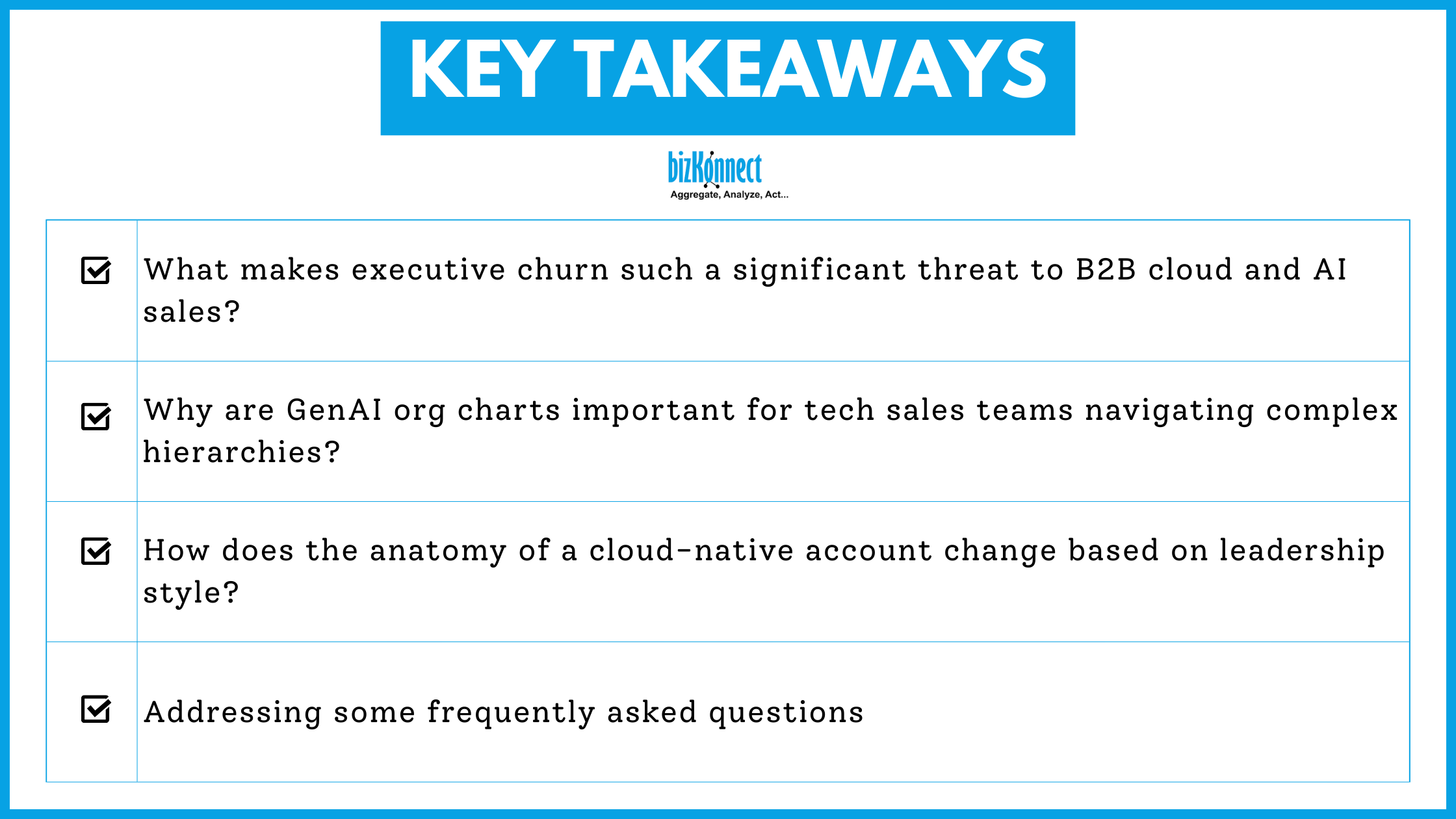
What makes executive churn such a significant threat to B2B cloud and AI sales?
In the current landscape, stability is a luxury. High-growth sectors are experiencing a talent "arms race," leading to frequent shifts in leadership. For instance, recent major moves has unfolded across some of the most influential names in enterprise technology:
- Amazon saw its AI chief Rohit Prasad depart in late 2025, creating uncertainty across teams that were mid-conversation with vendors around AWS-integrated AI solutions.
- OpenAIexperienced a series of senior departures as the company pivoted toward commercial engineering, reshuffling internal ownership of procurement and infrastructure decisions.
- Kyndryl, the managed infrastructure giant spun off from IBM, has undergone multiple leadership transitions across its cloud practice divisions as it defines its independent market identity.
- Verizon replaced its long-standing CEO Hans Vestberg with Dan Schulman, triggering a broader leadership restructuring that directly affects how enterprise technology priorities and vendor decisions are evaluated across its Business Group.
These changes reflect a pattern across the sector. When a key stakeholder leaves, they don't just take their expertise; they take the internal history, the "buy-in," and the momentum of your deal with them.
For sales teams, the challenge is the ripple effect. Without an updated tech company org chart, you may spend weeks pitching to a legacy contact while the new decision-maker is already reshaping the department's priorities. This lack of enterprise IT org mapping leads to:
- Stalled Momentum: Deals get stuck in "limbo" as new leaders re-evaluate existing vendor shortlists.
- Relationship Gaps: You lose your internal champion, leaving you without a voice in private stakeholder meetings.
- Wasted Resources: Marketing budgets are spent targeting "ghost" profiles who have already moved to competitors.
Why are GenAI org charts important for tech sales teams navigating complex hierarchies?
The complexity of modern tech company organizational structure means you are rarely selling to one person. You are selling to a network of influencers across IT, finance, security, and operations. Tech company org charts serve as your strategic map, allowing you to visualize the "messy middle" of the decision-making process.
Take Verizon for example, where a full CEO transition in late 2025 reshuffled strategic priorities across its Business Group, meaning stakeholders who once controlled enterprise technology decisions may now sit under entirely different reporting lines. Or consider Kyndryl, where delivery units are structured by geography and service line, meaning the decision-maker for a cloud modernization deal in North America is an entirely different stakeholder than the one managing a similar engagement in Europe. Without mapping these structures, your outreach is essentially a guess.

By understanding the tech company hierarchy, you can practice "multi-threading." This involves building relationships with multiple people at different levels so that the departure of one executive doesn't kill the entire deal. Knowing exactly where the Chief Information Officer (CIO) sits in relation to the Head of Cloud Infrastructure allows you to tailor your technical and financial pitches simultaneously.
Not just that. These dynamic maps act as a compass in the shifting tech landscape, providing:
- Dynamic Visualizations: Automated updates that reflect executive churn as it happens.
- Tailored Mapping: The ability to see a startup tech company org chart alongside global IT giants like Amazon or Kyndryl, filtered by specific business units.
- Contextual Intelligence: Insights into not just who people are, but what their specific roles are in hybrid versus multi-cloud environments.
How does the anatomy of a cloud-native account change based on leadership style?
Pitching to a leader focused on Hybrid Cloud requires a different narrative than one committed to Multi-Cloud strategy. A GenAI-driven tech company org chart approach allows you to see the functional focus of different departments before your first call.
- Hybrid Cloud Leadership: Often found in enterprises like Kyndryl or large telcos such as Verizon, where legacy network infrastructure coexists with modern cloud layers and new leadership transitions create shifting vendor priorities. These leaders focus on integration, legacy system compatibility, and security. Your pitch needs to highlight seamless transitions and minimal disruption.
- Multi-Cloud Leadership: More common in digitally native organizations and fast-scaling AI companies. These leaders prioritize vendor flexibility, cost optimization across platforms, and avoiding lock-in with any single provider.
Using IT company org charts to identify whether a company has a unified "Cloud Center of Excellence" or fragmented departmental IT helps you decide whether to lead with a broad platform play or a specialized niche solution.
In enterprise IT selling today, knowing tech company hierarchy with a GenAI-powered enterprise IT org mapping separates teams that keep deals flowing from those left chasing stale paths. Staying ahead of leadership change is not just a tactical advantage, it is a necessity for sustained success in cloud and AI arenas.
Now addressing some frequently asked questions:
1. How do I identify the real influencers in a tech company organizational structure?
Look for "work charts" or contextual account maps. These go beyond formal titles to show who is actually responsible for GenAI (Generative Artificial Intelligence) implementation or cloud budgets, often found within a tech company hierarchy that links cross-functional teams.
2. Are hybrid and multi-cloud leaders equally influential?
Yes. Leaders responsible for hybrid environments and those managing multi-cloud strategies both shape buying decisions, but their influence paths differ. Targeting both strengthens your engagement strategy.
3. Can I use these charts for account-based marketing (ABM)?
Yes. You can use a company org chart to target specific clusters of influence with personalized messaging, ensuring your marketing content reaches the exact business units relevant to your solution.
4. What signals indicate an upcoming reorganization that might affect your deals?
Key indicators include: executive departures within a two-week period, missed quarterly targets announced in earnings, new funding rounds closing, major product launches underperforming, activist investors joining the board, or external consulting firms being engaged. Any of these can trigger structural changes within 30-90 days.
Find the right door-opener faster within High-Growth AI & Cloud Sectors. CLICK HERE to see how GenAI-powered actionable org maps do it with BizKonnect.