


BP's corporate structure just changed at the top, and most vendors are still reaching out to the wrong people.
On April 1, 2026, Meg O'Neill became BP's new CEO, the first woman ever to lead a Big Oil supermajor. She spent nearly a decade at Woodside Energy and 23 years before that at ExxonMobil. That's not a career path that builds loyalty to BP's existing vendor roster. O'Neill is an operator with a track record of bold structural moves, she steered the merger of BHP's petroleum business into Woodside in 2022.
She is not walking into BP to preserve what was already there.
For vendors who sell into BP, this is a window. One that closes fast once the new org settles and buying decisions calcify around a new inner circle. This guide walks through how to read that window, and how GenAI-driven BP org charts help vendors navigate and approach BP systematically before the opportunity closes.
What Does BP's Business Strategy in 2026 Actually Mean for Vendor Access?
BP's strategy under O'Neill is still forming, but the signals are clear.
She inherits a company under sustained pressure from activist hedge fund Elliott, from share underperformance, and from a market that has speculated about whether BP could be a takeover target for Shell or one of the U.S. majors.
What does that mean for vendors?
BP oil and gas leadership in 2026 is focused on fixing internal inefficiencies, reconfiguring capital allocation, and rebuilding investor confidence. Vendors who lead with product features will be tuned out. Those who come in with cost, efficiency, or strategic alignment angles have a real opening.
The less obvious point is:
When a new CEO arrives with no legacy attachments, procurement authority often gets redistributed. Relationships that worked under Murray Auchincloss may now run through different nodes in the BP corporate structure such as new direct reports, newly promoted division heads, or freshly appointed functional leads.
If your sales motion still routes through the same names from two years ago, you're navigating a map that no longer reflects the territory.
How Do You Read BP's Shifting Organizational Structure Without Getting Stuck at the Gatekeeper Level?
The standard mistake after a C-suite change is going to LinkedIn, finding a few senior titles, and calling it research. That tells you who exists at BP, not who has buying authority now, who reports to whom after restructuring, or which functions are being consolidated.
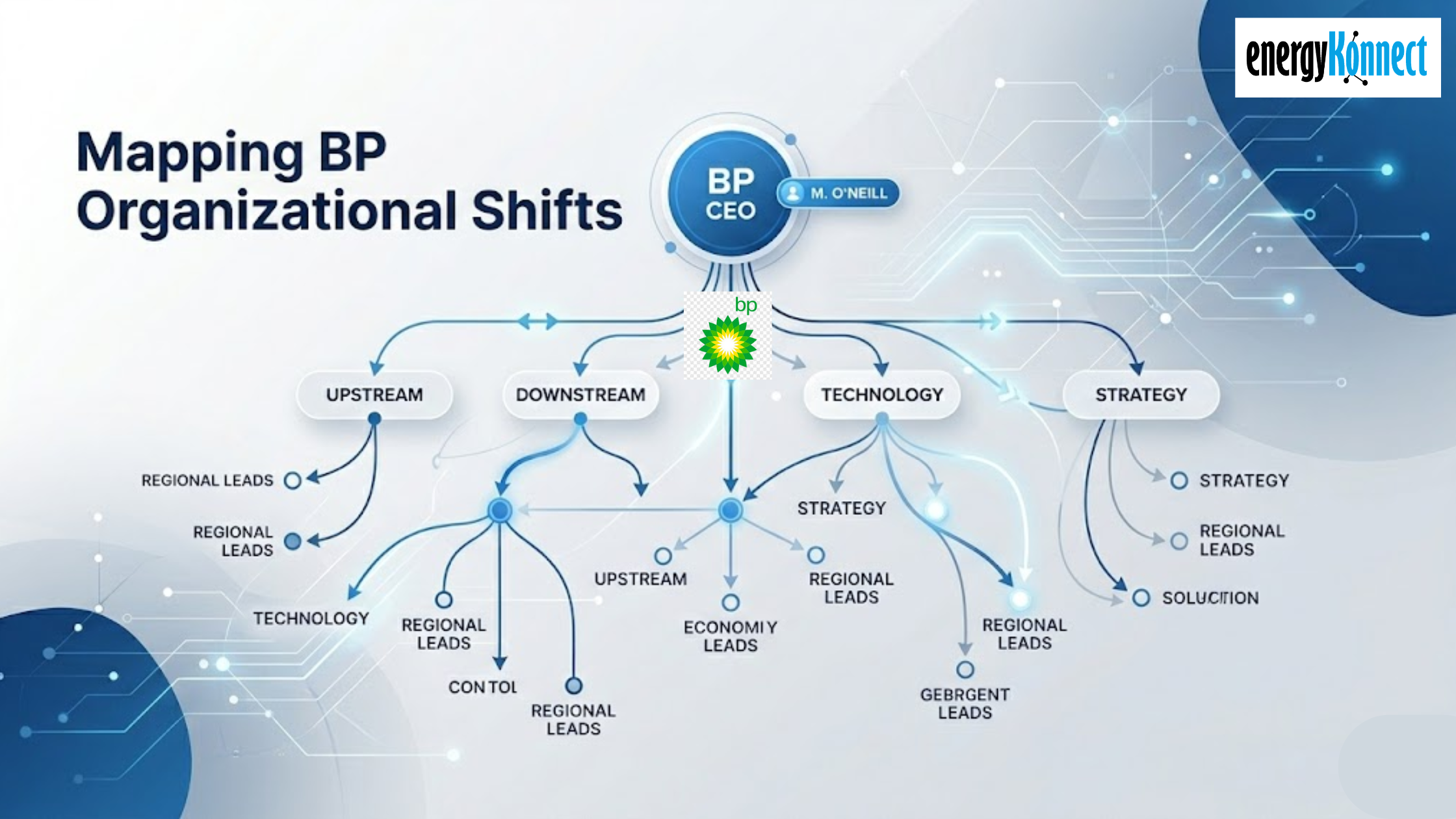
BP's organizational structure has multiple operating layers:
- Group-level leadership: the CEO, CFO, and executive committee
- Business segment heads: covering upstream, downstream, trading, low carbon, and other units
- Regional and functional leaders: where most vendor decisions actually happen
- Procurement and category leads: the formal gatekeepers, but rarely the decision-makers for strategic vendor selection
Most vendors get stuck at the procurement layer because it's the most visible. The real conversations happen at the functional and segment level, with people who own specific budget lines and mandates to drive performance.
GenAI-driven energy company org charts solve this by continuously mapping reporting lines, tracking personnel changes, and surfacing decision-maker context.
When O'Neill reshapes her direct reports or elevates someone into a new role, that change appears in a live org chart before any press release. Before outreach, you should know which segment your solution addresses, who leads it, who their direct reports are, and whether those names changed in the last 90 days.
Which Parts of the BP Management Team Are the Right Entry Points?
BP oil and gas leadership is not a single decision tree. There are three distinct entry paths depending on what you sell:
- Technology, software, and digital solutions: The right entry is the function that owns digital transformation or operational technology. O'Neill's background means she understands operational technology well. Framing around production efficiency or emissions data management lands differently than a generic software pitch.
- Services, engineering, and operations support: Entry is through the relevant upstream or downstream segment at the regional or asset level. Segment heads typically have more discretion than central procurement.
- Advisory, consulting, and strategic services: The CFO and strategy function are the right targets, especially with BP under investor pressure to demonstrate financial discipline. O'Neill came in to fix performance; her lieutenants on the financial and strategy side are where those conversations begin.
Across all three paths, a GenAI-driven org chart maps the human path from your solution to the person who can approve it.
How Should Vendors Time Their Outreach Given the BP Leadership Transition?
There's a roughly 90-to-120-day window after a new CEO takes a seat during which the organization is genuinely open to new input. Existing vendor relationships are under evaluation, new mandates are being drafted, and functional leaders are looking for allies who can help them succeed under a changed agenda.
After that window, priorities calcify. Vendors who weren't part of the early conversation get classified as reactive sellers.
For BP in 2026, that window is open now as O'Neill took the role on April 1. Her restructuring decisions and strategic priorities are actively being shaped. Vendors who map the new BP organizational structure accurately and reach the right people with relevant propositions are in the window. Those who wait until things are "settled" will find that settled means closed.
Practical moves to act within the window:
- Track executive appointment announcements in BP's press releases and investor communications
- Use GenAI org charts to flag new titles or reporting line changes within BP's management team
- Build outreach around a specific business outcome tied to BP's current strategic pressure
With these challenges and solutions in mind, a few important questions naturally arise for teams navigating similar situations.
Frequently Asked Questions (FAQs)
Q: Does a CEO change at BP automatically reset all vendor contracts?
No. Existing contracts continue. What changes is the appetite for new relationships and scrutiny on renewals. Long-standing vendors should re-qualify under the new leadership's priorities.
Q: How quickly does BP's org chart shift after a CEO appointment?
Significant changes typically happen within 60 to 120 days. Based on O'Neill's track record, her restructuring is likely to be operational rather than cosmetic.
Q: Is it too late to approach BP as a new vendor if the first weeks have passed?
No. The transition window spans several months. But each month reduces senior-level openness, so earlier is meaningfully better.
Q: What's the most common mistake vendors make with a newly restructured energy company?
Contacting the same people from before the leadership change and assuming access still holds. Personnel shifts after a CEO transition redistribute authority quickly and without public announcement.
Vendors looking for a current map of BP's management team 2026, including reporting lines updated post-O'Neill, can get there faster with GenAI-powered energy company org charts. CLICK HERE to see how BizKonnect helps sales teams navigate BP and other major energy company hierarchies with precision.
CLICK HERE to know more with BizKonnect.