


The boardroom presentation is ready, your sales deck is polished, but when your Chief Marketing Officer asks:
"How is ourAI content strategy actually influencing the pipeline from enterprise accounts?" The room goes quiet.
You've generated 10x more blog posts, emails, and whitepapers this quarter using GenAI tools. Yet, the C-suite remains unconvinced.
Why? Because volume without precision is just noise, and decision-makers don't have time for noise. The old times of feeding generic prompts into AI tools and expecting breakthrough results is over.
In 2024-2025, B2B marketers experimented with GenAI content strategy for enterprise buyers, cranking out content at unprecedented speeds. But 2026 marks a fundamental shift: with 95% of B2B marketers now using AI tools, enterprises are no longer impressed by how much you produce.
They're evaluating how accurately your content addresses their specific pain points, regulatory challenges, and ROI expectations.
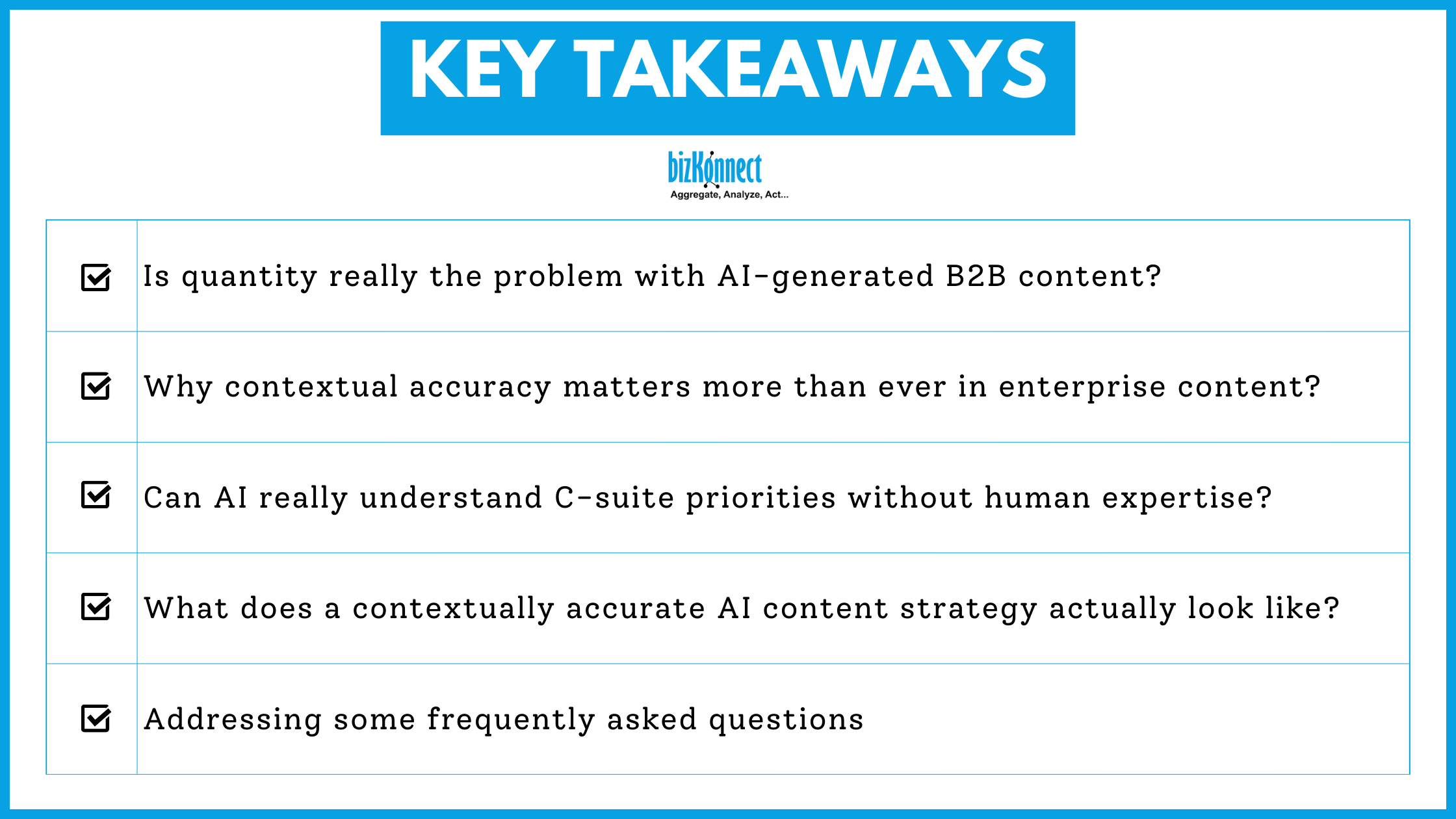
Is quantity really the problem with AI-generated B2B content?
Not exactly. The problem isn't that marketers are producing too much, it's that they're producing content that lacks contextual depth.
Generic AI prompts create generic outputs. When you tell an AI tool to "write a blog about cybersecurity for financial services," you get surface-level content that could apply to any industry. It doesn't speak to the CISO's actual challenge: implementing zero-trust architecture while maintaining compliance with evolving data privacy regulations.
This is where B2B AI content hits a roadblock. Decision-makers, especially at the C-suite level, can spot AI-generated content instantly. They're looking for evidence-based marketing:
- ROI calculators that reflect their industry benchmarks
- Case studies featuring companies facing identical challenges
- Thought leadership that demonstrates deep domain expertise
Meanwhile, your AI-powered CRM systems like HubSpot AI and Salesforce Einstein are tracking engagement signals: website visits, content downloads, email opens. But without contextual accuracy, that data just identifies prospects, not what resonates with them.
Why contextual accuracy matters more than ever in enterprise content?
Contextual accuracy in AI content means your output reflects the specific challenges, language, and priorities of your target account. It's the difference between a vague claim and a measurable result:
"AI-powered predictive lead scoring reduced our client's sales cycle by 34% by identifying in-market accounts 3 weeks earlier than traditional methods."
Generic vs. Contextual AI Prompts: The Real Difference
| Element | Generic Prompt | Contextual Prompt |
|---|---|---|
| Target audience | "Software buyers" | "VP of Operations at mid-market manufacturers (200-500 employees)" |
| Pain point | "Efficiency challenges" | "Integration with legacy ERP systems" |
| Outcome focus | "Improve productivity" | "Demonstrate ROI within 6-month payback periods" |
| Content Output | Surface-level, applies to any industry | Specific, resonates with exact buyer challenges |
| C-suite impact | Ignored or skimmed | Read, shared, acted upon |
Generic vs contextual AI prompts is no longer a stylistic choice, it's a strategic imperative.
This is where hyper-personalization at scale becomes critical. Modern AI doesn't just insert names into templates, platforms like Jasper, Copy.ai, and Writesonic combined with sales tools like Apollo.ai and Outreach.io can tailor entire email sequences, optimize subject lines based on predicted open rates, and trigger automated follow-ups based on prospect behavior and real-time intent signals.
The differentiation comes from precision:
- Sales enablement materials that address specific objections from procurement committees
- Account based marketing content tailored to individual stakeholders within the buying committee through ABM 2.0, creating seamless, personalized experiences across all decision-makers, not just targeting companies
- Industry-specific frameworks that demonstrate understanding of regulatory environments
- Multichannel content that integrates email with LinkedIn social selling, video marketing, and interactive elements
Generic vs contextual AI prompts is no longer a stylistic choice, it's a strategic imperative.
A generic prompt asks for "email sequence for software buyers." A contextual prompt specifies: "Email sequence for VP of Operations at mid-market manufacturers (200-500 employees) evaluating supply chain visibility platforms, addressing integration with legacy ERP systems and demonstrating ROI within 6-month payback periods."

Can AI really understand C-suite priorities without human expertise?
In reality, AI is exceptional at processing data, identifying patterns, and generating structure. Agentic AI systems can now manage entire workflows from prospecting and qualification to scheduling and nurturing. Conversational AI chatbots on B2B websites handle 24/7 lead qualification and meeting booking. AI even manages data enrichment and hygiene, keeping your CRM updated and cleansed for targeted outreach.
But what is a generic AI prompt fundamentally lacking? Human judgment about what matters to decision-makers.
GenAI for B2B marketing works best when marketers feed it with:
- Deep buyer intelligence - firmographic data, behavioral signals, competitive positioning, and first-party data (increasingly critical as third-party cookies disappear)
- Industry expertise - regulatory requirements, market dynamics, seasonal buying patterns
- Historical context - what messaging has worked, which objections appear repeatedly
This is why "human-centered" AI content is emerging as the differentiator in 2026 where AI handles scale and humans ensure authenticity. When you're targeting enterprise buyers, they need proof of authenticity: documented case studies from similar companies, expert interviews from practitioners who've solved their exact problem, transparent ROI frameworks.
Even autonomous AI agents need humans to define what "qualified" means for your specific enterprise customers and to validate that technical specifications align with real-world implementation challenges.
What does a contextually accurate AI content strategy actually look like?
Start by mapping your content to actual buying committee roles and their specific information needs. Your CFO isn't reading the same content as your CTO. Your CFO wants financial impact models. Your CTO wants technical architecture diagrams and integration requirements.
Build a robust first-party data foundation like collect behavioral signals, engagement patterns, and explicit preferences from your owned channels. This fuels AI personalization far more effectively than generic demographic data.
Then, build prompts that include:
- Specific pain points: "Compliance teams struggling with multi-jurisdiction data residency requirements"
- Measurable outcomes: "Reduce vendor onboarding time from 6 weeks to 8 days"
- Competitive context: "Compared to incumbent solutions requiring custom development"
Layer in Generative Engine Optimization (GEO) principles and structure your content with tables, FAQs, and clear data points. So, AI tools like ChatGPT and Perplexity can accurately represent your expertise when enterprise buyers ask: "Which vendors solve [specific problem] for [specific industry]?"
Tools like ZoomInfo with AI Insights, Intercom, and Drift can identify who's engaging and when they're in-market. But the content they're engaging with must be contextually relevant, not just algorithmically generated.
The future of B2B AI content isn't about generating more. It's about generating content so precisely aligned with enterprise buyer needs that it cuts through the noise and creates genuine pipeline impact.
Now, let’s address some frequently asked questions:
Q1. What is a generic AI prompt and why doesn't it work for B2B content?
A generic AI prompt provides broad, non-specific instructions like "write about AI in marketing." It produces surface-level content because it lacks buyer context, industry specifics, and measurable outcomes that enterprise decision-makers require.
Q2. Does contextual prompting require more time from marketing teams?
Initial setup takes effort, but connected data systems and Artificial Intelligence agents automate much of this input over time.
Q3. What is the biggest risk of relying solely on generic AI prompts in 2026?
The biggest risk is "brand dilution" and loss of trust. If your content provides zero new value, buyers will categorize your brand as a "vendor" rather than a "partner," making you easily replaceable by the next lowest bidder.
Q4. How should we measure the success of a quality-first AI content strategy?
Shift your KPIs (Key Performance Indicators) from click volume to "engagement depth," "pipeline influence," and "sales velocity." Success is no longer about how many people saw the post, but how many qualified accounts moved to the next stage because of it.
Ready to move beyond the "generic" and start penetrating the C-suite with high-impact, contextual precision? To see how the right data foundation can transform your GenAI content strategy for enterprise buyers, CLICK HERE to explore the intelligence solutions at BizKonnect.