


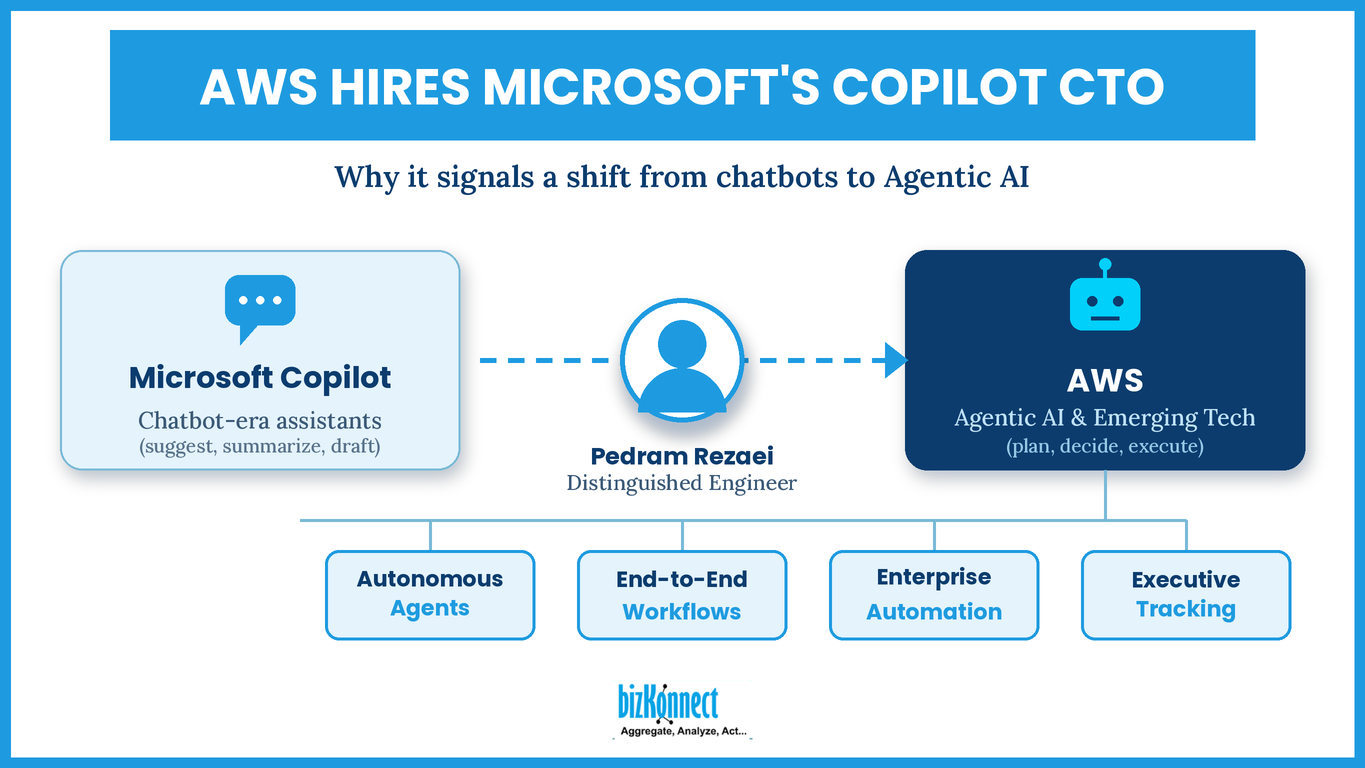
When Amazon Web Services (AWS) brought on Pedram Rezaei (former Chief Technology Officer of Microsoft Copilot and a 20-year Microsoft veteran) as a Distinguished Engineer in its Agentic AI and Emerging Technologies division, it was more than just a high-profile executive transfer.
(EXPLORE AMAZON ORG CHART- Leverage a genAI-powered actionable org chart to map decision-makers, visualize any tech company org chart, and build a real-time account map for your GTM motion.)
It marked a major shift in the cloud computing landscape. Tech giants are moving away from passive, conversational chatbots and toward autonomous AI agents, systems capable of executing multi-step, complex end-to-end workflows like code generation, system architecture, and enterprise data analysis.
For B2B revenue leaders, account executives, and Go-To-Market (GTM) teams, high-profile talent shifts offer valuable early signals. Tracking executive movements across a tech company org chart and tracking engineering transfers provides key intelligence to anticipate product roadmaps, identify shifting vendor lock-in, and adjust sales strategies before competitors do.
1. The Strategic Pivot: Chatbots Are Out, Autonomous Agents Are In
For the past several years, enterprise AI adoption focused heavily on generative assistants, tools that answer queries, summarize documents, or write basic text. However, enterprise buyers are now seeking tools that automate complete workflows rather than just providing suggestions.
AWS hiring top talent from Microsoft Copilot indicates a sharp focus on building autonomous agents. Rather than merely assisting a human operator, agentic systems:
- Execute End-to-End Tasks: Autonomously write, test, and deploy code, or orchestrate complex enterprise data pipelines.
- Integrate Deeply into Infrastructure: Operate directly within the enterprise cloud ecosystem, bypassing disconnected third-party interfaces.
- Leverage Advanced Reasoning: Utilize neurosymbolic AI and automated reasoning to adhere to strict enterprise security and policy frameworks.
When an enterprise vendor invests heavily in talent for a specific product category, it serves as a leading indicator of where R&D budget, feature rollouts, and enterprise integration efforts will concentrate over the next 12 to 18 months.
2. Why Enterprise Buyers Shift Evaluation Criteria When Architects Move
Enterprise procurement and IT architecture teams closely monitor executive moves between major cloud providers like AWS, Microsoft Azure, and Google Cloud. A top product architect moving to a rival firm impacts buyer decision-making in several key ways:
A. Reassessing Product Lineage & Feature Parity
When a leader responsible for scaling a major enterprise product (such as Microsoft Copilot) shifts to a key competitor, enterprise buyers expect rapid feature alignment and accelerated innovation from the hiring company. Buying teams often pause or re-evaluate platform evaluations to see how the new leadership will shape the hiring vendor's upcoming releases.
B. Long-Term Vendor Viability & Lock-In Risks
Enterprise software investments involve long-term commitments. If an organization plans to standardize its developer or workplace productivity stack, knowing that top engineering leadership has shifted helps CIOs assess which cloud platform is best positioned to lead the next generation of enterprise AI.
C. Ecosystem Migration Pathways
Distinguished Engineers bring unique expertise in architectural frameworks, enterprise security models, and developer workflows. When key technical architects move platforms, enterprise buyers anticipate smoother migration pathways and better interoperability between previously siloed enterprise ecosystems.
3. How GTM and B2B Sales Teams Can Turn Executive Transfers into Revenue Opportunities
For B2B sales reps and Go-To-Market (GTM) strategists, enterprise account maps should extend beyond current decision-makers. Tracking leadership and technical movements across key accounts and competitors provides a strong competitive edge. By using a GenAI-powered actionable org chart to parse a complex tech company org chart, sales teams can instantly convert account data into an interactive account map to spot shifting decision-makers and newly formed departments.
Here is how GTM teams can leverage executive tracking:
- Predict Product Strategy Shifts Before They Launch: Official product roadmaps are often published quarters after internal strategy shifts occur. Monitoring executive and engineering hires allows sales teams to anticipate upcoming product capabilities early, enabling them to align their value propositions with where the market is headed.
- Refine Competitive Battlecards in Real Time: When a competitor loses a core architect, it often signals potential friction or shifting priorities within their product division. Sales reps can use this context during competitive evaluations to address potential gaps in the competitor's long-term product vision.
- Identify Account Re-evaluation Windows: Major technical transfers often prompt enterprise clients to re-examine their current technology stack. Sales reps tracking these movements can proactively reach out to target accounts during these key decision-making windows, offering timely insights and comparative analysis.
- Multi-Thread Across Evolving Engineering Teams: Executive hiring frequently leads to broader team restructuring, new department budget allocations, and key promotions. Mapping an account’s dynamic structure using a GenAI-powered actionable org chart helps sales teams build a complete account map and execute a precision GTM play across any target tech company org chart.
Frequently Asked Questions (FAQs)
What is "Agentic AI" and how does it differ from traditional AI assistants?
Traditional AI assistants (like first-generation chatbots) require step-by-step human prompts to generate text or basic answers. Agentic AI refers to autonomous systems designed to execute multi-step workflows, make decisions based on defined goals, and interact directly with APIs, databases, and enterprise software without requiring constant human intervention.
Why do engineering leadership transfers matter more than standard executive moves?
While VP or CMO transfers often indicate changes in go-to-market strategy or sales positioning, Distinguished Engineers and CTOs directly shape product architecture, underlying technology stacks, and long-term capability roadmaps. Tracking these technical moves provides actionable insight into where actual product innovation is occurring.
How can B2B sales teams track key organizational changes at scale?
Sales teams use account intelligence platforms, live organizational mapping tools, and automated job-change alerts to stay updated on key talent moves. Relying on a genai powered actionable org chart to visualize any tech company org chart into an actionable account map enables GTM reps to engage the right decision-makers at the right time.
Turn Executive Movements into Revenue
Harness live, actionable org chart insights and real-time account maps to uncover key decision-makers, track critical executive movements, and close enterprise deals faster with BizKonnect.
Discover How BizKonnect Powers Real-Time Account Intelligence
CLICK HERE to know more with BizKonnect.