


Your carefully built relationship map at Wells Fargo, the one your team spent months nurturing, may now point to executives who no longer hold those roles.
If your BFSI account mapping hasn't been updated to reflect one of the leadership overhauls in recent megabank history, your outreach is landing in the wrong inboxes, or nowhere at all.
Under CEO Charlie Scharf, Wells Fargo replaced nearly its entire management team with external hires drawn primarily from JPMorgan Chase and Bank of New York Mellon. The board was refreshed in parallel. That means the institutional relationships your sales team built including the warm intros, the preferred vendor status, and the informal trust were tied to people who have since left the building. New faces bring new preferences, new vendor priorities, and in many cases, zero continuity with what came before.
This is the account mapping problem that most financial services GTM teams are not adequately prepared for.
This guide reveals why traditional methodologies fail during massive financial restructurings and outlines how dynamic corporate intelligence can help sales teams protect their pipeline and identify viable target accounts.
Why Do Account Maps Break So Completely in Large Banking Organizations?
Most account maps are built on a flawed assumption that organizational structures in large banks are relatively stable. They are not.
Megabanks like Wells Fargo operate across four primary business segments, i.e., Consumer Banking and Lending, Commercial Banking, Corporate and Investment Banking, and Wealth and Investment Management. Each segment has its own leadership chain, procurement relationships, and vendor preferences. When even one segment head is replaced, the downstream effects on vendor relationships can take months to surface, by which time your competitors may have already established new footing.
The Wells Fargo transformation is not a routine leadership shuffle, rather it is a structural rebuild.
The bank reported a 17% year-over-year increase in EPS, reaching $6.26 in diluted EPS for FY 2025, and set an aggressive new Return on Tangible Common Equity target of 17–18%. That financial momentum is being driven by new leadership executing a new strategy. Their vendor decisions will reflect that.
What breaks first in account maps during transitions like this:
- Title-to-person mappings go stale almost immediately after announcements
- Budget authority shifts as new leaders restructure their teams
- Approved vendor lists get reviewed early in any leadership transition
- Relationship-based access disappears with the person who held it
The teams that notice this soonest are the ones with active org chart intelligence, instead of static CRM data.
How Do You Track Decision-Makers in Wells Fargo When the Org Is Actively Changing?
The short answer is you cannot do it with point-in-time data.
A headcount export from LinkedIn or a static org chart from an annual report gives you a snapshot of a structure that may already be months out of date. In a transformation as deliberate as Wells Fargo's, where management has divested non-core assets, entered new business lines like options clearing, and launched new product lines including AI-powered tools for commercial clients, the organizational shape is changing several layers down.
Decision-making in large banks rarely sits with a single executive. A commercial banking sale, for example, typically requires alignment across the business unit head, the technology procurement lead, the compliance function, and sometimes the CFO's office.
If your account map only reflects the C-suite, you are missing the actual decision chain.
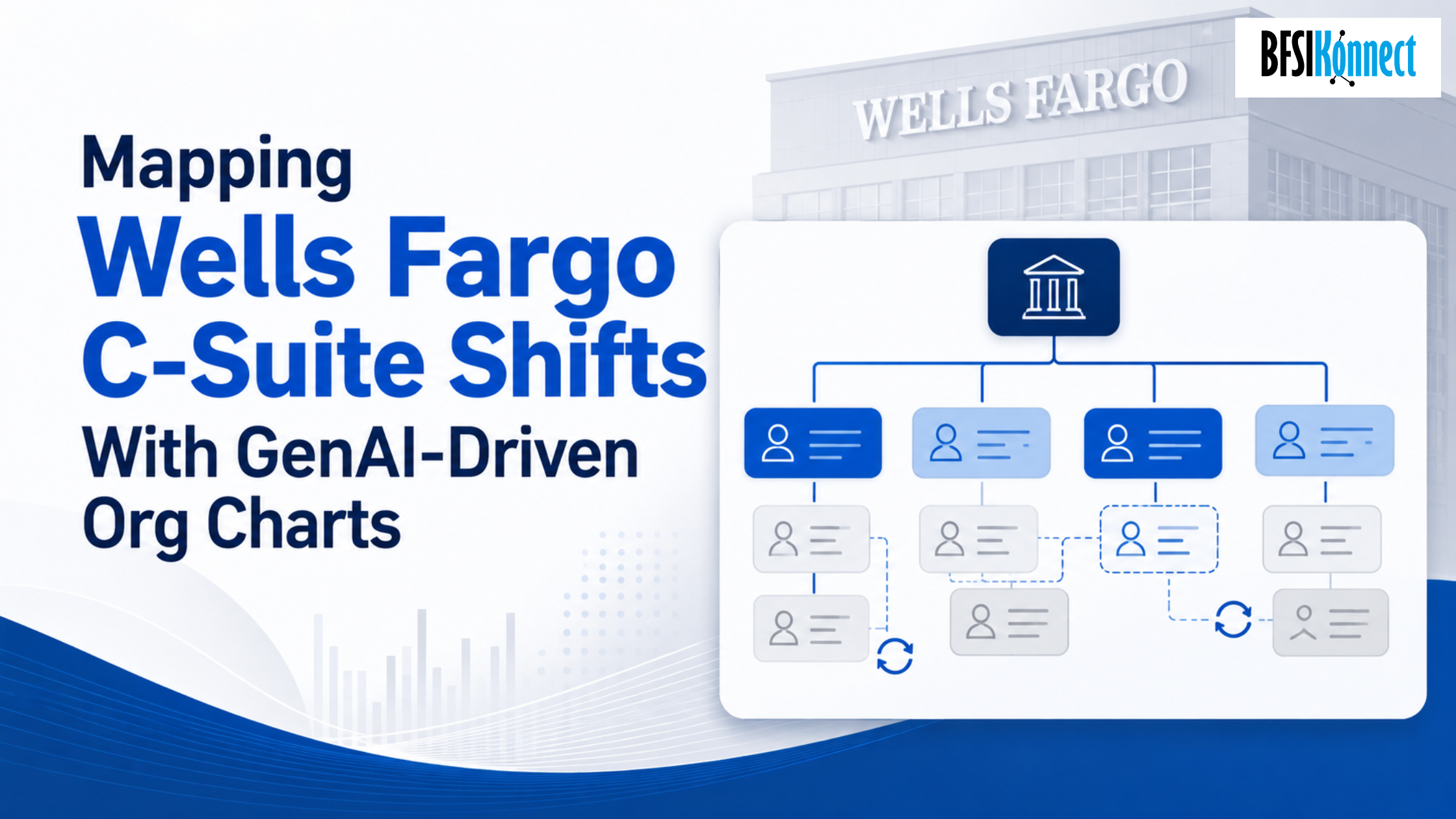
GenAI-driven org chart solution addresses this by continuously pulling from signal sources such as executive announcements, regulatory filings, job postings, press coverage, and board disclosures, reassembling the organizational picture in close to real time. Rather than waiting for a CRM update cycle or an annual account review, your sales team gets a working map of who holds authority now in Wells Fargo, not who held it last quarter.
Practically, this means:
- Identifying the new CIB leadership layer and their external backgrounds
- Mapping which JPMorgan or BNY Mellon alumni Scharf brought in, and what vendor relationships they carried with them
- Flagging roles that remain open, often the most strategically important gaps in the decision chain
- Tracing indirect influence: chiefs of staff, senior advisors, and titles that don't appear in press releases but gate access to the ones that do
What Does the Importance of Org Charts in Wells Fargo Sales Actually Look Like in Practice?
Consider what Wells Fargo's transformation actually unlocked.
With the Federal Reserve's $1.95 trillion asset cap lifted in mid-2025 after nearly seven years, the bank can now grow its balance sheet aggressively. Management has targeted an additional $2–3 billion in gross cost savings through automation and real estate optimization, while simultaneously reinvesting in digital technology and investment banking talent.
That combination, cost reduction plus capability expansion, is a textbook vendor evaluation trigger. Vendors that served the old Wells Fargo may not be positioned for the new one. And new vendors who haven't yet established a relationship now have a genuine opening, precisely because the decision-makers who locked out prior vendors are no longer in those seats.
Org chart intelligence in this context is a timing tool.
The window between a leadership change and the new executive's first major vendor decision is typically narrow, which is often six to twelve months. After that, preferences are calculated and approved vendor lists close back up.
Financial services GTM strategy has to account for this cycle. The teams that map Wells Fargo's new organizational structure now, before the new leadership settles into their vendor preferences, are the ones who will be in conversations while others are still updating their CRM contacts.
The practical application of a GenAI-driven Wells Fargo org chart looks like this:
- Segment-level mapping: Identifying who leads each of the four business units and the technology and procurement functions within them
- Tenure tracking: Flagging executives who are newly placed versus those carried over, since recently placed leaders are more open to new vendor conversations
- Network tracing: Understanding which executives came from the same institution and may share procurement philosophies
- Gap identification: Noting unfilled senior roles, which often signal upcoming reorganization and renewed budget authority
With These Challenges and Solutions in Mind, a Few Important Questions Naturally Arise for Teams Navigating Similar Situations.
Frequently Asked Questions (FAQs)
Q: How often should a BFSI account map be updated during a major leadership transition?
At minimum monthly, but ideally triggered by events like announcements, filings, job postings, rather than on a calendar cycle.
Q: Is the C-suite the right starting point for account mapping in Wells Fargo?
Not always. Middle-layer leaders such as segment heads, technology directors, and procurement managers often have more day-to-day vendor influence than the C-suite does.
Q: Why do account maps break even when personnel haven't fully changed?
Because authority shifts with reorganization, not just attrition. A retained executive may have a completely different scope after a restructuring.
Q: What is the biggest mistake BFSI sales teams make when a major bank reshuffles its leadership?
Waiting for their existing contacts to re-engage. The initiative has to come from the selling side, armed with an accurate picture of who now holds relevant authority.
Wells Fargo's transformation is one of the clearest examples of how fast the organizational ground shifts beneath a carefully maintained account map. The teams that will convert this moment into pipeline are the ones with org chart intelligence that moves as fast as the bank does.
CLICK HERE to see how BizKonnect helps BFSI sales teams navigate leadership transitions with live, AI-driven org chart intelligence mapped to real buying authority.
CLICK HERE to know more with BizKonnect.