


Entering the US in late 2025, businesses can already feel the shift. The year ahead promises both vast possibilities and fresh complexity for B2B companies seeking US expansion. With 2026 around the corner, budgets are tightening, buyer behaviour is evolving, and decision-makers are demanding higher relevance before engaging. In this new reality, the traditional all-onsite or all-remote sales models simply won’t cut it.
What many firms are discovering instead is that a hybrid sales setup, one combining local US presence with remote support, wins more often. They are the Fractional Field Force backed by generative-AI driven insights, paving the path to market credibility, accelerated leads and meaningful pipeline within your targeted US accounts. .
Here’s how you can think about the shift and ask the right questions.
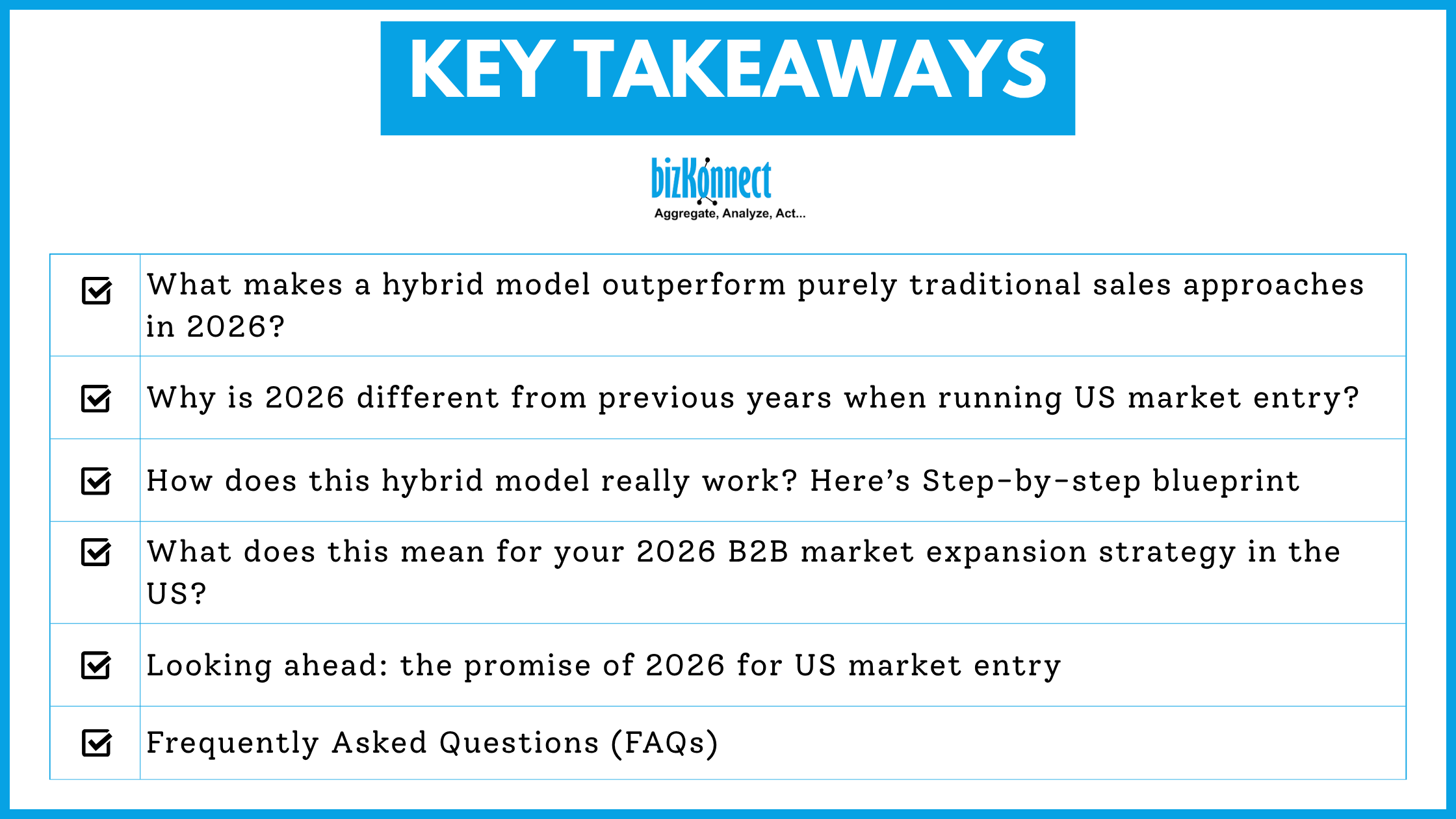
What makes a hybrid model outperform purely traditional sales approaches in 2026?
Traditional models often rely on either a remote sales team operating from your home base (for example, India) or a full in-country sales office in the US, each carrying cost, risk and limitations. Remote-only means your reps lack deep US network connections and on-the-ground credibility. On-site only often means heavy fixed cost, slower ramp and fewer touchpoints.
As we move into 2026, hybrid models are proving to bridge both worlds effectively. A hybrid model blends seasoned US-based sales executives embedded locally and supported remotely by intelligent data and campaign engines.
Let’s walk you through the structure:
- A fractional field force of senior US sales executives (with 10-15+ years of domain experience) aligned to your product, brand and target profile.
- Remote support team driving campaign planning, intelligence, lead generation, tracking, monitoring.
- Local US presence at meetings, events and conferences for face-to-face credibility.
- Generative-AI backed insights guiding whom to target, when to reach out, what message works.
This model brings you closer to prospects; not just by virtue of geography, but by delivering the right touch at the right time with local context. In 2026’s competitive market, context and personalization are not advantages, they’re prerequisites.
Why is 2026 different from previous years when running US market entry?
Because three major forces are converging as we transition from 2025 to 2026:
- Budget constraints and macro-pressure: The US economy is expected to grow modestly at around 1.5% in 2026, which makes buyers more cautious, investment-leet and procurement cycles longer.
- Hyper-personalization expectations: Buyers expect outreach tuned to their exact pain-points, industry, role and moment. One study found 78% of buyers favour experiences tailored to them.
- Physical presence matters again: Digital alone is no longer enough for major US enterprise deals. Face-to-face contact, events, conferences and local visits build trust, especially in a foreign market.
With only months left in 2025, global sales teams are recalibrating their B2B expansion strategies to match these trends. In short, to achieve market credibility and pipeline growth in the US, you must bring personalization, event-based engagement, local presence, and lead intelligence into one combined engine.

How does this hybrid model really work? Here’s Step-by-step blueprint
Let’s understand how you might build this for a successful 2026 B2B Expansion into the US, starting from the foundation you lay today.
Step 1 - Understand your target profile (Ideal Customer Profile or ICP):
Define the industry segments, roles, company size, region within the US, buying signals and decision-maker behaviours. This clarity drives all other steps.
Step 2 - Align local US sales executives:
Hire or partner with senior sales professionals based in the US, with strong domain networks. These representatives act as your boots-on-the-ground. They carry your brand message, do demos, meet prospects, and close deals.
Step 3 - Support lead generation & campaign intelligence:
Here is where your remote engine and GenAI insights come in:
- Identify and build a database of target contacts via LinkedIn, email lists, event attendee lists.
- Launch campaigns: track opens, clicks, link engagement, responses.
- Segment and send personalised follow-ups based on behaviour.
- Provide intelligence to local reps: who engaged, what content they viewed, what event they attended.
- Provide real-time pipeline reporting, analytics, adjustments.
Step 4 - Meet, demo, engage physically & close:
Your US representative uses intelligence to engage with prospects, attends trade shows and events, meets decision-makers in-person, exchanges business cards, and gathers insights for follow-up. They convert contacts into marketing qualified leads (MQLs) and sales qualified leads (SQLs) and finally close deals. Meanwhile your remote support monitors pipeline health, metrics and ROI.
What does this mean for your 2026 B2B market expansion strategy in the US?
As 2025 winds down, the time to redefine your B2B US market expansion strategy is now. Given these realities, here are three ways to realign your approach before the new year begins:
- Prioritise event-based sales strategy for enterprise growth. Use trade shows, regional meetups, executive round-tables in the US to build relationships.
- Leverage sales intelligence for expansion: use intent data, campaign analytics, local behaviour signals to refine your outreach.
- Treat US entry as a narrative of credibility rather than just volume. Since market credibility is critical,local presence with domain-specific networks builds trust faster.
Looking ahead: the promise of 2026 for US market entry
Standing on the edge of 2026, B2B companies must recognize that growth will favour those who bridge remote scale with local relevance. With a hybrid model powered by a fractional field force and GenAI-driven campaign intelligence, you are showing prospects you understand their market, you respect their context, and you invest locally. That translates into open meetings, deeper pipelines and higher close rates.
However, with these challenges and solutions in view, certain questions emerge which we are addressing below.
Frequently asked questions (FAQs)
1. Can a fractional field force really deliver in a complex US market in 2026?
Yes. By tapping senior US sales executives with established networks and combining them with remote intelligence, you avoid the overhead of a full US office while still delivering local credibility and execution.
2. What level of generative-AI insights should be expected for campaign support?
In 2026, predictive analytics and AI-powered outreach will be table stakes for B2B teams. These insights can help identify US prospects showing intent signals, predict message response rates and optimize campaign timing.
3. How should I measure ROI for a hybrid US expansion model?
Track metrics such as number of qualified meetings from events, campaign open/click rates, SQL conversion rate, deal close rate, cost per qualified lead in the US. Also monitor pipeline health and long-term deal expansion.
4. How soon can I expect results from this hybrid setup in the US?
While timelines depend on your industry, ICP and deal size, you should build a 6–12-month horizon for a meaningful pipeline. The combination of local presence, intelligence, and event engagement shortens the ramp compared to traditional setups.
Break into the US industry faster with BizKonnect’s hybrid sales model. Click here to learn more.
CLICK HERE to know more with BizKonnect.